



Nobody wants their insurance company to start dragging when something goes wrong.
A single claim can go through documents, policy checks, damage review, fraud screening, human approval, and payment before the customer gets an answer.
Every extra step adds time, manual work, and another roadblock.
AI in insurance can start cutting through that waiting time.
AI agents can collect information, analyze documents, coordinate workflows, and communicate with customers.
You can use them across claims, underwriting, policy servicing, fraud detection, and internal operations.
They’ll also interact with approved insurance systems.
The opportunity stretches across almost the entire insurance lifecycle.
EIOPA already identifies pricing, underwriting, claims management, and fraud detection as areas where insurers increasingly use AI.
So where should you actually use it?
Let's look at 20+ insurance AI use cases, where automation can deliver measurable value.
Trust us, there are things you need to consider before putting AI agents to work.
What Are AI Agents in Insurance?
The name gives it away.
AI agents are basically software systems that understand a request and decide what happens next.
They can use approved tools or information to complete tasks toward a set goal.
Think about a policyholder reporting a damaged vehicle.
Your standard, by-the-book chatbot will probably do just fine explaining how to submit a claim.
Then you’ve got an AI agent.
It can collect the initial information, retrieve policy details, request supporting documents, update the claims system, and route the case to the right adjuster.
That ability to call the shots is what makes agents useful for insurance automation.
There’s a catch, though.
The more systems an agent can access and the more actions it can perform, the more carefully you need to keep a leash on its permissions and autonomy.
OWASP specifically identifies excessive functionality, permissions, and autonomy as sources of risk in agentic systems.
Where AI Fits Across the Insurance Lifecycle
You can spot openings for AI from the moment someone requests a quote to the day they renew, change, or claim against their policy.
That doesn’t mean every insurance workflow is equally suited to automation.
The strongest candidates usually have something in common:
High volumes of information, repetitive steps, and clear rules around what happens next.
Claims and policy servicing are strong candidates, as they cut down the time spent on manual tasks.
Underwriting and other decision-heavy workflows can gain from AI.
However, they usually require tighter controls around data, explainability, and human judgment.
Let’s follow the insurance lifecycle and look at where AI agents can fit.
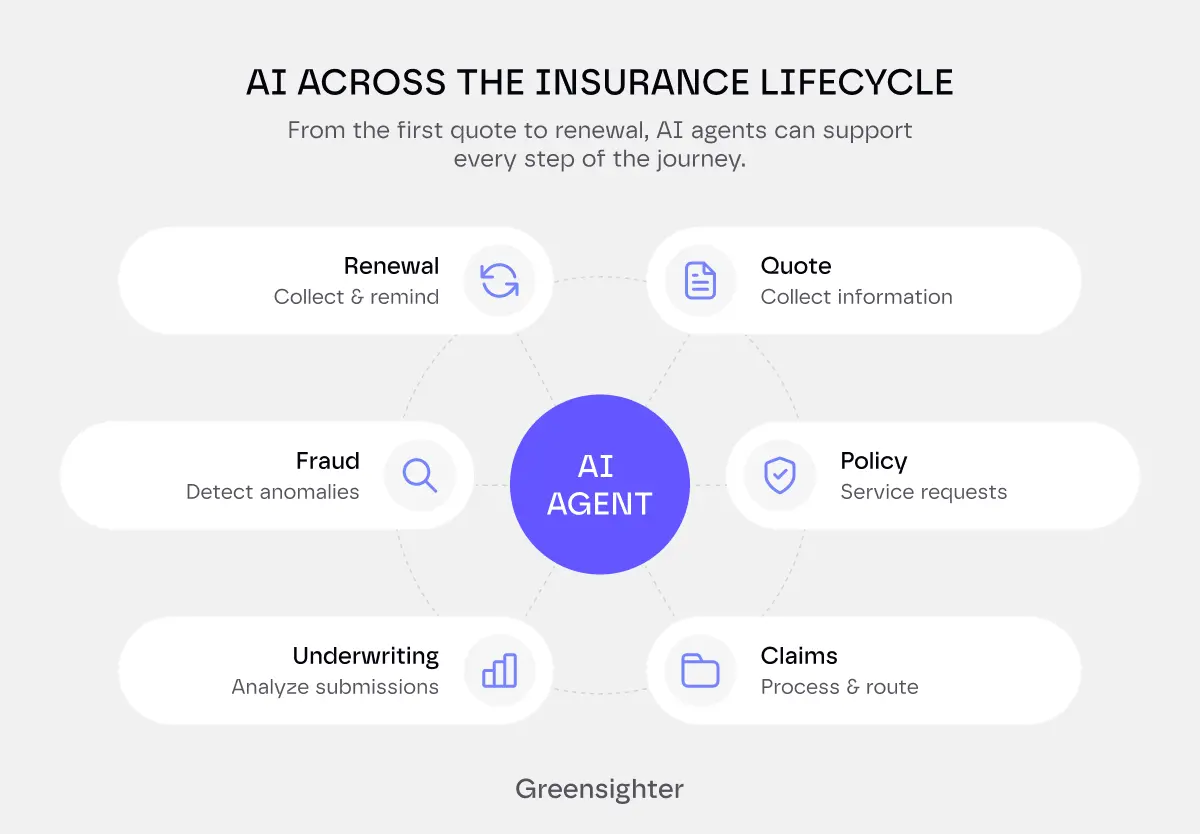
Quotes, Sales and Policy Servicing
AI can support the policy lifecycle before a claim ever happens.
From quote requests to policy changes, agents can handle repetitive steps while your sales and servicing teams focus on cases that matter.
1. Quote Assistance
Collecting info for a quote is cakewalk for an AI agent.
So is identifying missing details and guiding prospective customers through the process.
While it cuts down on unnecessary back-and-forth, your team can move the application forward.
2. Lead Qualification
Regardless of what they say, your sales team doesn’t need to manually investigate every inquiry.
Leave it to the agent to organize incoming leads based on predefined criteria and route them to where they need to go.
3. Product Recommendations
Agents are great at using customer-provided information to identify relevant insurance products.
You still need controls around how the system makes and explains recommendations.
Remember, these recommendations could cost your customers a pretty penny.
4. Policy Comparison
Not everyone is going to sit down and figure out the differences in policies.
AI agents can organize coverage, limits, deductibles, and other policy details.
This helps customers and employees compare options more easily.
5. Policy Servicing
You know what creates a constant admin workload?
Address changes, document requests, beneficiary updates, and other routine servicing tasks..
Agents don’t have to wait for an employee to move each of these forward.
They can help customers complete approved requests before that happens.
You can connect them to your policy administration system, CRM, and other customer service tools.
6. Policy Endorsements and Coverage Changes
Some policy changes go beyond routine account updates.
A policyholder may want to add a driver, change insured property, adjust coverage limits, or make another change that requires an endorsement.
An AI agent can collect the relevant information, find the right policy and prepare the request for processing.
Claims Automation: From FNOL to Settlement
Claims bring several insurance workflows together at once.
You need to collect information quickly, verify coverage, assess the claim to the right people, and detect suspicious activity.
And, you have to keep the customer informed throughout the process.
That makes claims automation one of the clearest areas for AI.
A typical AI-assisted workflow could look like this:
FNOL → Claim Creation → Coverage Verification → Evidence Collection → Assessment → Routing / Adjuster Review → Fraud Check → Settlement → Policyholder Update
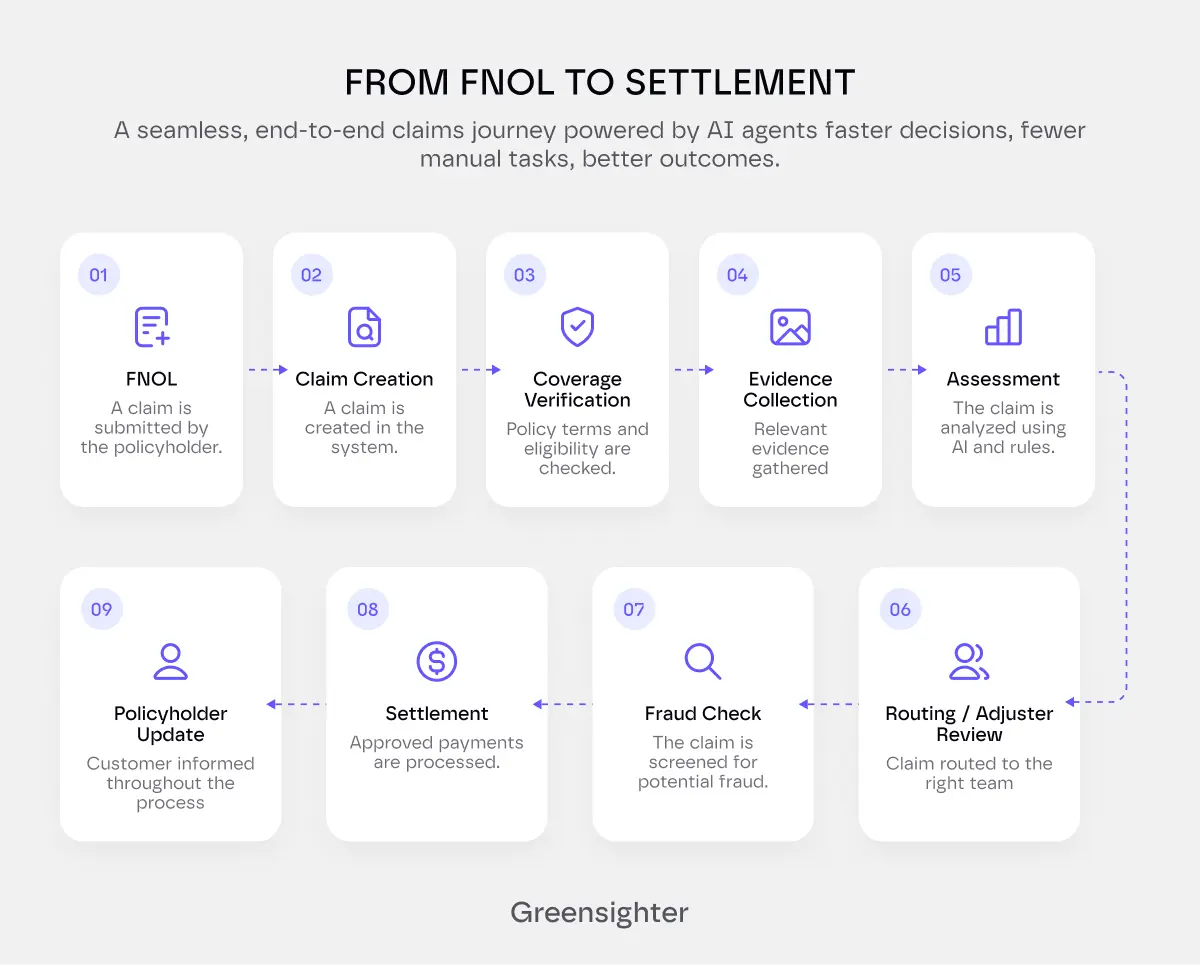
AI can support several stages without taking consequential decisions away from your claims professionals.
7. FNOL Intake and Claim Creation
First Notice of Loss sets the claims process in motion.
An AI agent can guide the policyholder through the first report, collect incident details, request supporting information, and check for missing fields.
It can then create the claim in your claims management system.
8. Evidence and Document Collection
Missing evidence can delay a claim before assessment even starts.
An agent can identify what the case still needs.
It’ll then request documents, photos, repair estimates, or other approved evidence.
It can also follow up when information is incomplete.
9. Claims Classification
AI can classify incoming claims by type, severity, complexity, or other set criteria.
This helps your claims system route simple cases to the right workflow and flag cases that need closer review.
10. Coverage Verification
Before a claim moves forward, your team may need to confirm the policy was active.
An AI agent can retrieve approved policy information and add the relevant details to the claims workflow.
If coverage is unclear, policy details conflict, or interpretation is needed, it can send the case to an authorized claims professional.
11. Damage Assessment Support
AI can help claims teams review images, documents, repair estimates, and other evidence before an adjuster steps in.
It can organize information, spot missing evidence, and flag details that need closer inspection.
This’ll give your specialists more time to focus on claims that require judgment.
12. Claims Routing and Adjuster Assignment
“What’s happening with my claim?” is a question your team probably answers every day.
An agent connected to your claims platform can pull approved status information and explain the next step.
It can also notify policyholders when documents, inspections, or other actions are still needed.
13. Settlement Preparation and Support
Settlement often brings together claim details, assessment results, documents, approvals, and payment information.
An AI agent can organize that information, identify missing steps, and prepare the case for review.
You can introduce human approval whenever the financial or customer impact requires it.
Using AI in Underwriting
Underwriting starts long before an underwriter makes a decision.
The real issue is how much time underwriters spend collecting, checking, and organizing information before they can use their expertise.
AI underwriting can take some of that groundwork off your team’s plate.
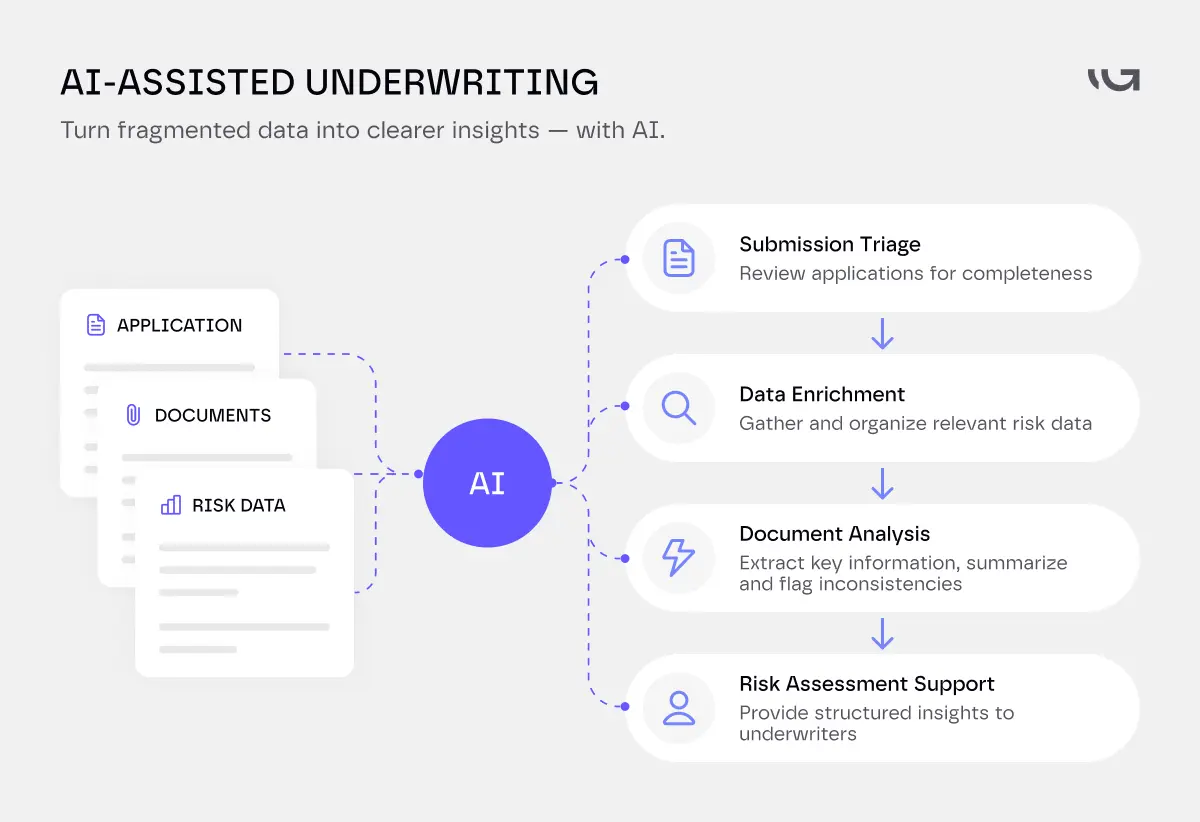
14. Submission Triage
AI agents can review incoming applications for completeness.
They can also sort cases by product, complexity, or predefined criteria so underwriters know which submissions need attention first.
15. Risk Data Collection and Enrichment
Underwriters often need more than the information provided in the initial submission.
AI can gather permitted risk information and bring it together with application data.
It can then organize it into a clearer picture for review.
What that information looks like depends on the insurance product.
Property, vehicle, business, life, and other risks all require different inputs.
16. Submission and Document Analysis
Applications can arrive with supporting documents that take time to read and compare.
AI can extract relevant information, summarize documents, and flag inconsistencies.
17. Risk Assessment Support
AI can help analyze approved data and surface information that may affect the risk assessment.
The underwriter can then use that information alongside underwriting guidelines and professional judgment.
The closer AI agents get to influencing consequential decisions, the more carefully you need to govern their role.
In the EU, for example, certain AI systems used for risk assessment and pricing in life and health insurance are considered high-risk under the AI Act.
18. Underwriter Assistance
An internal AI agent can help underwriters in more than one way.
It can retrieve guidelines, review policy information, summarize applications, and identify missing details.
That leaves more of the underwriter’s time for exceptions, complex risks, and decisions that require experience.
Claims Fraud and Compliance
Suspicious claims rarely announce themselves.
AI can help surface unusual patterns, inconsistencies, and other signals that deserve a closer look.
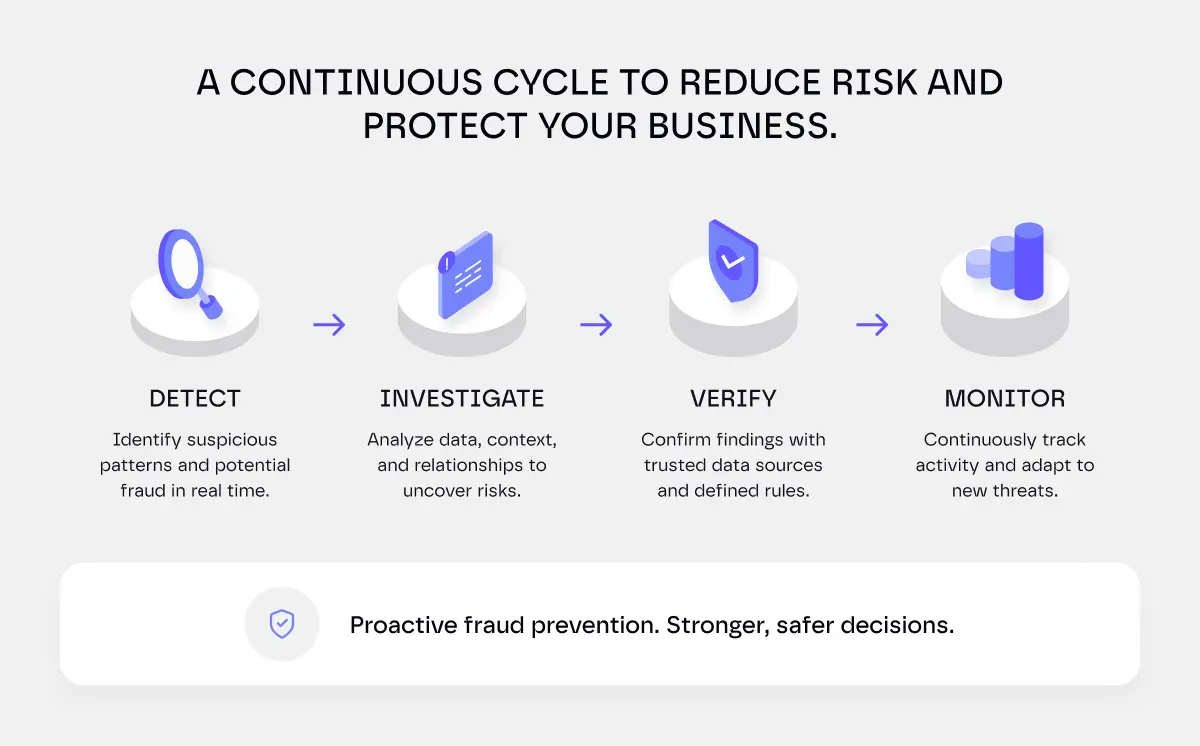
19. Claims Anomaly Detection
AI systems have a hawk’s eye for flagging unusual patterns across claims data.
They give investigators another way to identify cases that deserve closer attention.
20. Claims Investigation Support
Once you flag a claim, an agent can collect permitted information from relevant systems and organize it for the investigator.
This cuts down the grunt work required before someone reviews the case.
21. Identity Verification Support
Agents can support identity checks during applications, policy changes, or claims.
Failed checks and conflicting information can go directly to your team for review.
22. Compliance Monitoring
AI can help monitor workflows against internal policies and flag cases that require additional review.
Your compliance team still needs visibility into the actions AI supports and influences.
Renewals and Retention
Renewal brings another round of information gathering, policy review, communication, and customer decisions.
It simply makes everyday work move faster.
23. Renewal Preparation
An agent can identify policies approaching renewal, starting the approved workflow before the expiration date gets too close.
It can check whether required information is available, identify outstanding items, and prepare the case for renewal review.
24. Renewal Data Collection
Some policies need updated information before renewal.
An AI agent can request those details from the policyholder, check whether the response is complete, and follow up when something is missing.
Cases that require reassessment or further discussion can go to the appropriate employee.
25. Renewal Reminders and Lapse Prevention
Sometimes the problem is much simpler: the policyholder hasn’t responded.
Agents can send approved reminders, answer routine renewal questions, and keep customers informed about upcoming deadlines.
When someone wants to change coverage, dispute a renewal, or discuss their options, the conversation can move to your servicing team.
How to Measure the ROI of Insurance AI
Sooner or later, someone will ask the question that matters:
Is this actually saving us money?
You need a baseline before you can answer it.
Start with the workflow before you start with insurance automation.
If claims regularly sit waiting for information, find out how long.
If underwriters spend hours preparing submissions before reviewing risk, measure that work.
The same applies to policy servicing and renewals.
Look at how much manual work goes into routine requests, follow-ups, document checks, and customer communication.
Then compare performance after automation.
A successful implementation should change something the business cares about.
Claims may move faster.
Underwriters may spend less time preparing cases.
Your servicing team may handle fewer repetitive requests.
Renewal work may start earlier and require less chasing.
The value of insurance AI comes from what changes in the operation, not how many agents you deploy.
How AI Fits Into the Insurance Technology Stack
AI agents rarely replace the systems an insurer already uses.
They work across them.
Your policy administration system still manages policies.
Your claims platform still manages claims.
Your underwriting tools still support risk evaluation, while CRM, document management, fraud detection, and payment systems continue doing their respective jobs.
The AI layer can help move information and tasks between those parts of the operation.
A simplified workflow might look like this:
Policyholder / Employee → AI Agent → Insurance Systems → Review or Action
Take a claim as an example.
The agent can collect FNOL information, retrieve relevant policy details, request evidence, and prepare the claim for the next stage.
The claims platform remains the system of record, while your claims professionals step in where assessment, interpretation, or authorization is required.
The same principle applies elsewhere.
In underwriting, AI can prepare submissions before an underwriter evaluates the risk.
In policy servicing, it can help process routine requests.
During renewal, it can collect information and coordinate communication before your team needs to get involved.
This is why the workflow should determine how you design the AI layer.
Start with what needs to happen from beginning to end, then decide where automation can safely take over individual steps.
AI Insurance Compliance: What You Need to Consider
While it would’ve been nice, AI doesn’t remove your existing responsibilities as an insurer.
In the US, the NAIC Model Bulletin says AI-supported decisions must still follow insurance laws and regulations.
It also outlines governance expectations and the information regulators may request when reviewing an insurer’s AI use.
Your compliance approach should address:
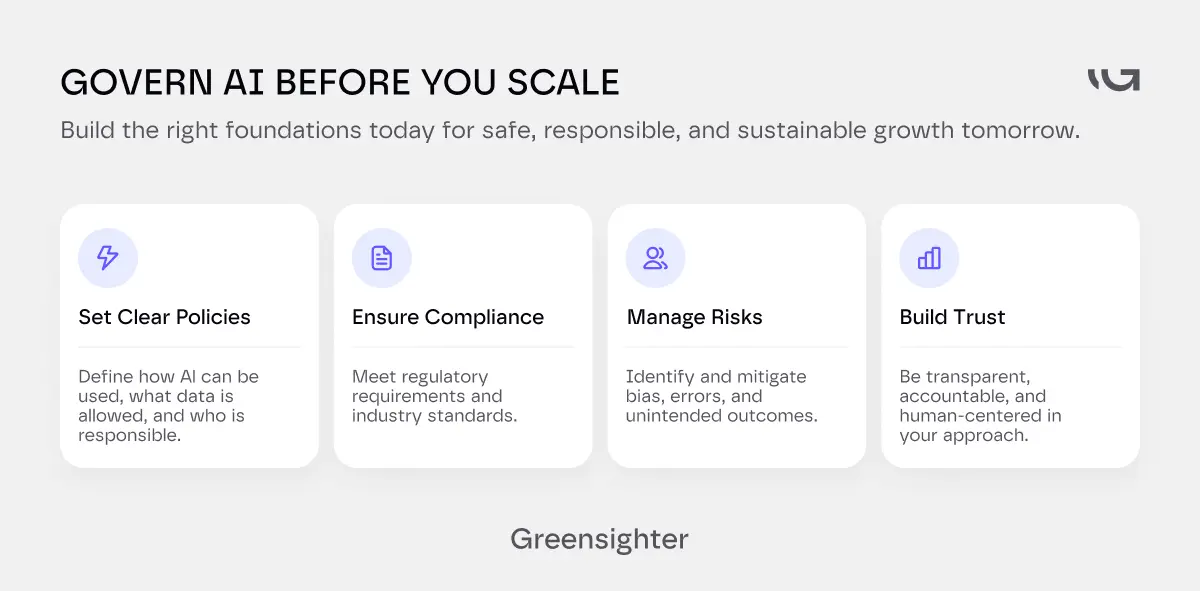
- Data governance
- Fairness and bias
- Explainability
- Cybersecurity
- Record keeping
- Human oversight
- Third-party AI providers
- Ongoing monitoring
These concerns aren’t limited to the US.
EIOPA's 2025 Opinion highlights data governance, record-keeping, fairness, cybersecurity, explainability, and human oversight when insurers use AI.
Regulators are also paying closer attention to third-party models.
The NAIC says its working group is developing a regulatory framework for third-party AI data and models.
As of March 2026, 12 states were also piloting its AI Systems Evaluation Tool.
The practical takeaway is simple: you need to know what your AI is doing.
Document which systems you use, what data feeds them, what decisions they influence, who owns them, and where humans take the reigns.
Best Practices for AI in Insurance
Keep your first implementation focused.
Choose a workflow with clear boundaries and measurable outcomes.
You don’t need to automate an entire department.
Limit Permissions
Give AI agents access only to the systems and actions they genuinely need.
This reduces the damage an incorrect or manipulated output can cause.
Keep People Close to Consequential Decisions
Claims denials, underwriting decisions, pricing, and other high-impact outcomes deserve stronger controls than routine administrative work.
Test Continuously
Your data, models, workflows, threats, and regulations will change after launch.
NIST's AI Risk Management Framework treats AI risk management as an ongoing activity across design, development, deployment, use, and evaluation.
Final Thoughts
AI can support insurance from the first quote request to underwriting, policy servicing, claims, and renewal.
The biggest opportunities often sit in the work surrounding important decisions:
- Collecting information
- Checking submissions
- Preparing cases
- Coordinating next steps
- Keeping policyholders informed.
You still decide where automation ends and professional judgment begins.
Start with a workflow that creates real operational friction.
Give AI a clear role inside it, keep consequential decisions under the right level of control, and judge the result by what actually improves.