



The wrong financial software development company can cost you an arm and a leg.
Far more than the original project budget.
The loop is a familiar one.
At first, the proposal is competitive.
Timeline? Seems realistic.
The portfolio looks second to none.
Then, you kick off development, and everything goes off the rails.
Requirements change.
Security concerns pop up.
Communication slows down.
Before long, your software project costs more than expected and takes longer to deliver.
This happens more often than you realize.
You can evaluate vendors based on price, delivery estimates, or visual design alone.
Those factors matter, but they only tell part of the story.
Financial software comes with its own baggage:
- Security.
- Compliance.
- Complex integrations.
- Long-term scalability.
A development partner should be prepared for those conversations from the first meeting.
This is why we’ve put this guide together.
Let’s go over the questions worth asking during vendor evaluations.
We’ll also show you signs that you've found a partner who can support your business beyond launch.

Why Choosing the Right Development Partner Matters
Think of every software project as an investment.
With financial software, the stakes are even higher.
Regardless of what system or platform you build, the development partner you choose will influence far more than the launch date.

They’ll shape:
- Product architecture
- Security decisions
- Integration strategy
- Scalability planning
- Long-term maintenance
As soon as development starts, these decisions become difficult and expensive to change.
Experience also matters across.
Projects in regulated industries like finance and healthcare share similar challenges around compliance, security, and data protection.
The earlier your development partner identifies those challenges, the easier you can solve them.
1. Look for Industry Experience, Not Just Development Experience
Every software company can build applications.
Does that mean every company understands financial products?
Not by a long shot.
A team that has built eCommerce websites or booking platforms might face a learning curve when developing fintech solutions.
Financial applications often include the same ingredients:
- Payment processing
- Banking integrations
- Identity verification
- Fraud prevention
- Compliance requirements
- Sensitive financial data
These requirements influence technical decisions from the beginning.
Ask prospective vendors about projects similar to yours.
Have they developed::
- Payment platforms?
- Digital wallets?
- Lending systems?
- Investment applications?
- Internal finance tools?
Past experience reduces uncertainty.
It also helps teams identify potential challenges ahead of time.
2. Look Beyond the Portfolio
We’ve all seen polished portfolios that create strong first impressions.
But they shouldn’t be deciding factors.
You can’t tell what happened behind a project just by screenshots.
Instead, you need ask questions like:
- What business problem did the client need to solve?
- What technical challenges emerged during development?
- How did the team handle changing requirements?
- What happened after launch?

Ask for case studies, not galleries of completed projects.
They reveal how a company approaches problem-solving, collaboration, and long-term product success.
Client testimonials can also help.
Look for feedback. And not just any feedback.
Try to understand communication skills, responsiveness, technical expertise, and post-launch support rather than design alone.
3. Security Should Be Part of Every Conversation
An experienced financial software development company should comfortably sit down and discuss topics like:
- Encryption
- Secure authentication
- Role-based access
- API security
- Audit logging
- Secure coding practices
You need to have these security discussions before greenlighting development..
If you don’t, you’ll end up making important architectural decisions that might be difficult to change.
Depending on the type of product you're building, the software company should also know the ropes or at least be aware of standards and frameworks such as:
This isn’t just about customer data. You need to protect business continuity, customer trust, and future growth.
4. Evaluate Their Development Process
A successful software project hinges on how the work is planned, communicated, and delivered.
Ask potential vendors how they approach:
- Discovery workshops
- Requirements gathering
- Project planning
- Quality assurance
- Testing
- Deployment
The answers you get will tell you a lot about what you (and they) are in for..
Also, pay attention to how they approach change.
Requirements evolve.
Priorities shift.
Unexpected challenges appear.
A structured development process is far easier to manage without the entire project.
5. Ask About Compliance Early
Compliance needs a seat at the table from day one.
Industry regulations have it all in for financial applications.
So do security requirements or market-specific regional legislation.
Topics may include:
- KYC (Know Your Customer)
- AML (Anti-Money Laundering)
- GDPR
- SOC 2
A development partner isn’t your legal or compliance team.
But, they do need to understand how compliance requirements influence the development process.
The earlier those discussions happen, the fewer surprises you'll face later.
6. Think Beyond Launch
From day one, the focus shouldn’t just be on delivery.
A better question is what happens after release.
Software isn’t static. It continues to evolve.
You add new features; security updates are a must.
Third-party integrations change.
Customer expectations grow.
Ask every financial software development company how they support products after launch.
Find out:
- How they handle maintenance
- How they deliver security updates
- How they plan new functionalities
- How they manage support requests
A long-term partnership often delivers far more value than a one-time project.
7. Strategic Thinking Creates Better Products
Development should start with business end-goals.
Technology supports those goals.
A strong development partner will ask questions that go beyond feature lists.
For example:
- Who will use this product?
- What business problem are you solving?
- How will success be measured?
- What should the platform support two years from now?
Those conversations shape better software.
They also reduce the risk of building features that complicate things instead of creating meaningful value.
This is where the rubber meets the road:
One vendor simply writes code; the other contributes to the product’s long-term success.
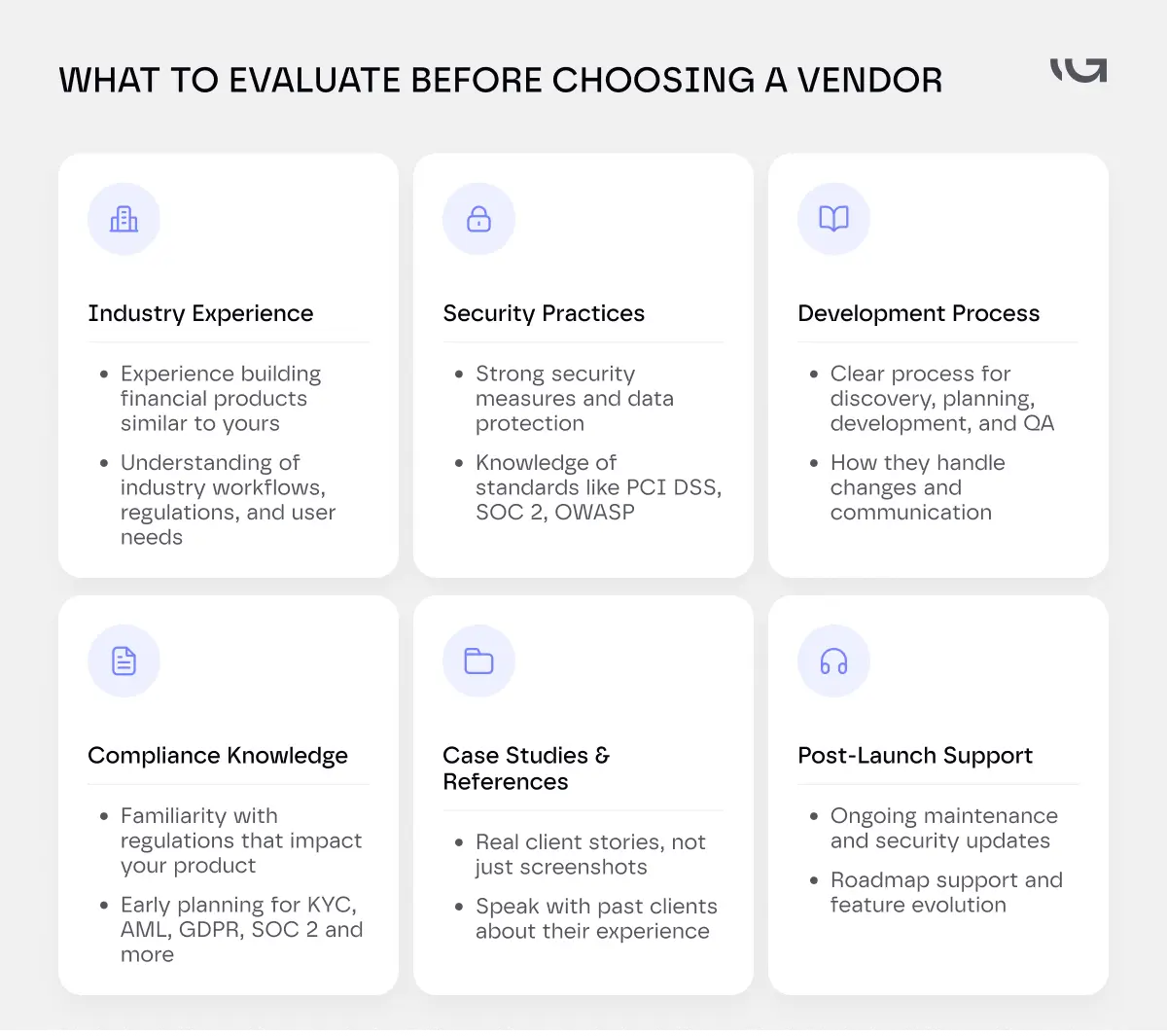
Common Vendor Selection Mistakes
Choosing a financial software development company is both a business and technical decision
Just like anything else, there are some common pitfalls.
Let’s take a look at them together.
Choosing Based on Price Alone
If the proposal is low, it’s usually a red flag.
Poor planning, communication issues, and technical debt can snowball after you start development.
Look at the overall value a partner brings. The initial quote isn’t as important.
Skipping the Discovery Phase
Don’t take shortcuts.
Discovery helps define requirements, identify risks, and align expectations.
If you don’t have it, development teams will build on assumptions instead of validated business needs.
That usually leads to revisions, delays, and unnecessary costs.
Ignoring Communication
Development is a two-way tango, so communicate.
Ask how frequently you'll receive updates.
Find out who your primary go-to person will be.
Understand how the partner documents decisions, changes, and feedback throughout the project.
Overlooking Long-Term Support
A successful launch is only the beginning.
Products require maintenance, security updates, performance improvements, and new functionality over time.
Choose a partner that’s prepared to support the product after release.
Forgetting to Speak With Existing Clients
Case studies are gold mines.
Direct conversations with previous clients can be even more revealing.
Ask about:
- Communication
- Responsiveness
- Problem-solving
- Delivery timelines
- Ongoing support
These conversations often pull back curtains that proposals can’t.
Final Thoughts
We wish that finding the right financial software development company would be as simple as comparing proposals.
The reality is, there’s more to it than that.
You need to figure out how each vendor approaches planning, security, compliance, communication, and long-term product growth.
The strongest partnerships start when expectations are crystal-clear.
And when you share business goals.
Technology changes.
Markets evolve.
Customer expectations shift.
A development partner should be ready to hit its stride alongside your business.
FAQ
How do I choose a financial software development company?
Start by evaluating industry experience, technical expertise, security practices, communication processes, and post-launch support.
A strong partner should understand both software development and the financial sector.
Why is industry experience important in financial software development?
Financial products involve unique requirements such as regulatory compliance, payment processing, fraud prevention, and data security.
Experience in these areas helps reduce project risk and improve delivery.
When should I invest in custom financial software?
Custom financial software is a good choice when your business requires unique workflows, specialized integrations, or functionality that off-the-shelf platforms cannot provide.
What questions should I ask during vendor evaluation?
Ask about:
- Relevant project experience
- Development methodology
- Security practices
- Compliance knowledge
- Maintenance and support
- Communication process
These topics provide a clearer picture than pricing alone.
How long does financial app development typically take?
Timelines depend on product complexity, integrations, compliance requirements, and project scope.
Simple applications may take several months, while enterprise financial platforms often require a year or more.
What should I expect after launch?
Post-launch support usually includes maintenance, security updates, performance optimization, bug fixes, monitoring, and future feature development.
A long-term support plan helps keep your software secure and aligned with changing business needs.


.webp)
.webp)
.webp)