



Every delay costs money.
A missing shipment. An unexpected stock shortage.
Inventory sitting in the wrong warehouse. A supplier that misses a deadline.
Problems like these rarely happen because your business lacks data.
On the contrary, you probably have all the data you need.
But, it’s likely scattered across disconnected systems.
Because of this, you can’t clearly see what’s happening.
At the same time, your supply chain keeps growing.
If you keep relying on spreadsheets or outdated software, running smooth operations will be difficult.
That's why more businesses are investing in supply chain software development.
Custom platforms connect inventory, warehouses, suppliers, transportation, and reporting into a single system.
This gives teams the visibility they need to respond faster, automate routine processes, and make better operational decisions.
This Greensighter guide explores the different types of supply chain management software.
We’ll also talk about the features modern platforms should include, and the development decisions that influence success down the road..

What Is Supply Chain Software Development?
Supply chain software development means building digital tools that help you manage goods from suppliers to customers.
They’re often developed around specific operational needs.
Depending on the business, a platform may support:
- Inventory management
- Warehouse operations
- Transportation planning
- Supplier management
- Procurement
- Order fulfillment
- Demand forecasting
- Reporting and analytics
The objective is to create a connected system.
That way, you get a bird’s eye view of every supply chain stage.
You’ll also be able to go around the grunt work and make sure your operation is running like clockwork.
Supply chain software comes in handy as you add distribution centers or your business expands into new markets.
Types of Supply Chain Software
Supply chains involve multiple operational areas, each with its own steps and stumbling blocks
Many organizations use several connected systems to manage different parts of the supply chain.
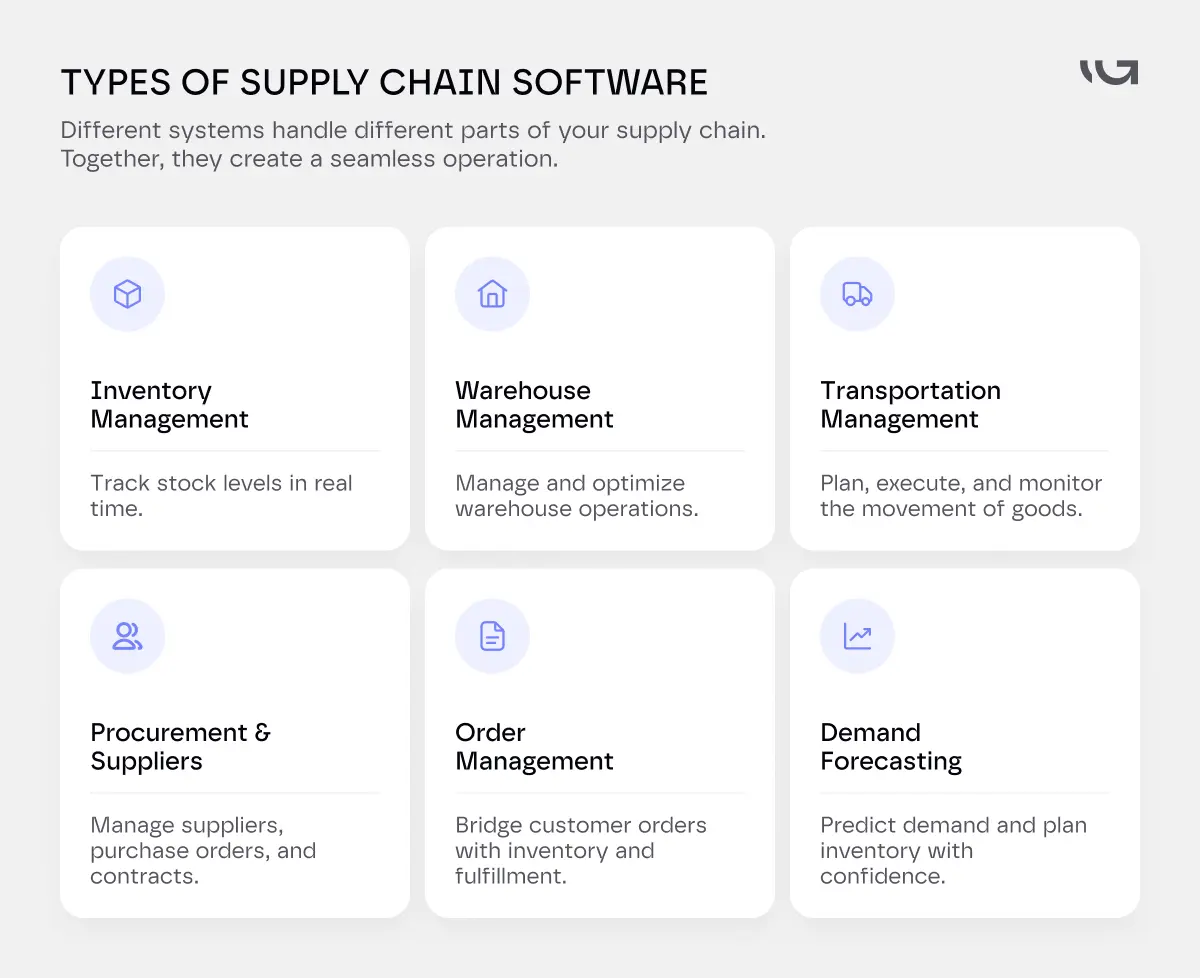
Supply chain management software comes in several forms, including:
Inventory Management Systems
Inventory platforms monitor stock levels across warehouses, stores, and distribution centers.
They do the heavy lifting by reducing stock shortages, avoiding excess inventory, and improving purchasing decisions through real-time visibility.
Warehouse Management Systems (WMS)
A WMS coordinates day-to-day warehouse operations.
Common capabilities include:
- Inventory location tracking
- Picking and packing
- Barcode scanning
- Receiving shipments
- Stock movement
- Warehouse reporting
These tools help improve warehouse efficiency while reducing fulfillment errors.
Transportation Management Systems (TMS)
Transportation platforms help with planning and managing the movement of goods.
Typical functions include:
- Route optimization
- Shipment scheduling
- Carrier management
- Freight tracking
- Delivery monitoring
Improving transportation can shorten delivery times while keeping operating costs in check.
Procurement and Supplier Management
Think of managing supplier relationships as a cornerstone of every supply chain.
These systems help manage:
- Supplier information
- Purchase orders
- Contract management
- Vendor performance
- Procurement approvals
Better supplier visibility supports stronger planning and more reliable purchasing decisions.
Order Management Systems
This is the software that bridges customer orders with inventory, warehouses, and shipping operations.
It makes order processing easier while providing accurate status updates throughout fulfillment.
Demand Planning and Forecasting
Demand forecasting solutions analyze historical sales, seasonal trends, and operational data to estimate future inventory requirements.
More accurate forecasting helps you improve purchasing decisions while trimming down the inventory costs you don’t want.
Core Features Every Supply Chain Platform Should Include
The value of logistics software development depends less on the number of features and more on how effectively those features support day-to-day operations.
Modern platforms should provide the visibility and automation businesses need to make more informed decisions on the spot.
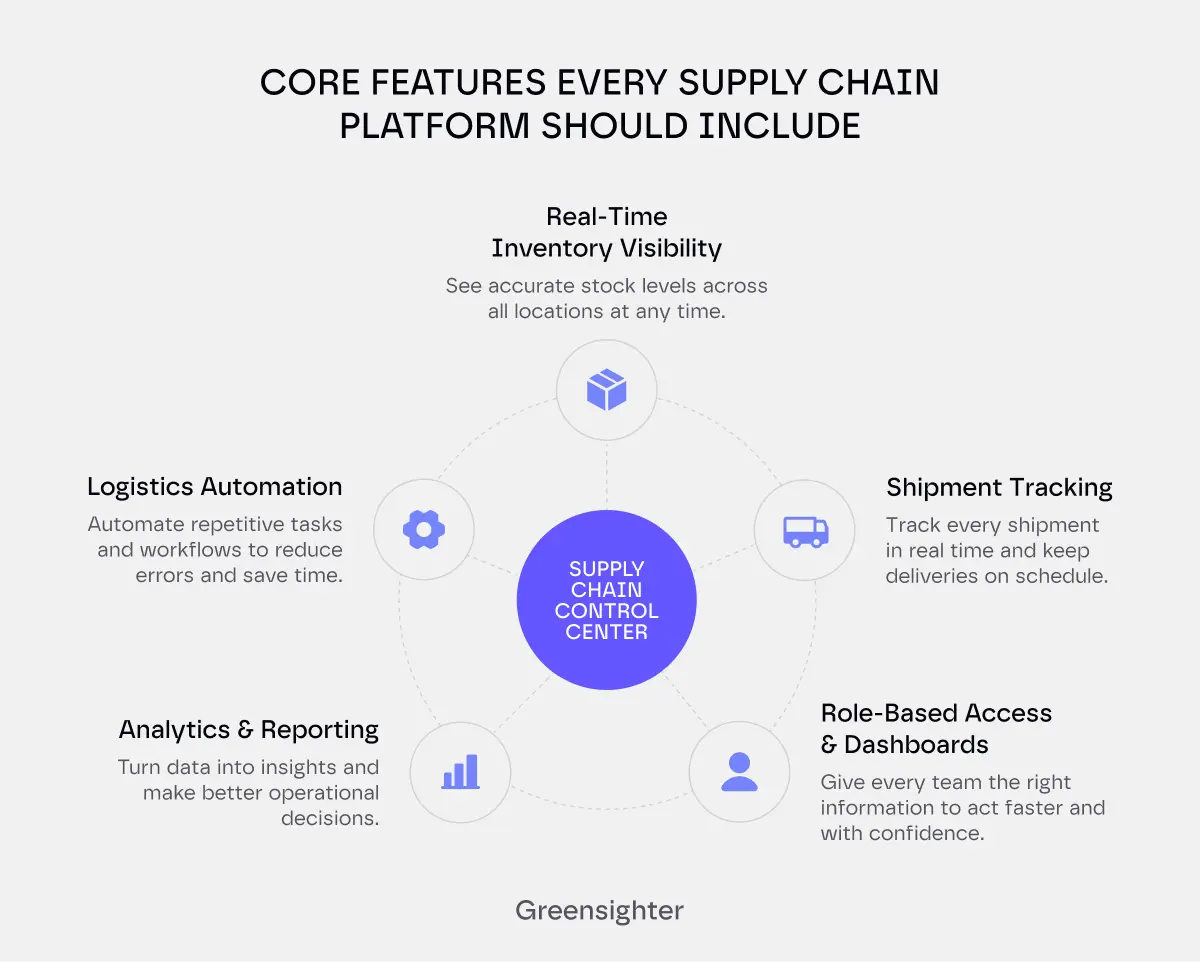
1. Real-Time Inventory Visibility
Inventory changes all the time.
Products are received, transferred, picked, shipped, and returned throughout the day.
A supply chain platform should provide real-time inventory information across every warehouse and storage location.
Accurate inventory data helps you:
- Cut down on stock shortages
- Avoid overstocking
- Improve purchasing
- Support faster fulfillment
- Increase inventory accuracy
Real-time visibility also improves decision-making.
It gives your teams a single source of truth.
2. Logistics Automation
Many supply chain activities follow repeatable workflows.
Automating these processes helps shave off hands-on work.
Examples include:
- Shipment scheduling
- Order routing
- Inventory replenishment
- Purchase order generation
- Carrier notifications
- Delivery updates
Automation allows your operational teams to focus on exceptions rather than routine administrative tasks.
3. Shipment Tracking
You know who expects accurate delivery info? Both customers and internal teams.
Shipment tracking provides visibility throughout the transportation process by monitoring goods from dispatch through final delivery.
This helps you zero in on delays earlier, communicate proactively with customers, and raise the bar in delivery performance.
4. Reporting and Analytics
Every supply chain generates valuable operational data.
Here’s the uphill battle: transforming that information into practical insights.
A modern platform should provide reporting on metrics such as:
- Inventory turnover
- Warehouse performance
- Order fulfillment rates
- Delivery times
- Supplier performance
- Transportation costs
These insights help you flag bottlenecks, turn operational planning around, and support continuous optimization.
5. Role-Based Access and Operational Dashboards
Different teams need different information.
That being said, all teams rely on supply chain data to perform their responsibilities.
Role-based dashboards allow each user to access the information most relevant to their role without exposing unnecessary operational or financial data.
This tightens up both security and usability while helping teams make quicker decisions.
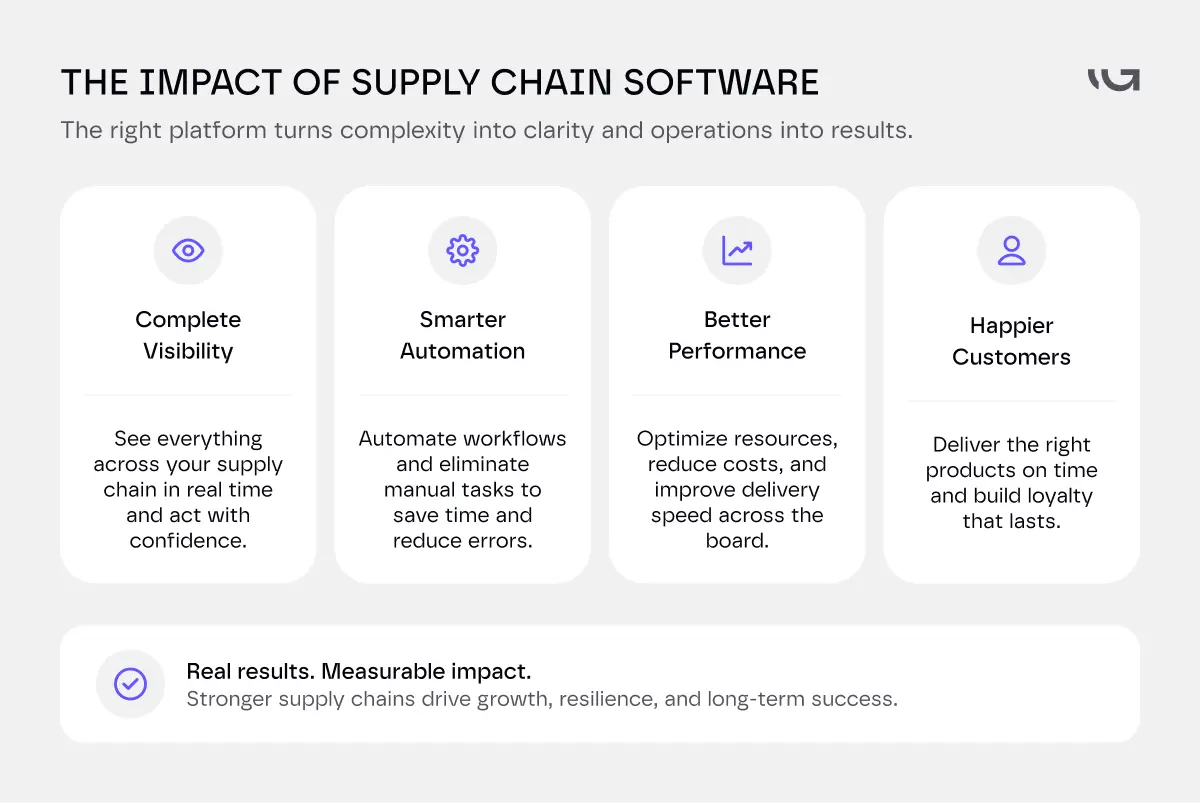
System Integrations: Connecting the Supply Chain Dots
Even the most capable supply chain platform delivers limited value if it operates solo.
Inventory, procurement, warehousing, transportation, finance, and customer service all depend on accurate, up-to-date information.
When these systems can’t exchange data, you end up facing:
- Duplicate data entry
- Reporting inconsistencies
- Delays that affect the entire operation
That’s why integrations should be part of the planning process from square one.
Modern supply chain management software commonly integrates with:
- Enterprise Resource Planning (ERP) systems
- Customer Relationship Management (CRM) platforms
- Accounting software
- eCommerce platforms
- Warehouse management systems
- Transportation management systems
- Barcode and RFID solutions
- Shipping carriers
- Business intelligence platforms
A connected ecosystem allows information to move automatically between departments.
This leads to a complete view of operations while taking manual tasks off your team’s plate.
Planning integrations early also makes light work of future expansion.
What Influences Supply Chain Software Development Cost?
No two supply chain platforms are identical.
Development costs depend on:
- The scope of the project
- The level of customization required
- The complexity of the operational environment.
Some of the biggest factors include:
Number of Modules
An inventory management platform requires a different level of investment than a solution that also includes multiple modules.
As functionality expands, so does development effort.
System Integrations
Connecting several third-party platforms is one of the most demanding parts of the project.
ERP, accounting, shipping, and IoT integrations require extra planning, testing, and ongoing maintenance.
Automation Requirements
Basic workflow automation is relatively straightforward.
More advanced automation increases both development complexity and implementation time.
User Roles and Permissions
Supply chain platforms typically support multiple departments, and each needs its own level of access.
Building secure permission structures adds complexity but steps up both usability and data security.
Reporting and Analytics
Dashboards, KPI tracking, and operational reporting provide valuable business insights.
The more advanced the reporting, the more effort it takes to collect, process, and present accurate data.
Tried-and-True Methods for Successful Implementation
Building the software is only one part of the project.
Successful implementation depends on how well the platform fits existing business processes and how effectively teams adopt it.
Map Existing Workflows
Before development begins, document how inventory, procurement, warehousing, transportation, and fulfillment currently operate.
Understanding today's processes helps find untapped potential for automation and improvement.
Involve Operational Teams
Different teams have their own way of working with the system.
Including them throughout the project is a great way of knowing whether the platform supports real operational needs.
One Phase at a Time
Launching every feature at the same time can disrupt daily operations.
A phased implementation allows teams to adapt gradually.
It’ll also give developers time to gather feedback and refine workflows.
Invest in User Training
Even the most intuitive software requires training.
Helping employees understand how the platform works and why new workflows matter supports faster adoption and more consistent use.
Measure Performance Continuously
Implementation shouldn’t end when the platform goes live.
You should keep close tabs on metrics such as:
- Inventory accuracy
- Order fulfillment time
- Warehouse productivity
- Transportation costs
- Delivery performance
- Inventory turnover
You can identify new optimisation opportunities as your business requirements evolve.
Final Thoughts
Modern supply chains depend on accurate information, efficient workflows, and the ability to act fast when conditions change.
Successful supply chain software development creates a connected environment where inventory, logistics, procurement, and reporting work together.
Success down the road requires the right planning and scalable architecture.
It also needs software that reflects how your business actually works.
That’s why investing in logistic software development is the way to go.
The right platform does more than digitize existing processes.
It gives you the visibility and control to make faster decisions, bring down costs, and support sustainable growth.
FAQ
What is supply chain software development?
Supply chain software development is the process of building custom digital solutions.
These solutions help businesses manage inventory, logistics, procurement, warehousing, transportation, and other supply chain operations.
What types of supply chain management software are available?
Common types of supply chain management software include:
- Inventory management systems
- Warehouse Management Systems (WMS)
- Transportation Management Systems (TMS)
- Procurement platforms
- Supplier management solutions
- Demand forecasting tools.
How much does supply chain software development cost?
Development costs vary depending on the project's scope, required integrations, automation capabilities, reporting requirements, and level of customization.
More complex enterprise platforms typically require a larger investment than standalone operational tools.
What systems should supply chain software integrate with?
Modern platforms commonly integrate with ERP systems, CRM platforms, accounting software, eCommerce solutions, shipping carriers, barcode and RFID systems, and business intelligence tools.
Can supply chain software automate logistics?
Yes. Logistics software development often includes workflow automation for shipment scheduling, inventory replenishment, order routing, carrier communication, warehouse operations, and delivery tracking.
How long does implementation take?
Implementation timelines depend on project complexity, the number of modules, integrations, and organizational requirements.
Many businesses adopt a phased rollout to lighten operational disruption and improve user adoption.