

You can build an app in a weekend now.
Chat with an AI agent. Describe what you need. Watch it scaffold a REST API with a PostgreSQL backend. You've got a working prototype before lunch.
It feels like magic. The old struggles, like boilerplate code, environment setup, and syntax errors, are gone. Tools like OpenAI Codex and StackBlitz's bolt.new have turned software development into a conversation.
This is "vibe coding." And it's everywhere in 2026.
Here's the problem: that weekend project is about to become expensive.
Haven't figured out your SaaS idea yet? In our previous guide, we walked through 30 validated micro-SaaS ideas, along with examples of profitable one-person businesses.
The Prototype Ceiling
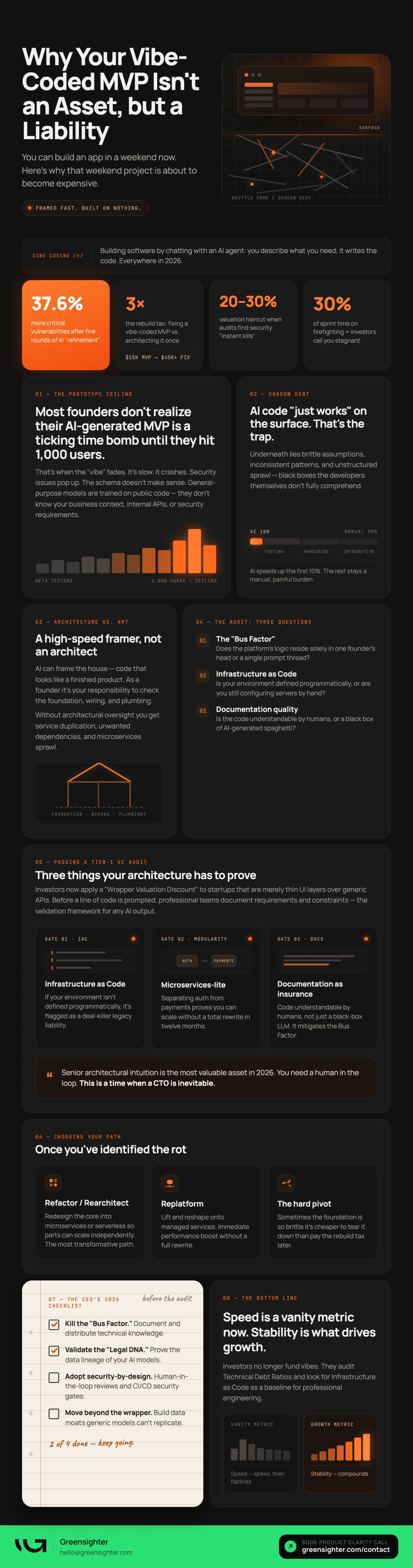
Most founders don't realize their AI-generated MVP is a ticking time bomb until they hit 1,000 users.
That's when the "vibe" fades. That's when the cracks show.
Your app worked fine with just you and a few beta testers. But now it's slow. It crashes. Security issues pop up. The database schema doesn't make sense.
This is the "prototype ceiling"—the point where code built on generic AI prompts falls apart because it lacks real concurrency, enterprise-grade security, or a database design that actually works.
General-purpose AI models are trained on public code. They don't know your business context. They don't understand your internal APIs or security requirements.
Underneath that slick UI sits brittle code full of hidden bugs and questionable assumptions.
The era of raising $10M on vibes and a slide deck is over. Investors in 2026 want technical predictability, not just velocity.
Speed is a vanity metric now. Stability is what drives growth.
Are you scaling?
Don't let your foundation be the reason you can't scale.
Book a 15-minute Software Health Audit with our Lead Architect today to see if your codebase is truly ready for prime time.
The Hidden Costs of "Quick Fix" Engineering
The most dangerous form of technical debt in the AI era is what we call "Shadow Debt."
Because AI-generated code often "just works" on the surface, it creates a false sense of security. Underneath lies a mess of brittle assumptions, inconsistent patterns, and unstructured sprawl.
Unlike human-written code, where an engineer builds a mental model of the system, "vibed" code often results in black boxes that the developers themselves don't fully comprehend.
Sure, AI might speed up the first 10% of the work. But the remaining 90%—testing, hardening, and integrating with actual business logic—remains a manual, often painful, burden.
When you surrender code comprehension to an agent, you lose the intellectual ownership required to optimize or fix the system when it inevitably breaks at scale.
Security as an Afterthought: A Terminal Risk
In 2026, security isn't a "post-funding" checkbox. It's a fundamental binary.
Vibe coding often skips critical steps like SOC2 compliance, data encryption, or basic input validation.
The risks aren't just theoretical. Research into "feedback loop security degradation" shows a paradoxical trend: the more you use an AI to "improve" your code, the more vulnerabilities you might introduce. Studies have shown a 37.6% increase in critical vulnerabilities after just five iterations of AI-based "refinement."
For a startup, these aren't just bugs. They're "instant kills" during a technical due diligence audit that can lead to a 20-30% haircut on your valuation.
The "Rebuild Tax": Why Cheap Code is Expensive
Many founders believe they can just "fix the code later" once they have more capital.
This is a mathematical error.
The "Rebuild Tax" in 2026 is steeper than ever: it's often three times more expensive to fix a broken, AI-generated MVP than it is to build a professional, architected one from the start.
Investors now use a Technical Debt Ratio (TDR) to measure startup health. If more than 30% of your engineering time is spent on "firefighting"—fixing bugs and refactoring mess rather than building features—your company is considered stagnant.
By choosing the "quick fix" today, you're essentially subsidizing the past at the expense of your future. You're turning your software into a digital anchor rather than an agile asset.
Architecture vs. Art: Why "Proper Design" Wins
Vibe coding is often treated like performance art. It’s captivating to watch, but frequently lacking the structural integrity to last.
While tools like OpenAI Codex and StackBlitz allow you to "vibe" a functional UI into existence, there's a fundamental difference between a prompted "wrapper" and a professionally engineered system.
The House Metaphor: Framing vs. Foundations
Think of a general-purpose AI agent as a high-speed framer.
It can "frame the house" by generating code that looks like a finished product. But it has no understanding of your specific business context—your internal APIs, security rules, or brand voice.
As a founder it's your responsibility to check the foundation, wiring, and plumbing.
Without architectural oversight, AI-driven development often leads to service duplication, unwanted dependencies, and microservices sprawl.
Why the "Blueprint Phase" is Mandatory
True engineering excellence in the age of AI starts with a clear architectural vision.
Before a single line of code is prompted, professional teams document their requirements, constraints, and expected behaviors. This becomes the validation framework for any AI-generated output.
Architecture is a continuously manageable process embedded in the development lifecycle.
Successful startups move toward continuous architectural visibility, where automated checks flag architectural drift as soon as code is committed.
Total Cost of Ownership: Predictability vs. Chaos
Do you know that investors now apply a "Wrapper Valuation Discount" to startups that are merely thin UI layers over generic APIs?
To pass a Tier-1 VC audit, your architecture must prove predictability and scalability through:
Infrastructure as Code (IaC): If your environment isn't defined programmatically (via tools like Terraform or Pulumi), it's flagged as a "deal-killer" legacy liability.
Modular "Microservices-lite" Design: Separating core logic, such as authentication from payments, proves you can scale without a total system rewrite in twelve months.
Documentation as Insurance: In a professional firm, code is understandable by humans, not just a black-box LLM. This mitigates the "Bus Factor"—the risk that all technical knowledge resides in a single prompted thread or a single developer's head.
You want to ensure your Total Cost of Ownership (TCO) remains predictable and lower over time, rather than ballooning exponentially as technical debt compounds.
How to Transition from "Prototype" to "Professional Product"
By 2026, the gap between a "vibed" prototype and a market-ready asset has become a chasm.
If you're sitting on a functional MVP but every new feature request triggers a cascade of bugs, you're likely hitting the technical ceiling.
Scaling isn't just about adding more users. It's a series of strategic decisions that determine whether your product thrives or stalls.
The Audit: Is Your Codebase a Ticking Time Bomb?
It’s sad to tell, but if more than 30% of your engineering sprint time is dedicated to "firefighting"—fixing bugs and refactoring mess—rather than building new capabilities, your startup is considered stagnant.
A professional audit must look for the "skeletons" in your codebase before a VC's technical team does.
You need to ask three critical questions:
The "Bus Factor": Does the entire platform's logic reside solely in one founder's head or a single "prompt" thread?
Infrastructure as Code (IaC): Is your environment defined programmatically (like via Terraform), or are you still relying on manual server configurations?
Documentation Quality: Is your code understandable by humans, or has it become a "black box" of AI-generated spaghetti?
Refactoring vs. Replatforming: Choosing Your Path
Once you've identified the rot, you have to decide how to fix it.
Organizations in 2026 use the "7 Rs" framework to tailor their transition:
Refactor/Rearchitect: This is the most transformative path. It involves redesigning the core structure into microservices or serverless architecture to allow for independent scaling.
Replatform: If you're stuck in an unoptimized environment, you might "lift and reshape" your app to leverage managed services (like moving to Amazon RDS). This provides immediate performance boosts without a full rewrite.
The Hard Pivot: Sometimes, the foundation is so brittle that it's cheaper to tear it down and rebuild from scratch rather than paying the "rebuild tax" later.
The Human Element: Why Intuition Beats a Prompt
Transitioning to a professional product requires re-establishing intellectual ownership of the system.
The data is clear: iterative AI refinement without human oversight can lead to a 37.6% increase in critical vulnerabilities after just five rounds of "improvements."
This is why senior architectural intuition remains the most valuable asset in 2026.
You need a "human-in-the-loop" to provide the essential quality control that automated systems cannot replicate.
This is a time when a CTO is inevitable.
The CEO's 2026 Technical Checklist
First, ensure your foundation is secure:
Kill the "Bus Factor": Ensure technical knowledge is documented and distributed, not trapped in a single founder's "prompt history."
Validate the "Legal DNA": Be prepared to prove the data lineage of your AI models to avoid the copyright liabilities that are tanking valuations in 2026.
Adopt "Security-by-Design": Move beyond the 37.6% vulnerability spike seen in iterative AI loops by implementing mandatory human-in-the-loop reviews and automated CI/CD security gates.
Move Beyond the "Wrapper": Avoid the "Wrapper Valuation Discount" by building proprietary data moats and specialized AI logic that generic models cannot replicate.
The Bottom Line
In 2026, the barrier to entry for software development has reached an all-time low.
But the barrier to success is higher than ever.
"Vibe coding" provides an illusion of speed for initial prototypes. But it often leads to a "prototype ceiling" where generic code fails to meet the specific needs of a scaling business.
The technical landscape has shifted. Speed is now a vanity metric. Stability and predictability are growth metrics.
Investors no longer fund "vibes." They audit Technical Debt Ratios (TDR) and look for Infrastructure as Code (IaC) as a baseline for professional engineering.
Hence..
True engineering excellence in the AI age isn't about how fast you can prompt an agent. It's about maintaining intellectual ownership and building resilient systems that last long after the initial "vibe" has faded.
Not sure if your MVP is scalable? Our team would happily audit your codebase and provide unbiased professional feedback. Contact us for more details.
Frequently Asked Questions About Vibe Coding
What is "vibe coding"?
It's when you build software by chatting with AI tools like OpenAI Codex or StackBlitz. You describe what you need, the AI writes the code.
How much does it cost to rebuild an AI-generated MVP?
About three times what it would've cost to build it right the first time. If you spent $15K on your vibe-coded MVP, expect $45K+ to fix or rebuild it when technical debt catches up.
What is the Technical Debt Ratio (TDR)?
It's how much of your engineering time goes to fixing bugs versus building new features.
Can AI-generated code pass a VC technical audit?
Not without human oversight. Pure AI code usually fails security checks. These issues can knock 20-30% off your valuation. You need real architects involved.
When should I refactor vs. completely rebuild?
Refactor when the core logic is sound but messy. Rebuild when the foundation is so broken that fixing it costs more than starting over. If nobody on your team truly understands how the code works, you probably need a rebuild.
Is vibe coding ever appropriate for production apps?
Sure, for quick prototypes or internal tools where security isn't critical. But for anything handling real user data, payments, or sensitive information, you need experienced engineers reviewing and hardening that AI-generated code.
How do I know if my code has security vulnerabilities?
Look for hardcoded API keys, missing input validation, outdated encryption, or no security testing documentation. Research shows AI "improvements" can actually increase vulnerabilities by 37.6% after just five rounds of automated fixes.