




Most businesses don't ask this question until they're already in pain.
A mid-size logistics company recently told us their ops team spent every Monday morning manually reconciling shipping confirmations across three carrier portals into one master spreadsheet.
Four hours. Every week. For two years.
The data existed in all three systems. Nobody had ever connected them.
That's not a people problem. That's a process problem nobody has put a number on yet.
Here are the ten signs your business needs AI, the kind you can act on this quarter, not some theoretical someday-AI.
10 Signs It's Time to Automate
Below’s a quick checklist for you:
☐ Your best people are stuck doing copy-paste work
☐ The same questions keep hitting your inbox
☐ Mornings start with "catching up," not real work
☐ One person leaving would break a process
☐ You can draw the process on a whiteboard, no exceptions
☐ Mistakes are creeping in from sheer repetition
☐ You're hiring just to keep pace with volume
☐ Customers wait on you more than you wait on them
☐ The data already exists, just scattered across tools
☐ Leadership keeps asking, "Can't we just automate this?"
What's your score?
Count how many boxes you checked.
0–2 → Probably not ready yet. Focus on cleaning up your data and documenting your core processes first.
3–5 → Strong candidate for automation. At least one process on this list is costing you more than you realise.
6 or more → You're likely losing significant time and money to manual processes every single week. The question isn't whether to automate. It's where to start.
Let's look at each sign in detail:
1. You're paying smart people to do dumb work
If your best hire spends two hours a day on copy-paste, you're not using their judgment.
You're using them as a router between two systems that should talk to each other.
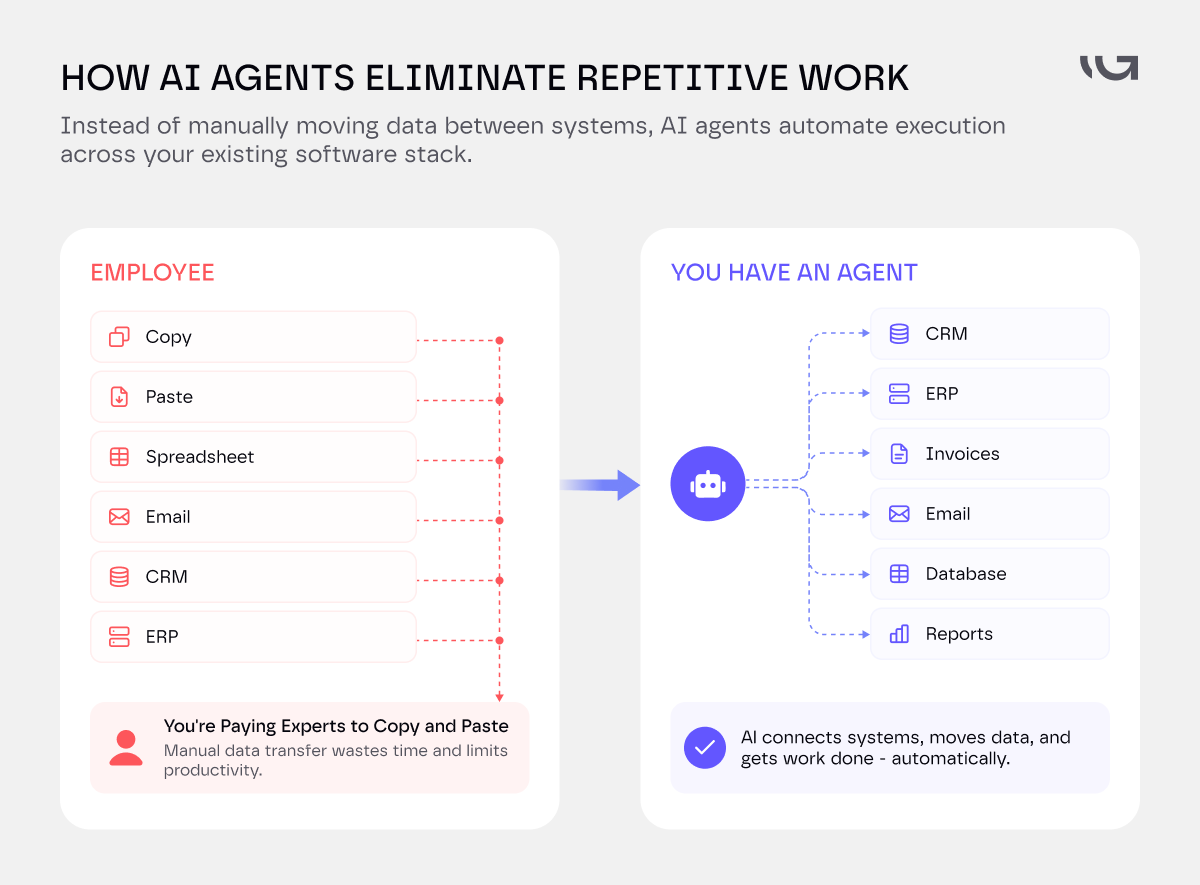
2. The same question keeps showing up in your inbox
Twenty emails a week asking the same three things is a pattern, not a coincidence. A pattern is exactly what an agent is good at handling.
3. Your team's first hour is "catching up," not creating
If the start of every day is spent reconstructing what happened overnight instead of doing the actual work, that's lost capacity you're paying for and never getting back.
4. One person leaving would break the process
Picture the new hire who spent her first three weeks just learning where everything lives, because nothing was ever written down.
That's not job security. That's a single point of failure.
5. You can draw the process as a flowchart, no exceptions
If you can sketch the steps on a whiteboard and there's rarely a "well, except when," that process is ready.
The ambiguous ones aren't, yet.
A few processes that look structured but usually aren't: performance reviews (the rubric exists, but every manager scores differently), customer refund approvals (policy says yes or no, but judgment calls creep in), and onboarding checklists (the steps are written down, but exceptions pile up fast).
If the process lives in someone's head more than it lives in a document, automate the document first.
6. Mistakes are creeping in from sheer repetition
Humans doing the same task two hundred times a day get worse at it, not better. Fatigue-driven errors are a signal, not a training problem.
7. You're hiring just to keep pace with volume
If your headcount has to grow in a straight line with your order volume, your cost structure is the bottleneck, not your team's effort.
8. Customers wait on you more than you wait on them
Slow response times on routine requests, like a status update or a reschedule, are usually a process gap, not a staffing gap.
9. The data already exists, just scattered across five tools
If the information an agent would need already lives somewhere, in your CRM, your inbox, your spreadsheets, you're closer to ready than you think.
10. Leadership keeps asking, "Can't we just automate this?"
There's a reason that question has become someone's closing line in every Monday meeting. When it comes up unprompted, more than once, that's organizational readiness talking.
If three or more of these sound familiar, you're not early to this. You're behind schedule on something that was already worth fixing.
Most businesses nod at six of these and then spend another year doing nothing about it.
Here's what staying manual actually costs.
If one person spends two hours a day on a task an agent could handle, that's 500 hours a year. At a fully-loaded cost of $40 an hour, that's $20,000 annually. Per person.
Most businesses have three or four of these processes running in parallel, quietly, in different departments, with nobody adding them up.
The cost of inaction isn't zero. It's just distributed enough that nobody sees the total.
Processes Suitable for Automation
McKinsey's research found that about 50% of today's work activities are technically automatable with current technology.
In roughly 60% of occupations, at least a third of the daily activities qualify. That's a meaningful slice of almost any job description.
The processes worth automating first share a few traits. They're repeatable: the steps don't change much from one instance to the next.
They're high-volume: it happens often enough that the time savings actually add up.
And they have clear inputs and outputs: you can describe what goes in and what should come out, without much guesswork in between.
Good fit vs. poor fit for automation
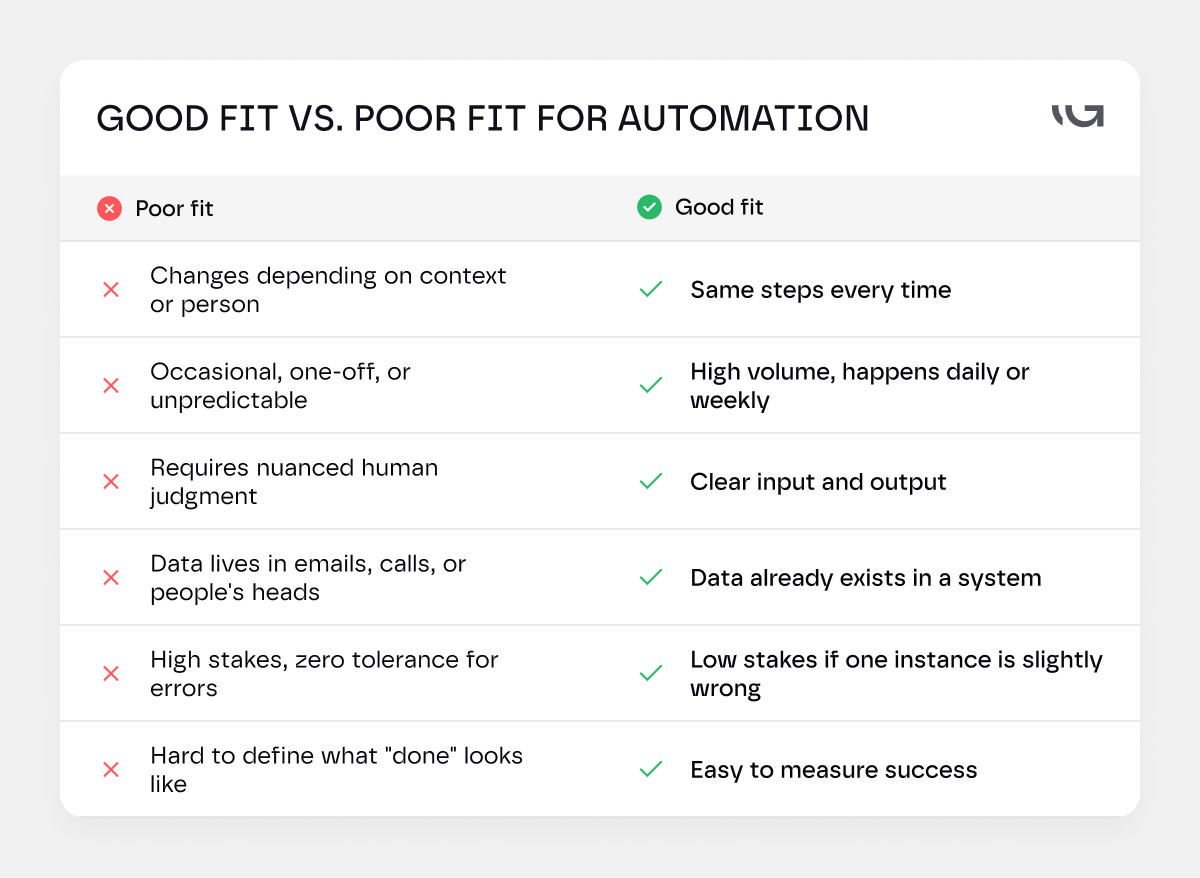
If your process lands mostly in the left column, it's ready. Mostly right column means fix the foundations first.
Not every process qualifies, and that's worth saying plainly.
McKinsey's own research warns that poor-quality data and a tangle of underlying systems can quietly add cost and time to automation efforts that looked simple on paper.
If your data is a mess or your process changes every other week, that's not a reason to avoid automation. It's a reason to fix the process first.
Business Use Cases for AI Agents
A few starting points show up again and again across the businesses we talk to.
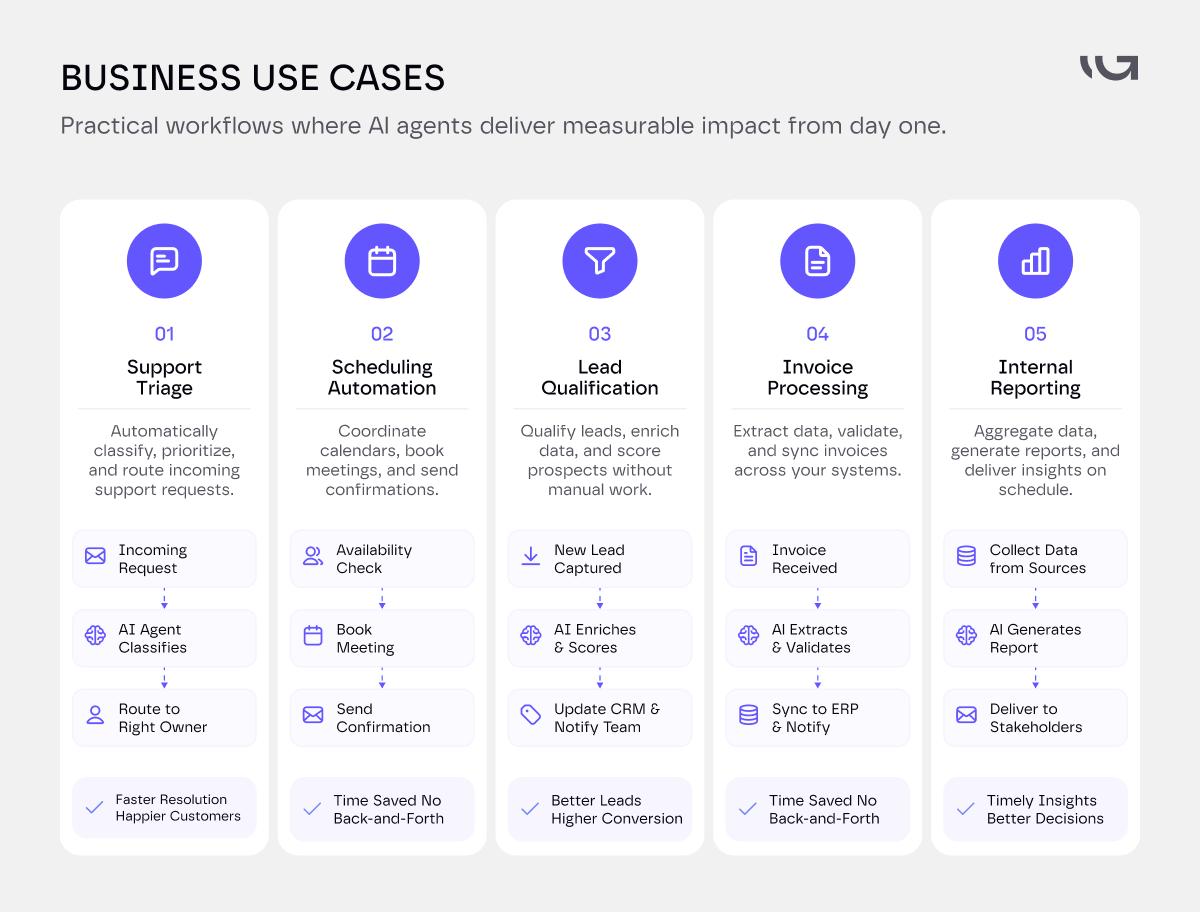
Support triage. An agent reads the incoming request, answers what it can, and routes the rest to the right person, instead of a generic queue.
Scheduling and intake. Greensighter's own piece on clinic scheduling mistakes that lose patients is a good example of how much a single broken handoff costs in a vertical where the stakes are especially high.
Lead qualification. An agent scores incoming leads against your actual criteria, instead of a rep manually reading through every form submission.
Invoice and document processing. Pulling line items, checking them against a PO, and flagging anything that doesn't match policy.
Internal reporting. Pulling numbers from five tools into one weekly summary, the kind of task that's tedious for a person and trivial for an agent.
None of these need a six-agent system on day one. Start with whichever one is costing you the most hours this month.
Good AI workflow automation for business almost always starts narrow, with one painful process, not a company-wide rollout.
Prepare for AI Adoption
Readiness isn't just about the process. It's also about what's happening around it.
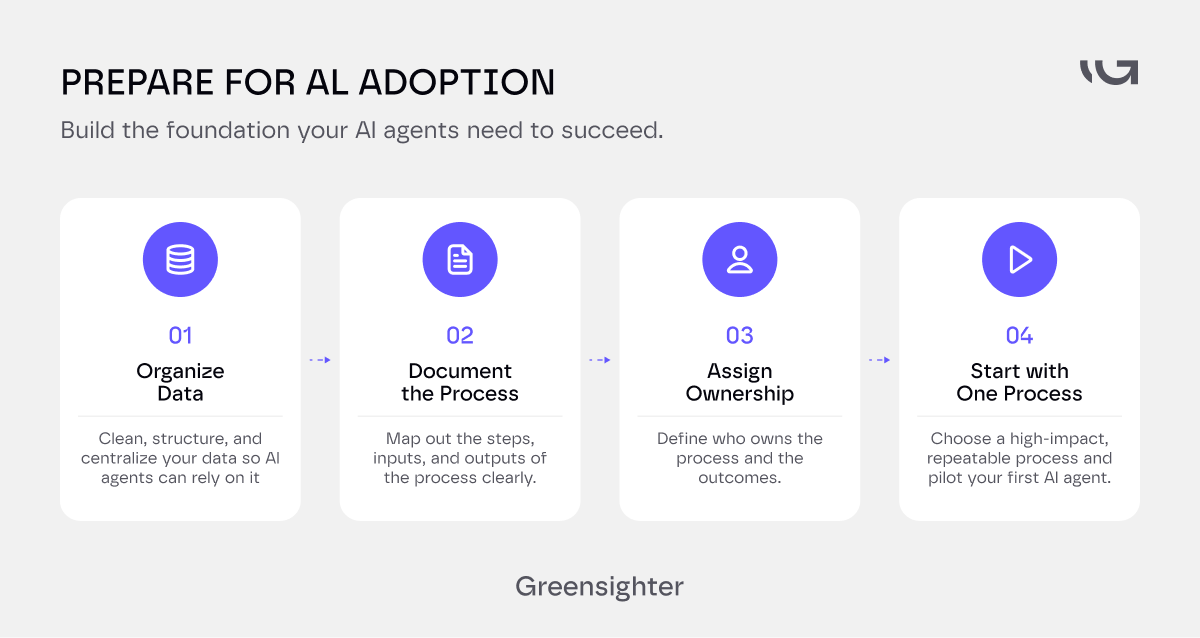
- Get your data in one place, or at least mapped
An agent can only work with what it can reach.
If the information lives in someone's personal spreadsheet, that's the first thing to fix, not the agent's job to work around.
- Document the process before you automate it
You can't automate what nobody in the building can fully explain.
If three people on your team would describe the same process three different ways, write it down first.
- Decide who owns it once it's live
An agent without an owner drifts. Someone needs to watch how it performs, catch when it starts getting things wrong, and update it as the business changes.
Start with one process, not five
Greensighter's own take on why every feature you add makes your startup weaker applies just as well here.
The instinct to automate everything at once is usually the thing that sinks the project.
Presidio's 2024 AI Readiness Report found that 80% of companies had already adopted generative AI, but half admitted they launched before they were actually prepared to do so.
Adoption without readiness is how AI agent workflow automation becomes a six-month headache instead of a six-week win.
Most businesses don't fail at automation because the technology didn't work.
They fail because nobody decided which process to start with, or who'd own it once it shipped.
Greensighter helps you figure out both before you spend a dollar on development.
The Bottom Line
Business process automation with AI isn't about replacing your team. It's about giving the repetitive 30% of someone's day back to them.
You don't need to automate everything. You need to automate the one thing that's quietly costing you the most, and prove it works before you touch anything else.
Greensighter's comparison of MVP, MLP, MMP, and MMF product strategies covers the same "smallest version that proves the idea" thinking.
It applies directly to your first AI agent for business automation.
If three or more of the ten signs above sound like your Tuesday, you already know where to start.