



Let’s call a spade a spade: patients are losing their appetite for delays.
They don’t want to wait for slow booking systems. They don’t like confusing forms.
If scheduling an appointment feels frustrating, they’re just going to leave and book somewhere else.
This is the reality of modern appointment scheduling in healthcare.
It’s easy to underestimate how quickly small UX problems turn into lost revenue:
- A slow-loading calendar
- Too many booking steps
- Poor mobile usability
- No appointment clarify
In healthcare, every missed patient represents significant long-term revenue.
At Greensighter, we often see the same pattern
Clinics invest heavily into patient acquisition, but they ignore the exact moment patients are ready to convert.
That moment is more decisive than you realize.
Together, we’ll walk through the most common clinic appointment scheduling mistakes that are driving patients away.
Most Booking Systems Create Friction Too Early
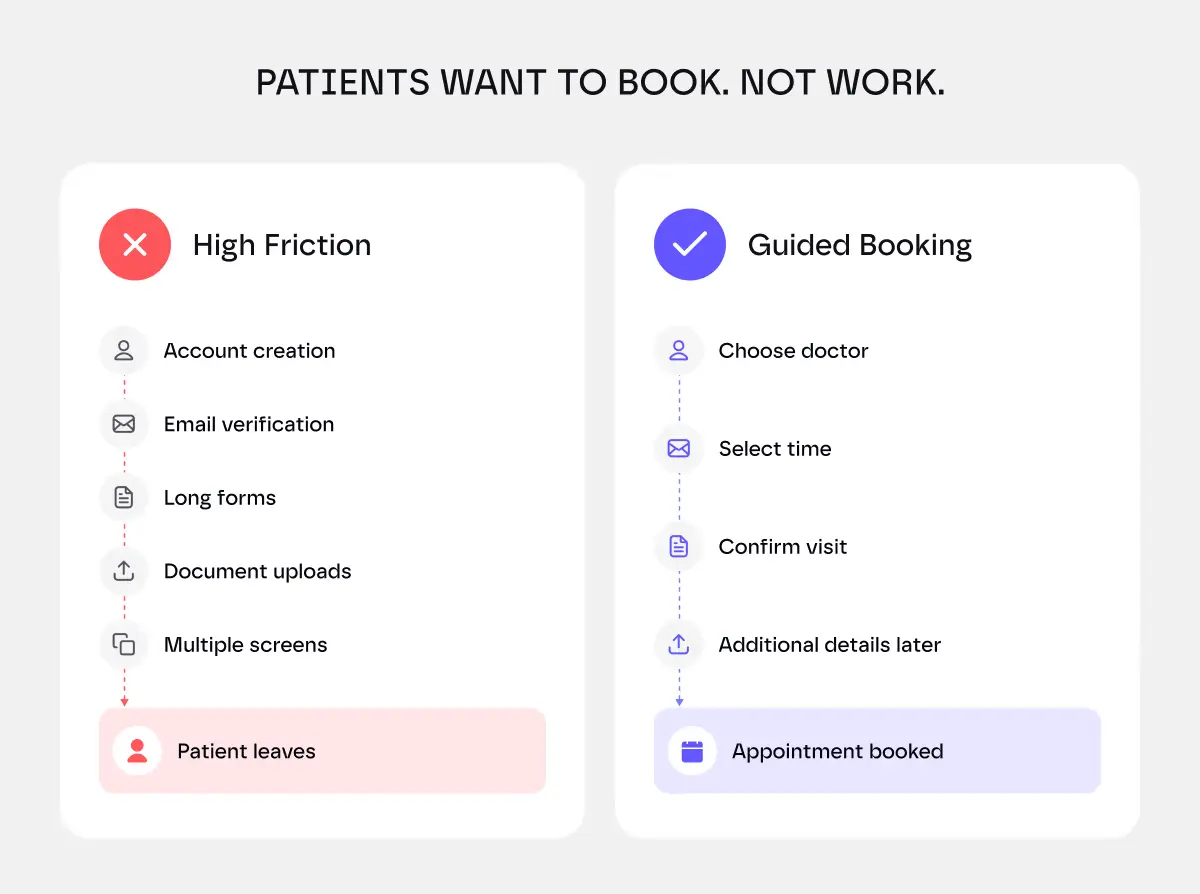
Your patients arrive at booking pages with one goal: booking an appointment, fast.
That’s it.
But, you might unknowingly interrupt that intent by asking them to:
- Create accounts
- Verify emails
- Complete lengthy forms
- Upload documents
- Select unclear appointment types
- Navigate multiple screens
Don’t get us wrong. All of these are necessary. You just need to request them at the right time.
Healthcare booking systems are more sensitive compared to others.
If you ask for too much too early, you’ll increase abandonment risk.
Your users are usually stressed, distracted, in pain, and probably not that familiar with healthcare jargon.
This changes the way you structure the user experience.
A clinic booking experience should feel calm and guided, not administrative.
Why Patients Abandon Booking Forms
Form overload is a recurring headache in appointment scheduling in healthcare.
Patients land on your booking form to schedule an appointment. It’s that simple.
If you push them to do more, you’ll create psychological resistance. Especially on mobile.
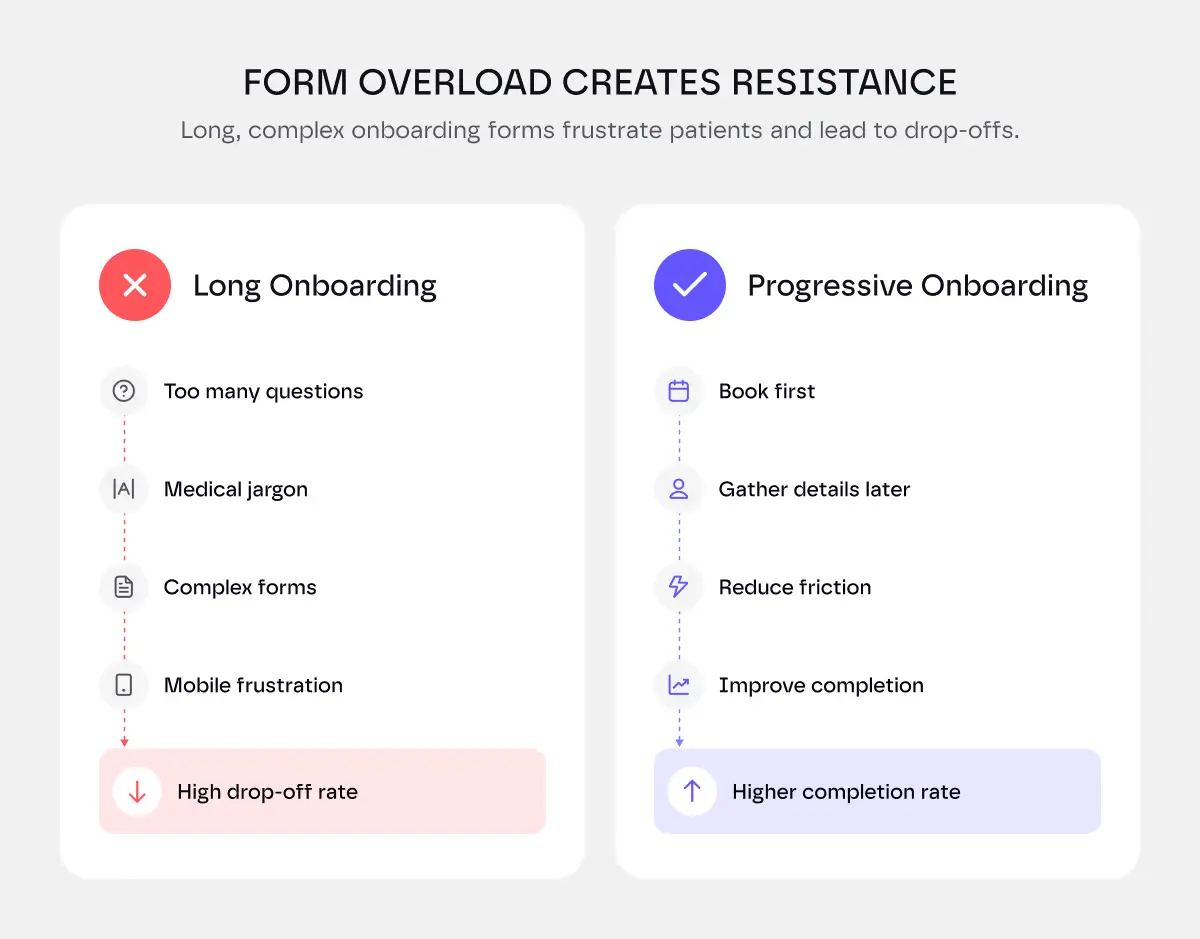
Do this instead: take them through progressive onboarding.
Let them book their slot, then ask for secondary information later.
This reduces friction by miles.
Mobile Booking Experiences Are Still Surprisingly Bad
It’s time to let go of your clinic’s desktop-first booking system.
It’s outdated, with common problems like:
- Tiny calendar interfaces
- Difficult date selection
- Broken autofill
- Unclear validation errors
- Poor tap spacing
- Endless scrolling
Fixing clinic booking UX starts with mobile-first thinking, and applying that to all channels.
Clinics Are Hiding Availability, Without Realizing
From what our experience tells us, unclear availability visibility is one of the most damaging clinic appointment scheduling mistakes.
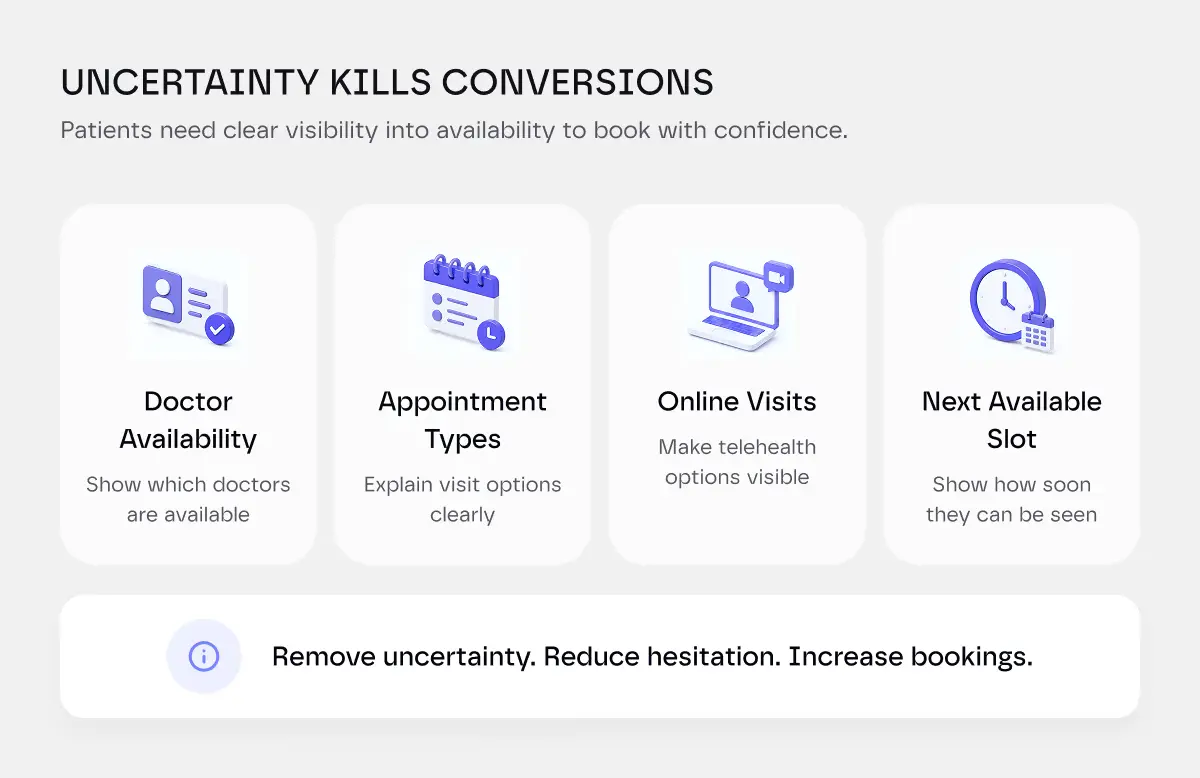
Patients need to understand:
- Which doctors are available
- How soon appointments exist
- Whether online consultations are possible
- Which appointment types apply to them
Remove any of these from the process, and you create uncertainty.
Uncertainty leads to hesitation, and hesitation kills conversions.
There’s No Immediate Clarity
The best scheduling systems are the ones that cut down on decision fatigue.
They clearly show the patients what they want to see, without overwhelming them.
What you should strive to achieve is helping patients decide faster, instead of giving them too much information.
Online Scheduling vs. Manual Booking
Phone-based scheduling is still a thing, and many clinics are heavily relying on it.
There are two reasons for this.
Either they’re just used to it, or their online systems aren’t up to par.
This might work for patients who’ve been with the clinics long enough.
However, expectations are changing.
The average patient today expects some form of digital scheduling capabilities from healthcare providers.
This creates serious operational pressure for clinics who still depend on the good old phone calls.
Manual Booking Creates Operational Bottlenecks
Missed calls, scheduling errors, limited booking hours, delayed callbacks…
All of these create pressure on staff.
Patients, especially the younger demographic, don’t like to wait.
They’re used to on-the-go digital experiences when appointment scheduling in healthcare.
This doesn’t mean you should remove human support completely.
What you should do is this:
Let digital scheduling handle routine booking flows efficiently.
Let your staff focus on higher-value patient interactions.
It’s a win-win.
=cta=
Scheduling UX Problems Usually Reflect Deeper Operational Problems
If you treat booking UX as simply a front-end issue, we recommend looking at the bigger picture.
Bad scheduling experiences usually expose operational misalignment that has deeper roots.
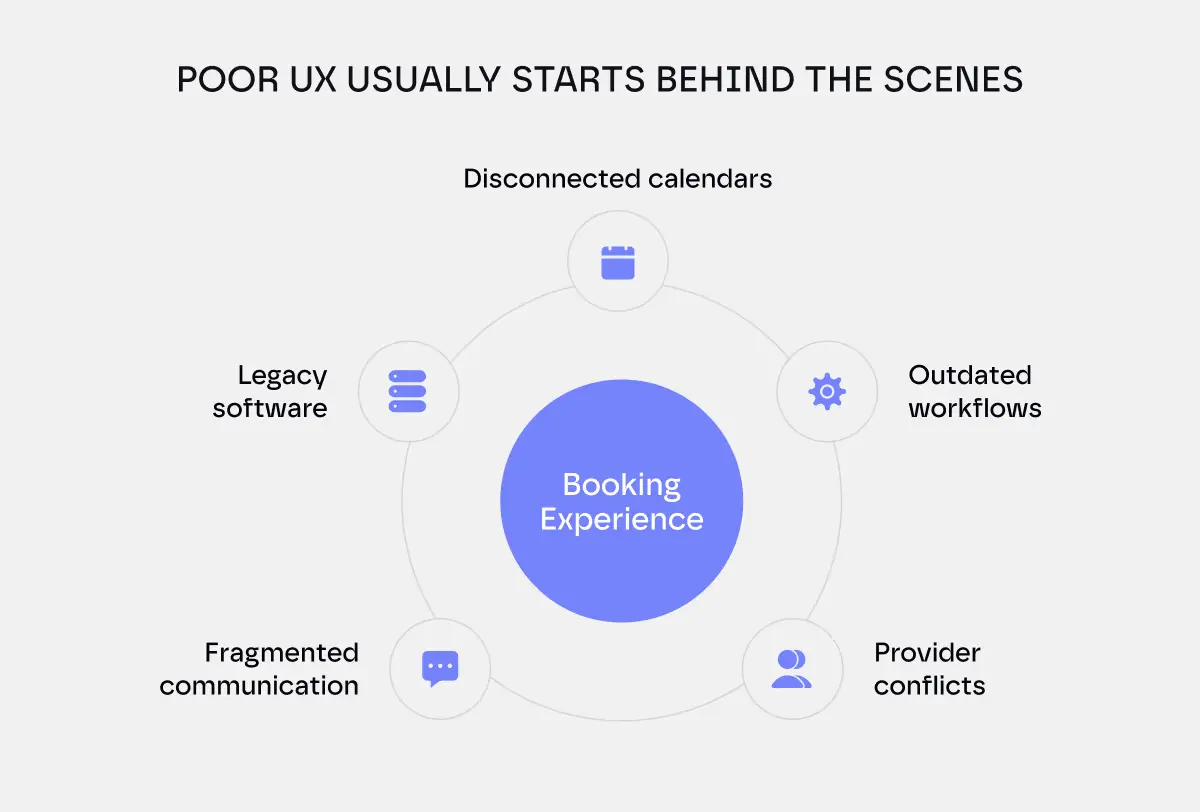
Let’s look at a few examples:
- Disconnected calendars
- Outdated workflows
- Inconsistent provider availability
- Fragmented communication
- Legacy software limitations
When patients end up on the booking interface, they experience these internal problems head-on.
That’s why you can’t solve everything just by redesigning the interface.
Standards and Security Are Overlooked
In healthcare environments, you need to integrate your scheduling systems with interoperability standards such as HL7 and FHIR.
Without proper integration planning, you might end up with issues like:
- Fragmented scheduling experiences
- Disconnected patient data
- Operational inefficiencies
All of these scale poorly over time.
Another thing you need to keep in mind are security expectations.
In healthcare, they are high.
You need to align your platform’s infrastructure with standards such as SOC 2 Type II.
This way, you’ll:
- Support partner trust
- Facilitate vendor evaluations
- Develop enterprise healthcare partnerships
Poor Accessibility = Invisible Patient Drop-Offs
Almost all systems are now required to include accessibility metrics, especially healthcare.
Patients may suffer from:
- Visual impairments
- Motor disabilities
- Cognitive limitations
- Screen reader dependencies
As such, accessibility isn’t optional. It directly impacts patient access.
You’re increasingly required to align your healthcare scheduling systems with WCAG 2.1 Level AA accessibility standard.
This applies to all channels: websites, apps, and digital forms.
Depending on population size, ADA Title II digital accessibility deadlines have been extended to April 2027 and April 2028.
That being said, WCAG 2.1 compliance remains the required benchmark for digital experiences in healthcare.
Common Accessibility Failures
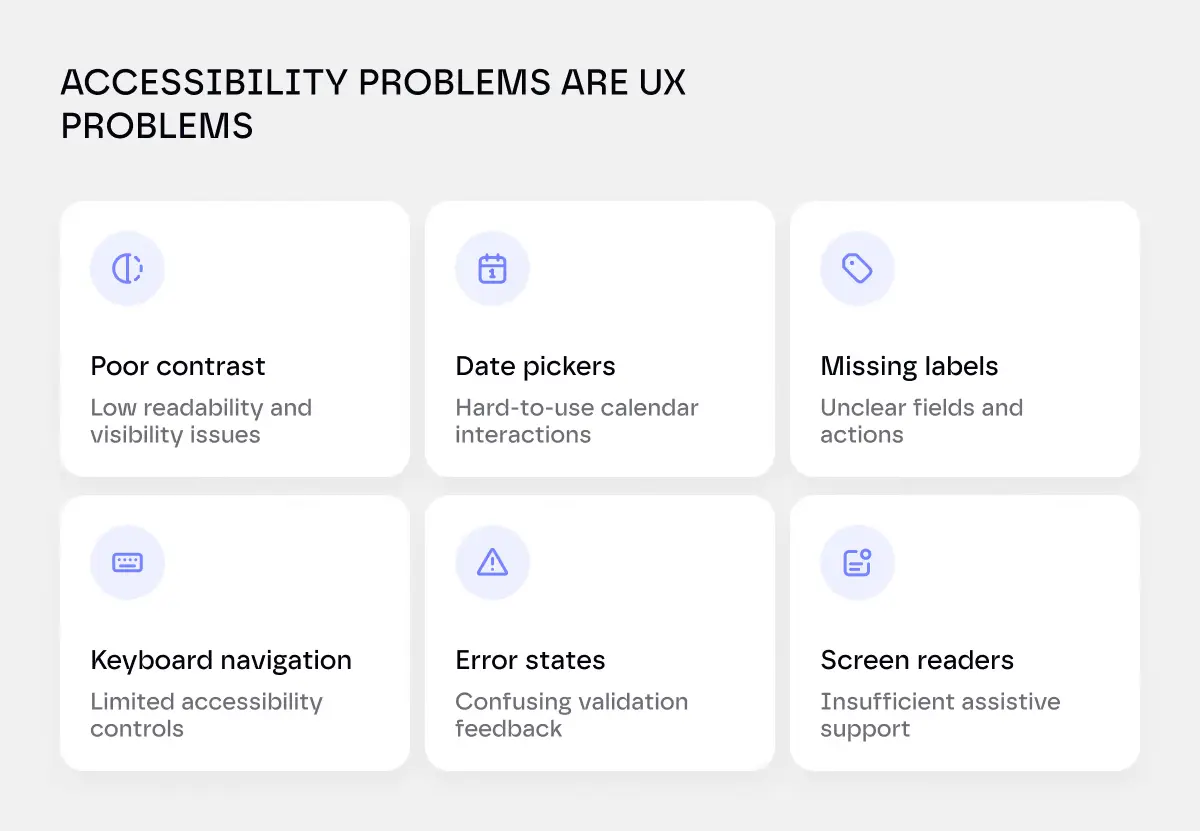
From our experience at Greensighter, here are some of the common pitfalls of not making your forms accessible:
- Poor contrast ratios
- Inaccessible date pickers
- Missing form labels
- Keyboard navigation issues
- Unreadable error states
- Broken screen reader support
You might get away with some of these on desktop, but they’re especially problematic on mobile.
Keep this in mind:
Accessibility problems are also UX problems.
And in healthcare, they become trust problems, too.
Confirmation and Follow-Up Flows Are Often Neglected
Clinic appointment scheduling mistakes don’t start and end during onboarding.
In physical settings, patients expect some sort of salutation as they fill out a form or leave the clinic.
The same needs to be replicated online.
Make sure you provide one or all of these after the patient completes onboarding:
- Clear confirmation
- Preparation instructions
- Reminders
- Rescheduling flexibility
Offboarding is severely underrated. Get it wrong, and you might increase no-show risk.
Patients Need Reassurance
Healthcare interactions carry emotional weight.
Patients always want reassurance that:
- The appointment is confirmed
- You’ve received their information
- They know what happens next
- They will not miss important details
These simple confirmation systems improve trust and reliability.
You can do this with:
- SMS confirmations
- Email reminders
- Calendar integration
- Appointment summaries
- Preparation instructions
Small UX improvements = large trust improvements.
Steering Clear of Overengineering Scheduling Systems
This is one of the most common clinic appointment scheduling mistakes.
There’s no need to load your form with too many filers, pathways, or options.
If you expose too much logic to your patients, you’ll create confusion over efficiency.
Simplicity Is Key
We’re living in the age of minimalism, where patients generally want three things:
- Find the right doctor
- Choose a time
- Book aan slot
Appointment scheduling in healthcare should feel effortless.
Try your best to keep complex internal scheduling logic invisible whenever possible.
Cognitive overload is a major reason why patients abandon booking systems.
Clinics Rarely Measure Scheduling Drop-Off Properly
You’ll find that a lot of healthcare businesses track:
- Booked appointments
- Cancellations
- No-shows
But they rarely track:
- Incomplete booking sessions
- Form abandonment
- Mobile drop-off points
- Failed scheduling attempts
- Rage clicks
- Broken user journeys
If you don’t track these, you’re not getting the full picture of how much patient loss happens before conversion.
With modern UX analysis tools, you can pinpoint the exact point of struggle.
Without this visibility, you might end up repeating the same clinic appointment scheduling mistakes.
Final Thoughts
The biggest bugs scheduling problems aren’t technology problems.
Patients let go of healthcare booking systems because the process becomes a headache.
It either confuses them, or exhausts them.
That’s the real danger of poor appointment scheduling in healthcare.
Every unnecessary step reduces patient conversion.
Over time, these losses stack up.
If your clinic wants to win digitally, your system should be able to reduce friction.
At Greensighter, we help healthcare businesses avoid common clinic appointment scheduling mistakes.
With our expertise, you can design patient experiences that convert more effectively.
If your clinic is struggling with patient book drop-offs, scheduling UX issues, or fragmented digital flows, talk to us about your platform today.
=cta-black=
FAQs
Why do patients change their mind when appointment scheduling in healthcare?
Patients make decisions quickly.
If the booking process feels slow, confusing, or frustrating, many simply leave and look for another provider.
In healthcare, convenience heavily influences trust.
Can complicated scheduling systems reduce clinic revenue?
Absolutely.
Every abandoned booking flow represents lost consultations, treatments, and long-term patient value.
Small scheduling problems create major conversion leaks over time.
What makes a healthcare booking experience feel frustrating?
Patients usually struggle when scheduling systems feel overly administrative.
This often includes:
- Too many steps
- Unclear appointment options
- Poor mobile usability
- Delayed confirmations
How does poor scheduling UX affect patient trust?
Patients often judge the clinic experience before the appointment even happens.
If booking feels disorganized or difficult, trust drops immediately.
In healthcare, trust and usability are closely connected.
Are accessibility problems really affecting patient conversions?
Yes.
Patients dealing with visual impairments, motor limitations, or cognitive challenges often struggle during onboarding and scheduling.
Many clinics never realize how many patients abandon the process because the experience was simply too difficult to complete.


.webp)
.webp)
.webp)