



If you’re a healthcare organization, you’re bound to face growing pressure.
Patients are constantly setting the bar high.
WIth that, comes more administrative workload that consumes your staff’s time.
Clinicians spend hours completing repetitive tasks that take attention away from patient care.
Is hiring more people the answer? Not always.
The key is improving efficiency.
This is where AI agents are turning healthcare on its head.
They’re not your run-of-the-mill automation. They don’t follow fixed rules.

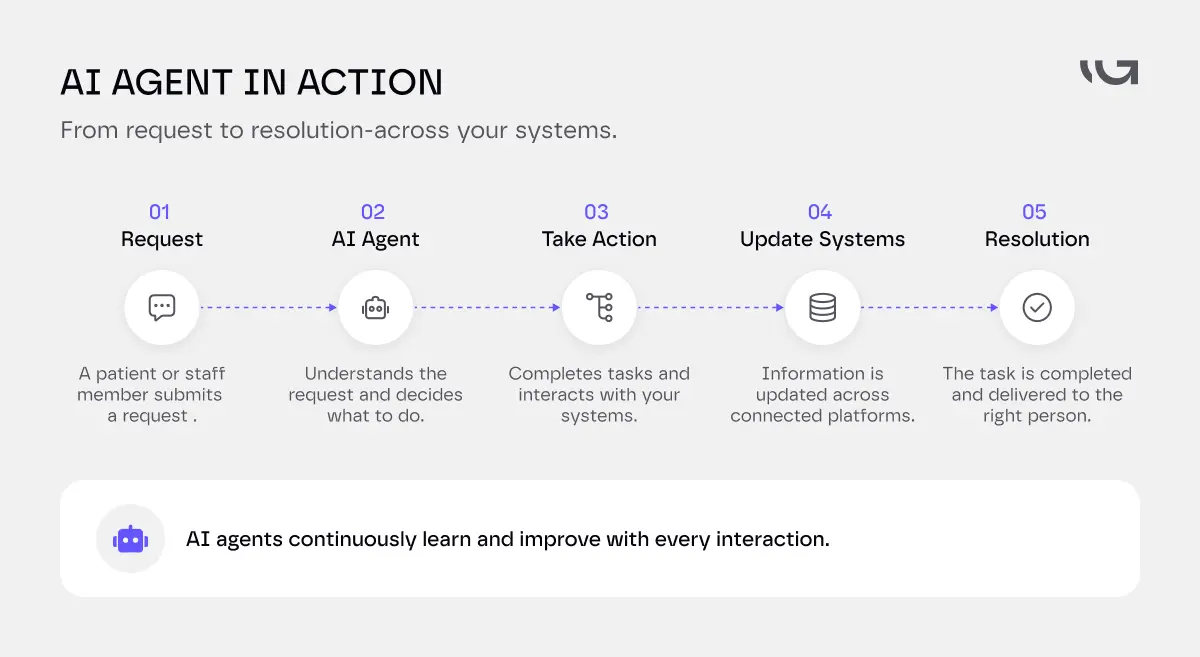
AI agents can understand requests, complete multi-step tasks, and interact with multiple systems.
What’s more, they can do all of this while adapting to changing situations.
They help automate routine work, improve patient communication, and support faster decision-making.
Contrary to popular belief, they don’t replace clinical expertise.
The result is win-win for both patients and healthcare teams.
Let’s take a look at how an AI agent for healthcare works, the real-world problems healthcare AI agents solve today, and how you can safely implement them.
What Is an AI Agent for Healthcare?
It’s basically an intelligent software system designed to complete specific goals with minimal human intervention.
They’re different from conventional chatbots that respond to predefined questions.
AI agents can analyze information, make decisions within established boundaries, and complete tasks across multiple systems.
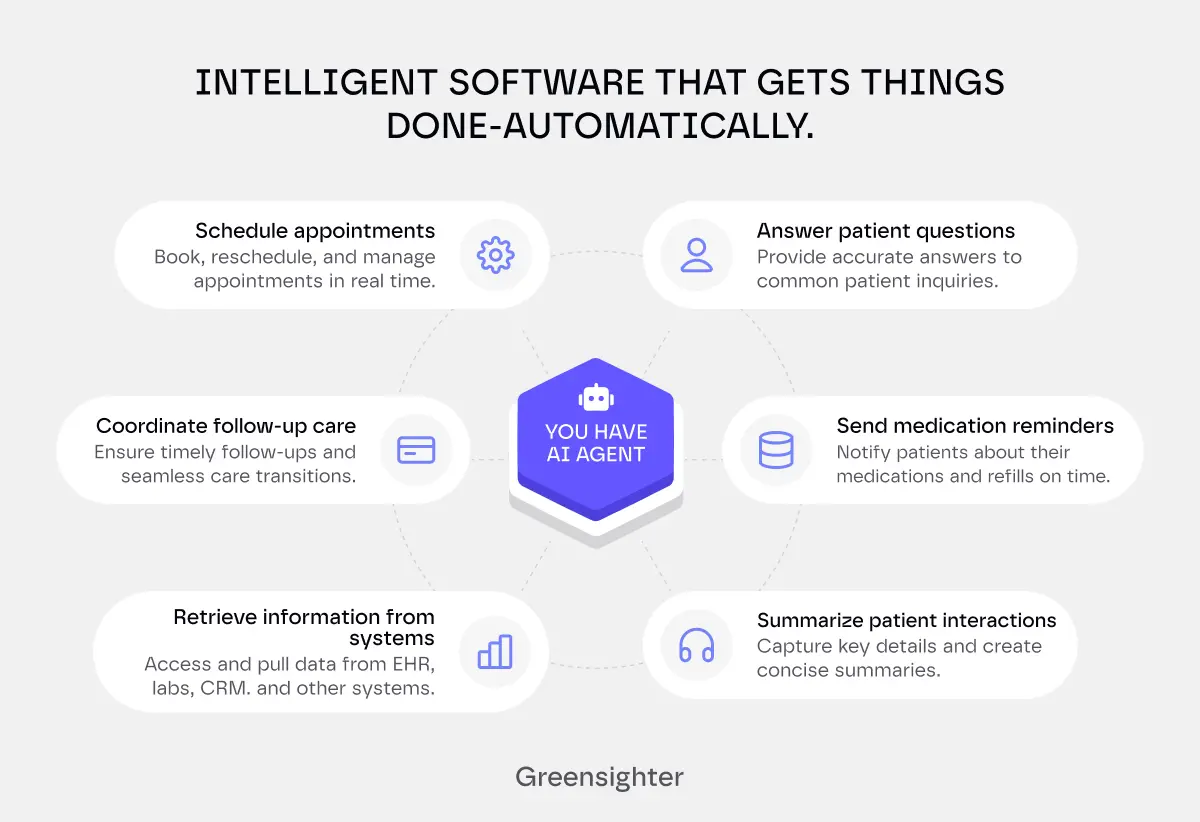
In healthcare, an AI agent can:
- Schedule appointments
- Answer patient questions
- Send medication reminders
- Coordinate follow-up care
- Summarize patient interactions
- Retrieve information from integrated systems
The agent becomes an active participant in administrative and operational workflows.
Their goal is to support healthcare professionals, not replace them.
Clinical judgment, diagnosis, and treatment decisions remain the responsibility of qualified medical staff.
Why Healthcare Organizations Are Investing in AI Agents
As of June 2026, AI agents for patient care are all the rage.
In just a single month, they drew $335 million as health tech funding heated up.
True, records are digitized, patient portals are a thing, and communication has modernized.
But, most of the routine processes still rely on manual work as a crutch.
Staff juggle multiple applications to complete a single task.
Patients wait on hold to book appointments.
Administrative teams manually send reminders and follow-up messages.
There’s nothing wrong with any of this.
However, these tasks do eat up a lot of time.
What’s more, they don’t even directly improve patient outcomes.
Healthcare AI agents take the wheel while maintaining consistency and reducing operational overhead.
Organizations adopting AI agents commonly aim to:
- Reduce administrative workload
- Improve patient engagement
- Shorten response times
- Support care coordination
- Increase operational efficiency
- Allow clinicians to spend more time with patients
They want to use AI to remove unnecessary friction from everyday healthcare operations.
Real-World Use Cases for Healthcare AI Agents
AI agents are now across a wide range of operational and patient-facing activities.
So, where does the greatest value come from?
It comes from automating repetitive processes that follow clear workflows.
The key point here is that you need to allow staff to step in whenever necessary.
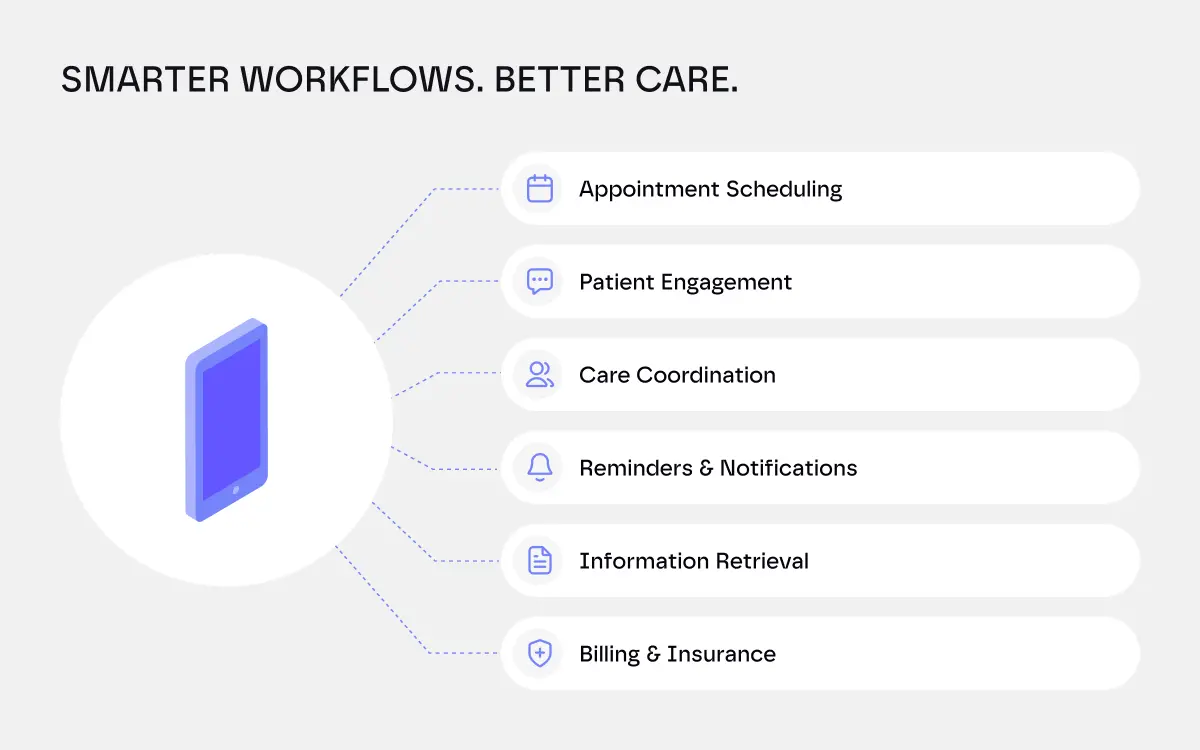
1. Appointment Scheduling
AI healthcare automation and scheduling really jell well together.
Instead of relying entirely on phone calls or manual booking, AI agents can:
- Schedule appointments
- Suggest available time slots
- Reschedule visits
- Process cancellations
- Send confirmations and reminders
Patients get faster service, while front-office teams spend less time managing calendars.
2. AI Patient Engagement
You need to stay in touch with your patients even after they book an appointment.
It’s just as important as managing the appointment itself.
AI agents can automatically deliver:
- Post-visit instructions
- Medication reminders
- Preventive care notifications
- Wellness check-ins
- Satisfaction surveys
The more you keep the communication loop going, the stronger your relationship with patients will be.
Plus, you’ll get to improve adherence to treatment plans at the same time..
3. Care Navigation
Patients often struggle to understand where they should go next.
With an AI agent, you can guide them through the healthcare journey by helping them:
- Locate the correct department
- Prepare for appointments
- Complete registration forms
- Access educational resources
- Receive follow-up guidance
Reduce uncertainty, and you’ll create a smoother patient experience.
4. Administrative Workflow Automation
AI agents can automate activities like:
- Document collection
- Referral processing
- Insurance verification
- Internal notifications
- Case routing
Your healthcare teams can do all of this, too.
However, automating these workflows will reduce delays and improve consistency across the board.
5. Billing and Insurance Support
Insurance verification, billing inquiries, claims status updates…
These tasks require staff to access multiple systems and respond to requests throughout the day.
An AI agent can help automate many of these interactions by:
- Answering common billing questions
- Checking insurance eligibility
- Providing claim status updates
- Collecting missing documentation
- Routing complex cases to the appropriate team
This lightens the load on admin staff, and gives patients faster access to information they need.
6. Internal Staff Assistance
AI agents can be a great helping hand to your teams.
Employees can ask an AI agent for immediate help instead of searching documentation or contacting another department.
Examples include:
- Locating internal policies
- Retrieving clinical protocols
- Answering HR questions
- Finding operational procedures
- Summarizing documentation
- Identifying the next step in established workflows
Your staff will thank you for quick access to reliable information, and you’ll see less interruptions and more productivity.
7. Population Health Outreach
Proactive communication is a must when improving long-term patient outcomes.
An AI agent can identify groups of patients based on predefined criteria.
This can include anything such as upcoming preventive screenings, chronic disease management programs, or annual wellness visits.
Once identified, the agent can automatically deliver:
- Personalized reminders
- Educational resources
- Appointment invitations
All through approved communication channels.
This approach helps you reach more patients without piling more onto your care teams’ plates.
Perks of AI Healthcare Automation for Providers and Patients
AI healthcare automation creates a ripple effect across the entire healthcare ecosystem.
Some of the most significant benefits include:
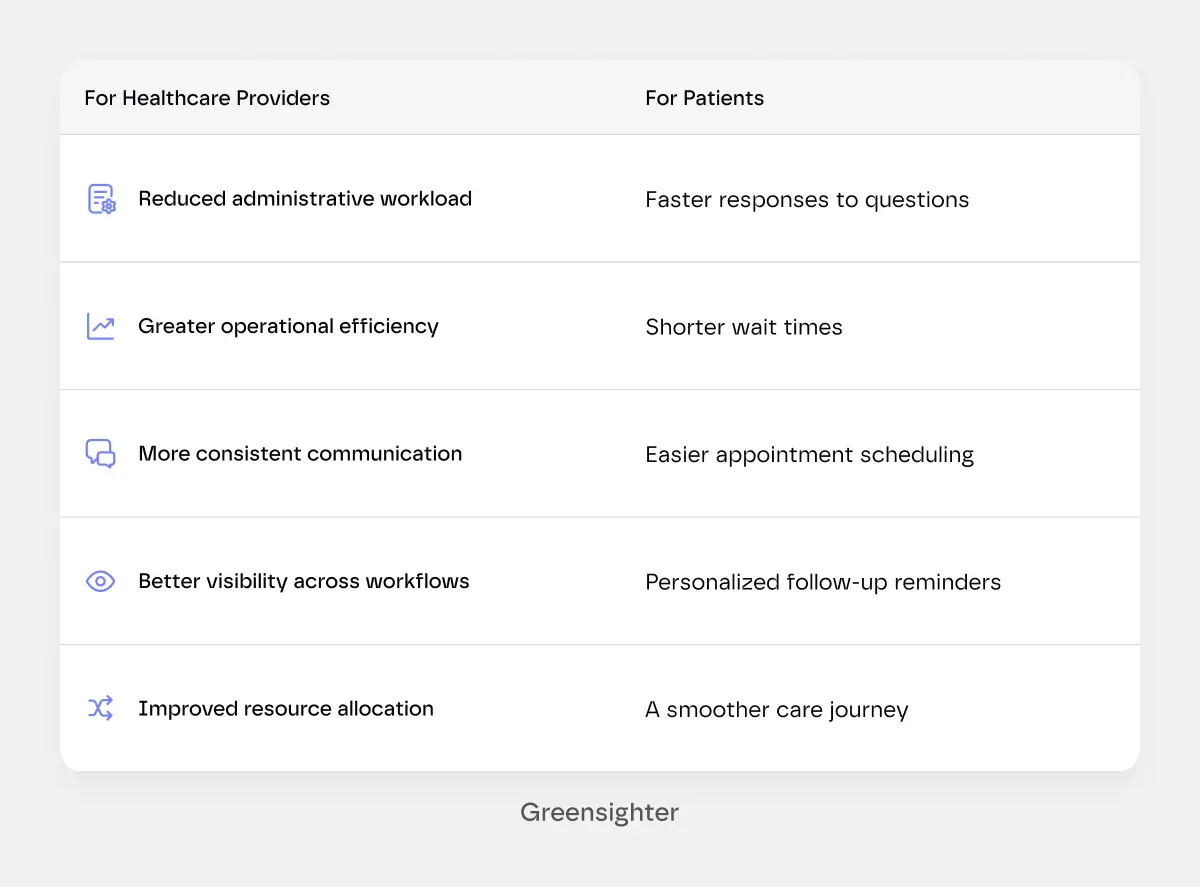
And that’s not all.
If you set them up carefully, AI agents improve operational performance, patient satisfaction, and ROI.
Which brings us to a common question we get from execs:
“Will AI agents really deliver measurable business value?”
They will, if you know where to apply them.
The greatest return on investment usually comes from automating repetitive, time-consuming processes.
You should still let your team handle highly specialized clinical tasks.
It’s predicted that AI in healthcare will generate more than $150 billion in annual savings.
That’s just for the U.S. market in 2026.
Imagine the impact on ROI on a global scale.
Compliance and Governance
Every rose has its throne, and AI is no different.
When deploying AI, you need to address security, privacy, transparency, and regulatory compliance.
AI agents process PHI, Protected Health Information.
As such, you must develop them with the same safeguards applied to other healthcare systems.
Key considerations include:
- HIPAA compliance
- Role-based access controls
- Encryption for data in transit and at rest
- Audit logging
- Secure authentication
- Ongoing monitoring
You should also establish clear governance policies.
These define where AI agents can operate independently, and where human review remains essential.
For example, an AI agent may successfully automate appointment scheduling or answer routine patient questions.
Clinical decisions, on the other hand, should always remain under the supervision of qualified healthcare professionals.
Maintaining that balance allows you to benefit from AI while preserving patient safety and trust.
Implementing AI Agents in Healthcare
Successful AI agent implementation starts with identifying the right problems to solve.
Don’t try to automate every workflow at the same time.
This leads to increased complexity and slowed adoption.
At Greensighter, we recommend a five-stage structured implementation process.
1. Identifying Repetitive Processes
Look for tasks that your staff spends way too much time on.
Scheduling, reminders, documentation, and administrative requests are often strong starting points.
2. Prioritize High-Impact Use Cases
Focus on areas where automation delivers measurable improvements for both staff and patients.
Early success builds confidence and supports broader adoption.
3. Integrate Existing Systems
AI agents become more valuable when you connect them to existing technologies.
These include EHR platforms, healthcare CRM software, scheduling systems, and patient portals.
Integration allows the agent to work with real operational data rather than functioning as a standalone tool.
4. Test with Human Oversight
Before full deployment, you should validate AI responses and monitor performance.
Make sure staff can review or override automated actions when necessary.
5. Measure and Improve
Implementation doesn’t end at launch.
You need to take stock of performance metrics such as response times, patient satisfaction, workflow efficiency, and staff adoption.
Ongoing optimization helps AI agents continue delivering value as organizational needs evolve.
Final Thoughts
The fact remains that AI is becoming a practical tool for improving healthcare operations.
The greatest value it brings?
Automating repetitive admin, strengthening patient communication, and supporting healthcare professionals on a daily basis.
Successful implementation depends on more than selecting the right technology.
You also need clear governance, secure integrations, and thoughtful planning.
That way, you’ll make sure that AI enhances patient care while maintaining regulatory compliance.
With healthcare in full innovation mode, healthcare AI agents are set to play an important role in helping you deliver more responsive, efficient, and patient-centered services.
FAQ
What is an AI agent for healthcare?
An AI agent for healthcare is an intelligent software system.
It can perform goal-oriented tasks such as appointment scheduling, patient communication, workflow automation, and administrative support.
It works alongside healthcare professionals.
How are healthcare AI agents different from chatbots?
Traditional chatbots typically answer predefined questions. Healthcare AI agents can complete multi-step tasks, interact with multiple systems, and make decisions within defined rules.
This makes them suitable for more complex workflows.
What can AI healthcare automation improve?
AI healthcare automation can streamline appointment scheduling, patient engagement, administrative processes, billing support, care coordination, and internal operations.
It helps organizations improve efficiency while reducing manual work.
Can AI agents integrate with EHR systems?
Yes. AI agents can integrate with EHRs, CRM platforms, scheduling software, and patient portals.
By doing so, they access relevant information and automate workflows across multiple healthcare systems.
Are AI agents HIPAA compliant?
AI itself is not automatically HIPAA compliant.
Compliance depends on how the solution is designed, implemented, and managed.
Organizations should ensure AI systems include appropriate security controls, access management, encryption, and audit logging when handling Protected Health Information.
How long does it take to implement healthcare AI agents?
Implementation timelines vary depending on the complexity of the project, existing integrations, compliance requirements, and the number of workflows being automated.
Many organizations begin with a limited deployment before expanding to additional use cases.


.webp)
.webp)