


A wrong healthcare software partner costs more than money.
It costs patient trust. It delays care. It creates compliance problems that take years to untangle.
This list covers the companies worth talking to in 2026. What each one does well, who they're best for, and where they fall short.
Greensighter is listed first because this is our list. The profiles that follow are honest. If another company is a better fit for your project, we'll say that too.
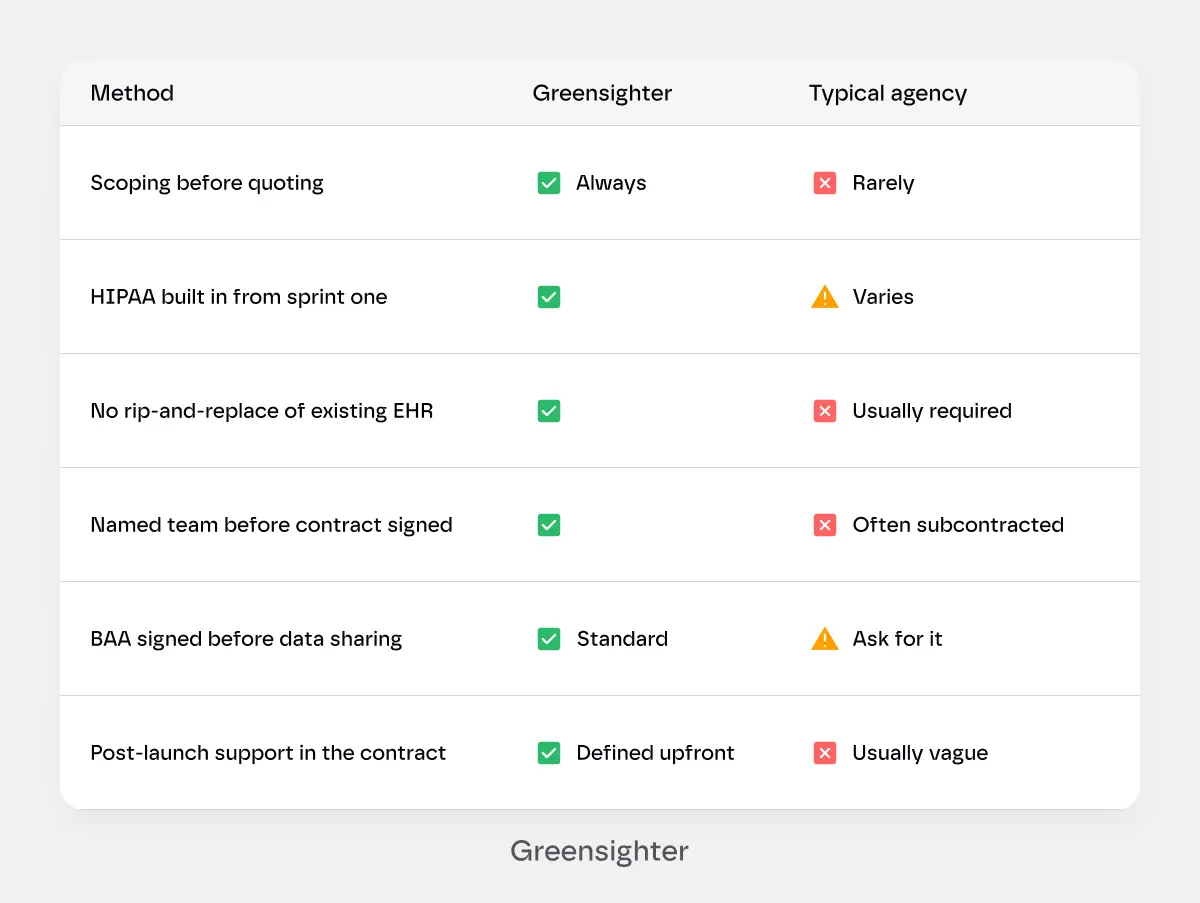
Here's the comparison table for you to take a quick glance:

1. Greensighter
Specialty: Custom healthcare software, EHR integration, AI-powered workflow automation
Greensighter builds custom healthcare software for clinics, digital health companies, and healthcare operators who need software that works inside real clinical environments, not around them.
What Greensighter is known for:
Custom EHR integration with Epic, Cerner, and Meditech using FHIR R4 and HL7 standards. Patient intake and scheduling automation, the kind of broken handoff that quietly costs clinics patients every week. AI agent integration into healthcare workflows, including HIPAA-compliant PHI handling, audit trails, and human checkpoints before anything touches a clinical record.
No rip-and-replace. Greensighter builds around your existing EHR. Your data stays. Your system stays. Only the constraints disappear.
Compliance: HIPAA, SOC 2, GDPR. BAAs signed as standard before any clinical data comes into scope.
Best for: Clinics, health tech companies, and digital health startups that need custom software built around a specific clinical workflow. Also, the right call for teams deciding between building custom and extending an existing system, Greensighter's healthcare software cost guide is the most direct resource for that decision.
See How Greensighter Scopes a Healthcare Project.
2. ScienceSoft
Specialty: Enterprise EHR modernisation, large-scale healthcare IT
Over 30 years in software engineering, 17 of them specifically in healthcare. ScienceSoft has one of the most documented portfolios in the industry, an oncology treatment platform handling 1,000+ therapy orders monthly, a pharmaceutical analytics suite processing over 500 million patient records.
Strengths: Legacy system modernisation. Enterprise-scale integration. Long-term engagement stability.
Compliance: HIPAA, ISO 13485, ISO 27001.
Best for: Large hospital systems and enterprise healthcare organizations with complex legacy infrastructure that needs modernisation without disrupting live operations.
3. Glorium Technologies
Specialty: Full-cycle digital health development, medical device software
Founded in 2010, 150+ digital health products delivered. Glorium holds ISO 13485 for medical device software quality management, one of the few firms where that certification reflects a genuine delivered standard, not a sales claim. Their portfolio covers EMR/EHR platforms, telemedicine, remote patient monitoring, and AI diagnostics.
Strengths: Medical device-grade compliance. Strong IoMT integration. Rigorous QA processes.
Compliance: ISO 13485, ISO 27001, HIPAA, HITRUST, GDPR.
Best for: MedTech companies building regulated products that sit at the boundary between software and medical device.
4. Topflight Apps
Specialty: AI-powered healthcare apps, FHIR/HL7 integrations
Topflight built Roundr, a mobile companion for hospital rounds giving hospitalists secure access to inpatient data and imaging via Epic FHIR/HL7 integrations. They've been early on AI features in clinical apps, with architectures that keep PHI isolated from third-party services.
Strengths: SOC 2 Type II certified. Deep FHIR/HL7 middleware experience. Strong on AI layers built over clinical data.
Compliance: SOC 2 Type II, HIPAA.
Best for: Digital health startups and mid-sized providers building AI-augmented clinical tools where PHI safety is non-negotiable.
5. iTransition
Specialty: Enterprise healthcare software, multi-system EHR modernisation
Founded in 1998. iTransition has worked with healthcare providers and health tech organizations on large-scale EHR platforms, data migration, and legacy modernisation. Strong project management track record on long, complex engagements.
Strengths: Multi-system integration. Legacy modernisation depth. ISO 27001 and ISO 9001 certified.
Compliance: HIPAA, ISO 27001, ISO 9001.
Best for: Enterprise healthcare organizations with technically demanding, multi-system integration projects and structured procurement processes.
6. Arkenea
Specialty: 100% healthcare-only development
No other verticals. Patient scheduling systems, telemedicine platforms, EHR integrations, AI-driven analytics. Arkenea's entire practice is healthcare, which means no generalist gaps on compliance or clinical workflow understanding.
Strengths: Healthcare-only focus. Consistent mid-market delivery track record. Strong patient-facing product design.
Compliance: HIPAA.
Best for: Mid-market healthcare providers and digital health companies that want a partner whose entire firm is built around clinical software, not a healthcare team inside a generalist agency.
7. OSP Labs
Specialty: Healthcare data exchange, workflow modernisation
OSP Labs focuses on connecting disparate clinical systems and making health data flow cleanly between them. Most of their work is integration-layer, getting existing systems to communicate rather than building new platforms from scratch.
Strengths: FHIR integration experience. Healthcare data interoperability. Strong on backend data plumbing.
Compliance: HIPAA.
Best for: Healthcare organizations whose primary challenge is getting existing systems to talk to each other, not building new software.
8. KMS Healthcare
Specialty: Compliance-first healthcare software development
KMS Healthcare runs integration-level compliance reviews as part of the build process. They catch PHI handling gaps during code review, not during a federal audit. That's a different posture from most firms on this list.
Strengths: Compliance embedded in the engineering process. Strong QA. Finds integration-level HIPAA issues generalist firms miss.
Compliance: HIPAA, SOC 2.
Best for: Healthcare organizations that have been burned by compliance issues before, or that are building in a regulatory environment where a post-launch audit finding would be genuinely damaging.
9. Thinkitive Technologies
Specialty: Specialty-specific EHR and EMR development
Founded in 2015. Thinkitive builds clinical workflow software for specific practice types, not one-size-fits-all platforms. Strong on interoperability and patient engagement tools for practices with non-standard workflows.
Strengths: Specialty-specific depth. Custom clinical workflows. SOC 2 and ISO 9001 certified.
Compliance: HIPAA, SOC 2, ISO 9001:2015.
Best for: Specialty practices and digital health companies whose workflows don't map cleanly onto generic EHR platforms.
How to Read This List
Every company above has a HIPAA checkbox and a portfolio page.
The real differentiators come down to four things.

Where is healthcare in their business?
Is it the whole firm or one team inside a generalist agency? Depth looks different depending on the answer.

Have they integrated with your specific EHR?
Epic integration is not the same as Cerner integration. Ask for named examples, not "we can integrate with any EHR." That phrase is a red flag, not a credential.
What happens six months after launch?
Compliance requirements change. Integrations break when connected systems update. Who owns that work, and what does it cost?
Can they describe a project that went wrong?
Every company on this list has had one. The ones who can tell you what broke, what they did about it, and what they changed are the ones with real experience. Vague answers mean thin portfolios.
The right partner depends on what you're building, your compliance environment, and whether you need a custom build or closer to configuration work on an existing platform.
If you're not sure which of these fits your situation, that's a conversation worth having before you shortlist anyone.

Tell Us What You're Building. We'll Tell You Who's Right For It.