



With over 85% of US adults owning a smartphone, you just know that every industry needs a mobile app, healthcare included. The go-to mistake for most clinics when it comes to app development is Googling “healthcare mobile app development cost” and getting hit with ranges like $10,000 to $500,000.
That’s not helpful, mostly because no one takes the time to walk them through what actually drives the cost.
So, let’s fix that.
By the end of this guide, you should be able to:
- Understand what a realistic budget looks like
- Break down cost per feature
- Spot when vendors price-gouge or under-deliver
- Decide what you need to build first
What a Healthcare Mobile App Really Costs
We’ll start with a grounded answer.
If you’re a small-to-mid-sized clinic, you’d typically look at a healthcare mobile app development cost of somewhere between $25,000 and $120,000.
That range reflects:
- A functional patient-facing app
- Core engagement features
- Basic HIPAA-compliant architecture
- A mid-market development team (US or Eastern Europe)
Anything below that usually means something critical is missing.
Anything far above that means you’re either:
- Building enterprise-level infrastructure
- Or paying for complexity you don’t need
Why Most Medical App Development Cost Estimates Are Useless
Here’s the issue.
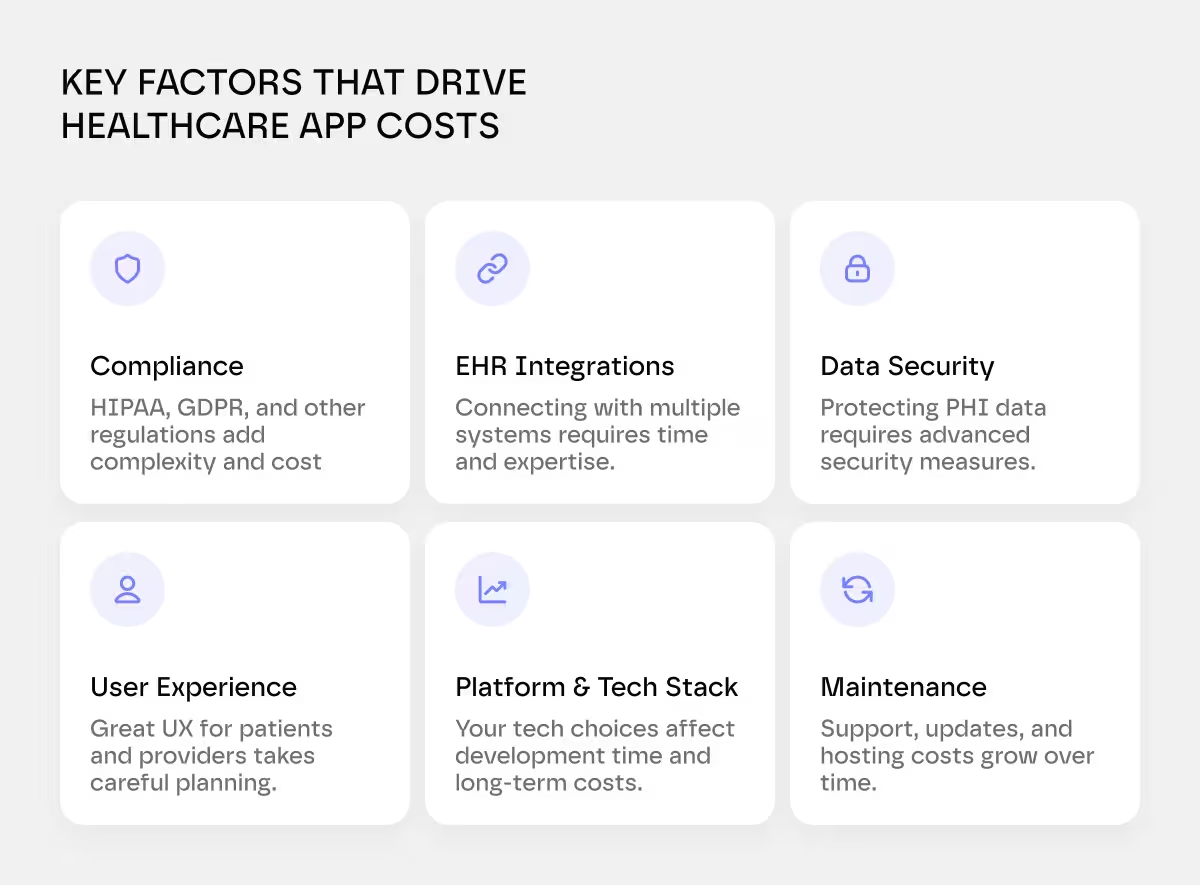
Most articles don’t tell the full story. They treat apps like off-the-shelf, fixed products. This isn’t the case. Your app is a combination of features, and each feature adds:
- Development time
- Integration work
- Compliance requirements
- Testing overhead
This is why you’ll see two clinics building the “same” app and ending up with completely different budgets.
We suggest skipping the guesswork and breaking it down properly.
Feature-Level Costs (Where Your Budget Actually Goes)
This is where things start to fall into place.
Below, you can find a realistic breakdown of what clinics typically pay for individual healthcare app features.
.avif)
Patient Registration and Login
- Basic: $4K-$8K
- Mid-tier: $8K-$14K
- Advanced: $14K-$22K
This seems simple, but complexity grows quickly.
Once you throw in:
- Role-based access (patients, doctors, staff)
- Identity verification
- Secure data handling
…you go beyond just a login system.
Appointment Scheduling
- Basic: $5K-$10K
- Mid-tier: $10K-$18K
- Advanced: $18K-$30K
Scheduling is a feature most people underestimate in healthcare apps.
Real-world requirements include:
- Availability logic across providers
- Rescheduling flows
- Time zone handling
- Calendar integrations
If it looks simple, it rarely is.
In-App Messaging (Chat)
- Basic: $4K-$7K
- Mid-tier: $7K-$12K
- Advanced: $12K-$20K
Don’t think of messaging as a casual chat.
It needs:
- Secure transmission
- Data encryption
- Audit trails
That’s what drives the medical app development cost up.
Video Telemedicine
- Basic: $8K-$15K
- Mid-tier: $15K-$25K
- Advanced: $25K-$45K
Telemedicine is one of the biggest cost drivers, owing to its reliability and security. We came across a 2021 analysis that showed an almost 40% spike in telehealth use.
According to the U.S. Department of Health and Human Services, telehealth systems must ensure secure handling of protected health information (PHI).
That requirement impacts:
- Infrastructure
- Encryption
- Session handling
EHR / EMR Integration
- Basic: $10K-$18K
- Mid-tier: $18K-$30K
- Advanced: $30K-$55K
This is where projects get complex fast.
You’re dealing with:
- Legacy systems
- Inconsistent APIs
- Data synchronization
Do this poorly, and your operation will break.
HIPAA Compliance Layer
- Basic: $6K-$10K
- Mid-tier: $10K-$16K
- Advanced: $16K-$28K
Don’t think of HIPAA as a feature you “add.” It’s something that reshapes the entire build.
Under the Health Insurance Portability and Accountability Act, any system handling patient data must meet strict security standards.
This affects:
- Backend architecture
- Data storage
- Access control
- Logging
Push Notifications
- Basic: $2K-$4K
- Mid-tier: $4K-$7K
- Advanced: $7K-$12K
This is one of the highest ROI healthcare app features you can build.
It directly supports:
- Appointment reminders
- Patient engagement
- Retention
Analytics Dashboard
- Basic: $4K-$8K
- Mid-tier: $8K-$14K
- Advanced: $14K-$22K
At this point, your app becomes a business tool.
You can track:
- Booking behavior
- Drop-off points
- Engagement trends
Without this, you’re plucking numbers out of thin air.
What Clinics Actually Need (And What They Don’t)
Here’s where most projects go wrong.
Clinics try to cover too much ground at once, and budgets spiral out of control.
If you don’t want this to happen, you need to think in phases. A good rule of thumb is to remember that more features don’t necessarily solve more problems.
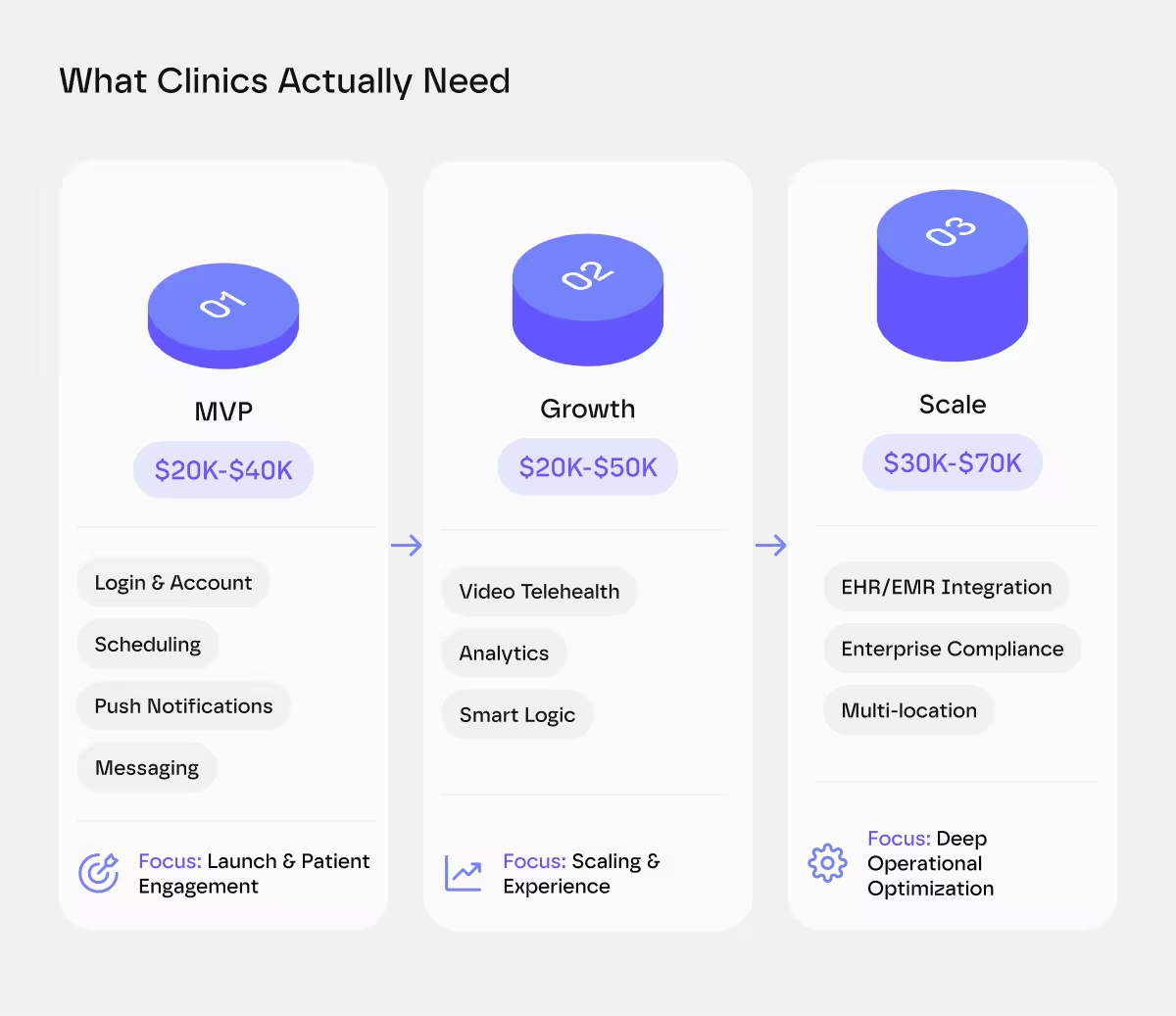
Phase 1: MVP (What You Actually Need to Launch)
Start with:
- Patient registration
- Appointment scheduling
- Push notifications
- Basic messaging
Estimated cost: $20K-$40K
This solves the core problem: getting patients to book and show up.
Phase 2: Growth Features
Once the basics work, expand with:
- Telemedicine
- Analytics
- Improved scheduling logic
Additional cost: $20K-$50K
This improves: efficiency and patient experience.
Phase 3: Advanced / Scale
Only after that, consider:
- EHR / EMR integration
- Advanced compliance layers
- Multi-location support
Additional cost: $30K-$70K+
This supports operational scaling.
How to Tell If You’re Being Overcharged
This is a big one. If you don’t know what “normal” looks like, vendors will start acting in bad faith.
Here are the tell-tale signs:
You’re likely paying above the market if:
- You get one flat price with no feature breakdown
- Everything is labeled “custom”
- The vendor avoids technical explanations
- There’s no discussion of trade-offs
You’re likely underpaying if:
- Compliance isn’t mentioned
- Integrations are ignored
- Timelines are unrealistically short
- The scope feels vague
What Actually Drives Cost (Behind the Scenes)
If you understand this, everything becomes clearer.
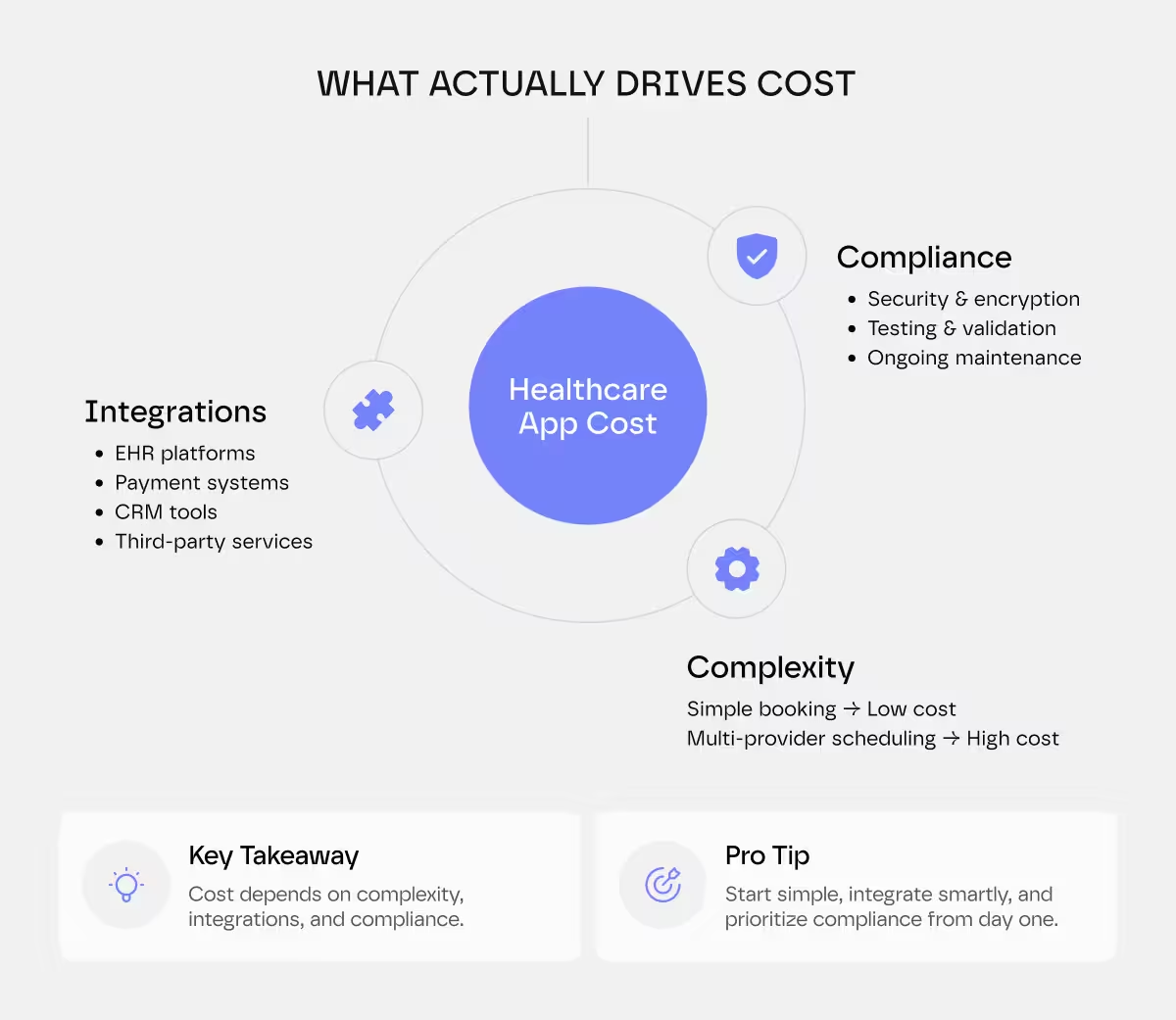
Your medical app development cost is driven by three things:
1. Complexity
The more logic your feature needs, the higher the cost.
Example:
- Simple booking → low cost
- Multi-provider scheduling → high cost
2. Integrations
Every external system adds friction.
Examples:
- Payment systems
- EHR platforms
- CRM tools
3. Compliance
Healthcare apps are not your everyday cookie-cutter apps.
Security, privacy, and regulation add:
- Development overhead
- Testing requirements
- Ongoing maintenance costs
Technology Stack Also Changes the Cost
The technology stack behind your app can really move the needle when it comes to budget and timeline.
You have two options to weigh here:
- Separate native apps for iOS or Android
- One cross-platform app using frameworks like React Native or Flutter
By cross-platform development, we’re referring to writing a single shared codebase that works across both platforms.
This will help you cut down on:
- Upfront cost
- Development time
- QA effort
- Maintenance cost
So, Why Doesn’t Everyone Go Cross-Platform?
Good question. Because there are trade-offs.
Cross-platform frameworks are great for speed and cost efficiency, but they’re not perfect for every healthcare product.
You might get boxed in by:
- Complex animations
- Device-specific functionalities
- Workflows that are performance-heavy
- Certain accessibility or hardware integrations
Native development also gives teams more direct control over platform-specific behavior.
That’s why you’ll see many clinics starting with cross-platform for MVP speed, then moving toward more native infrastructure later as the product grows.
A Smarter Way to Budget Your App
Forget fixed pricing models. The smartest approach is phased investment.
Start with:
- A clearly defined problem
- A minimal feature set
- A realistic MVP budget
Then expand based on real usage.
This approach:
- Reduces risk
- Prevents overbuilding
- Keeps costs under control
Before expanding your app, we recommend figuring out where users are actually dropping off. A simple UX audit will go a long way.
Final Takeaway
Healthcare mobile app development cost is more about decisions than the app itself.
- What you choose to build
- When you build it
- How complex it is
- How compliant it needs to be
Most clinics misallocate their budget because they build things too early.
If You’re Planning a Healthcare App
You don’t need a massive system from day one.
You need:
- A clear problem to solve
- The right feature set
- A realistic understanding of cost
And most importantly, you need a team that can explain the trade-offs instead of hiding them.
If you’re at the stage where you’re evaluating options or trying to make sense of pricing, it’s worth stepping back and mapping your app properly before committing to development.
And when you’re ready to take the next step, reach out to us and let us walk you the process.