


Can I save $30,000 if the apps look the same?
I've heard that question more times than I can count.
And to be fair, it's a good question.
If two companies promise the same app, the same features, and the same timeline, why wouldn't you choose the cheaper one?
At first, it feels like a smart business decision.
Six months later, the conversation usually changes.
Now it's, "Why does every update take so long?"
Or, "Why do we keep fixing the same bugs?"
The funny thing is, the app often isn't broken.
It just wasn't built to grow.
That's the part spoken less during the sales calls.
You can compare prices. You can compare portfolios. You can compare timelines.
You can't compare the quality of the decisions hiding underneath the code.
Not unless you know what to look for.
Cheap bids skip the architecture and design work that keeps a product easy to change later. Skip that once, and you pay for it on every update after.
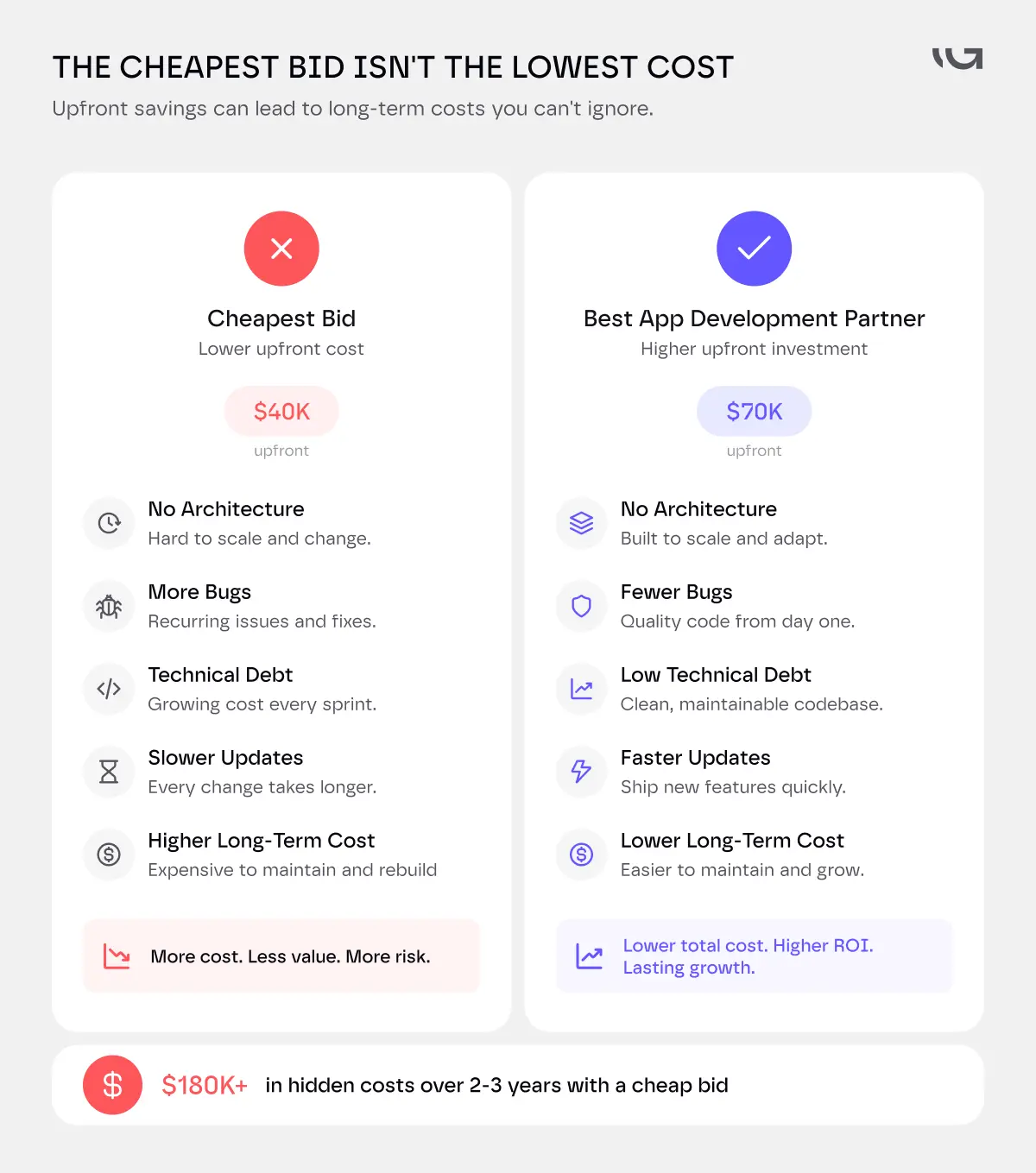
That's what this article is about. Not how to find the cheapest app development company. How to find the one you'll still be happy with two years after launch.
The ROI of Human-Centric Design in App Development
.webp)
Ask most founders what "design" means and you'll get the same answer.
Colors. Fonts. Rounded buttons.
That's aesthetic design. It matters. But it's not the whole story.
Functional design is the part nobody brings up on a sales call. It's how someone actually moves through your product. Can they find what they need in two taps, or does it take ten?
Aesthetic design makes a product look nice. Functional design makes it work.
Skip it, and you don't save money. You defer it.
Poor UX loses users.
Rushed code becomes technical debt.
Features ship slower.
That gap gets expensive fast on complex platforms like LMS tools. Bury one action under five menus, and a learner shouldn't need a tutorial to submit an assignment. Every extra click is a chance to give up. And leave.
Now the great news.
Baymard Institute found large sites can lift conversion by 35% through better design alone. Multiply that across the US and EU, and it's roughly $260 billion left on the table every year.
So when you're picking an app development company, don't lead with "what will you build." Lead with "what will you design."
Because code without design is just building fast toward the wrong thing.
Evaluating Top Mobile App Development Companies in the USA
Searching for "top mobile app development companies in USA" gets you the same ten names on every list. That's not research. That's repetition.
A better approach starts with fit, not fame.
Proximity still matters. A US-based team means overlapping work hours. It means fewer delays over a simple Slack question. It also means shared context. Your developer understands your market without a translation gap.
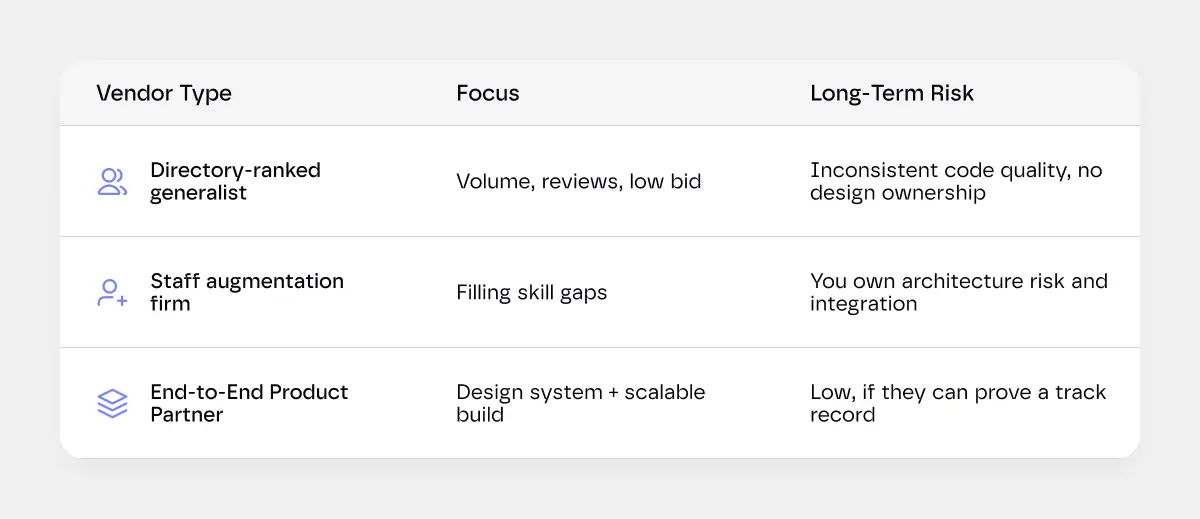
But location alone doesn't tell you how a company works. The real question is structure: are you hiring staff augmentation, or an end-to-end product partner?
Staff augmentation adds bodies to your existing team. You still own the architecture, the roadmap, and every hard decision. That works fine for short, well-defined tasks. It falls apart for a full product build.
An end-to-end partner owns outcomes. They bring design and development together under one roof, with one team accountable for both.
Here's how the two compare:
Look for a partner with a defined design system integration timeline, ideally around 8 weeks. Before it took 12 weeks to establish the first version of your coded design system.
But now AI generates tokens, component boilerplate, and docs directly from Figma into your codebase in parallel with design. That means design and code stop drifting apart from day one. What your team approves is already what ships.
The Hidden Cost of Technical Debt and Poor Code Quality
Technical debt sounds like a developer problem. It's actually a budget problem, and it's yours.
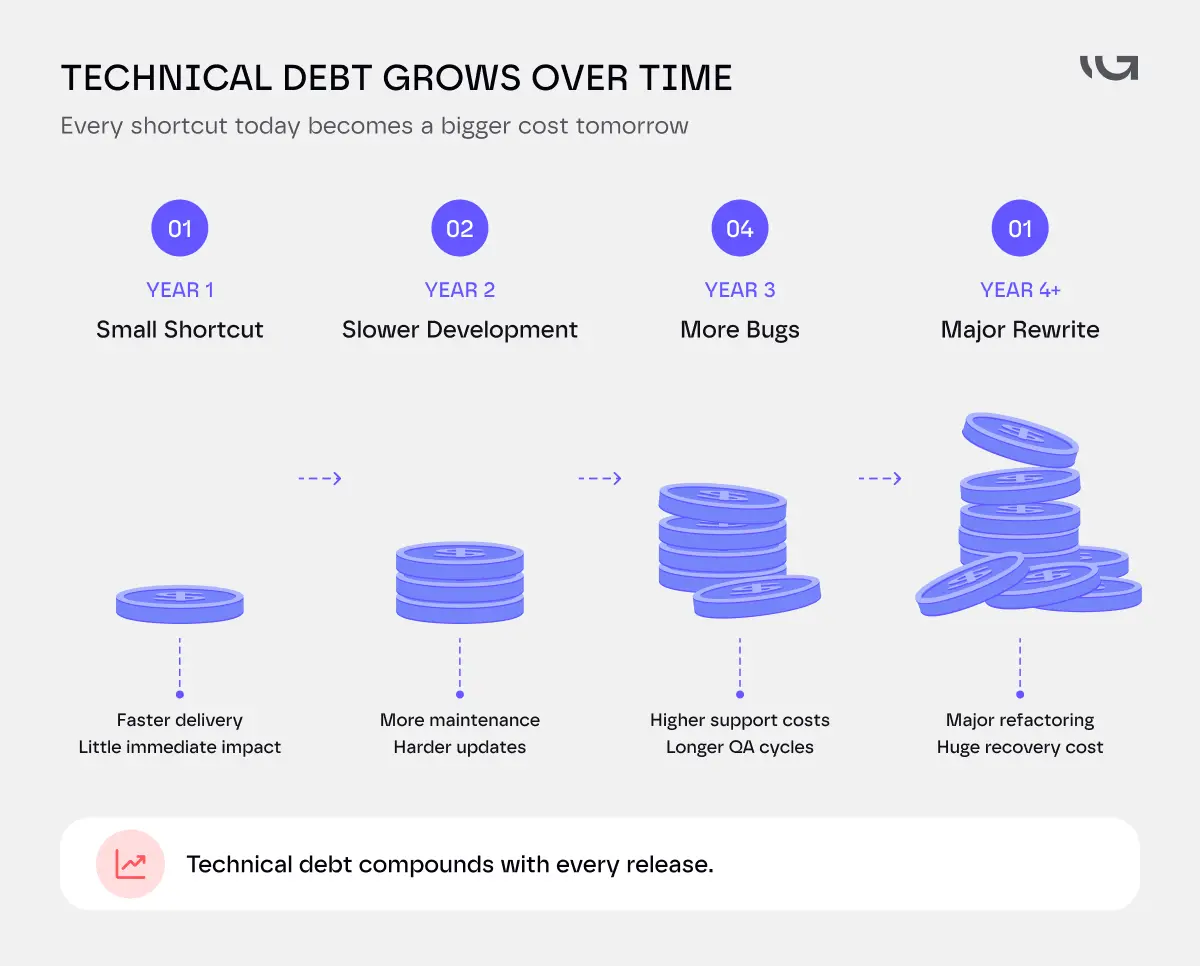
Think of it like a loan. You borrow time now by cutting corners on code. You pay it back later, with interest, in the form of slower features and more bugs. The difference is you don't get to choose the interest rate. Your dev team does, based on how they built things in year one.
Southwest Airlines found that out the hard way.
Its crew-scheduling software ran fine for years, right up until a 2022 winter storm exposed how outdated it was. Crews couldn't be reassigned fast enough, and the airline canceled nearly 17,000 flights over the holidays. The bill: roughly $800 million in losses, plus a $140 million federal penalty. The debt had been quietly piling up for years, waiting for one event it couldn't handle.
In fact...
- 62% of developers name technical debt their single biggest frustration at work, more than any other complaint. (Stack Overflow Developer Survey, 2024)
- Half of all developers now lose 10 or more hours a week to inefficiencies baked into how their team builds software. (Atlassian, State of Developer Experience, 2025)
- That time doesn't disappear. It gets billed to you, one sprint at a time.
- The longer bad code sits untouched, the more expensive it gets to fix. Small shortcuts compound into major rewrites.
A unified design system acts as a single source of truth. One set of components. One set of rules. Every screen and every developer pulls from the same playbook, instead of improvising a new one each sprint.
That consistency is the difference between a codebase that scales and one that collapses under its own patches.
How Unified Design Systems Accelerate Your Time-to-Market
Most app dev projects don't stall in the coding phase. They stall in the handoff.
A designer finishes a screen in Figma. Then it crosses a gap to the developer. Specs get lost. Spacing gets guessed. Colors get slightly wrong. Someone has to catch the mismatch, flag it, and wait for a fix. That back-and-forth eats weeks.
A design system closes that gap. Designers and developers pull from the same components, the same tokens, the same rules. Nobody has to guess.
Investing in design system will save huge design and development resources in the long run.
A 2025 Forrester study found teams using a connected design system saw 20 to 30% higher developer output, saving each developer more than 90 minutes a week. The return on investment reached 351% within three years. (Forrester, The Total Economic Impact of Figma Dev Mode, 2025)
A reusable component library pays off in three ways:
- Faster builds. New features assemble from existing parts instead of custom code every time.
- Fewer bugs. Tested components behave the same way everywhere they're used.
- Easier scaling. Adding a new screen doesn't mean starting from zero.
This is the difference between a sketch that stays a sketch and one that ships on schedule.
The Bottom Line: Choosing Your App Development Partner
By now the pattern should be clear. The cheapest bid and the flashiest portfolio rarely predict what happens to your product a year from launch. What predicts that is design discipline and code you can actually build on.
Here's what to look for before you sign a contract:
- Prioritize partners who offer end-to-end product creation, not just coding hours. Design and development should live under one roof, with one team accountable for both.
- Ask about their design system integration timeline. A defined process, ideally around 8 weeks, signals a partner who's done this before.
- Check for a track record of revenue results, not just launched apps. A finished product means nothing if it doesn't move the business forward.
- Ask how they manage technical debt before you sign, not after you're stuck with it. Their answer tells you how the next two years will go.
The best app development companies don't just build what you ask for. They build what your users need and what your business can scale into.
That's not a coding decision. It's a business one.
Next Steps for Founders and Product Teams
You don't need to overhaul your product tomorrow. You need to know where it stands today.
Start with an honest audit. Where does your current app slow down? Where do developers dread making changes? Those pain points are your technical debt, and they're the first thing a strong partner will ask about.
If you're running an established platform, like an LMS, the calculus changes slightly. You're not starting from zero. You're integrating a design system into something already live, with real users depending on it.
That's harder, and it's exactly why the 8-week integration window matters. Rushing it creates the same debt you're trying to fix.
Boutique agencies often deliver better ROI here than massive offshore firms. Smaller teams mean fewer handoffs, more accountability, and developers who actually remember your product between sprints.
Greensighter has completed over 250 projects, generating more than $40M in revenue for clients, by treating design and development as one job, not two.
Contact us to learn more.