



Accepting an online payment run like clockwork.
A customer enters their payment details, clicks a button, and…done!
At least, that’s what they see.
Behind the scenes, it’s a different story.
That simple interaction is a complex process.
It involves payment gateways, processors, issuing banks, fraud checks, encryption, and transaction validation.
Any snags in this process can end up in abandoned purchases, declined payments, frustrated customers, or lost revenue.
Make no mistake: payment gateway integration isn’t your typical walk in the park.
You need to plan it out carefully.
It needs strong security practices, and an architecture that can support reliable payment processing as your application grows.
In this guide, we’ll cover:
- How online payment integration works
- How to choose the right provider
- What to consider when implementing a payment gateway API
- The best practices that streamline payment processing in custom applications

What Is Payment Gateway Integration?
Let’s start off with the basics:
Payment gateway integration is the process of connecting an app to a payment service.
It securely authorizes and processes electronic transactions.
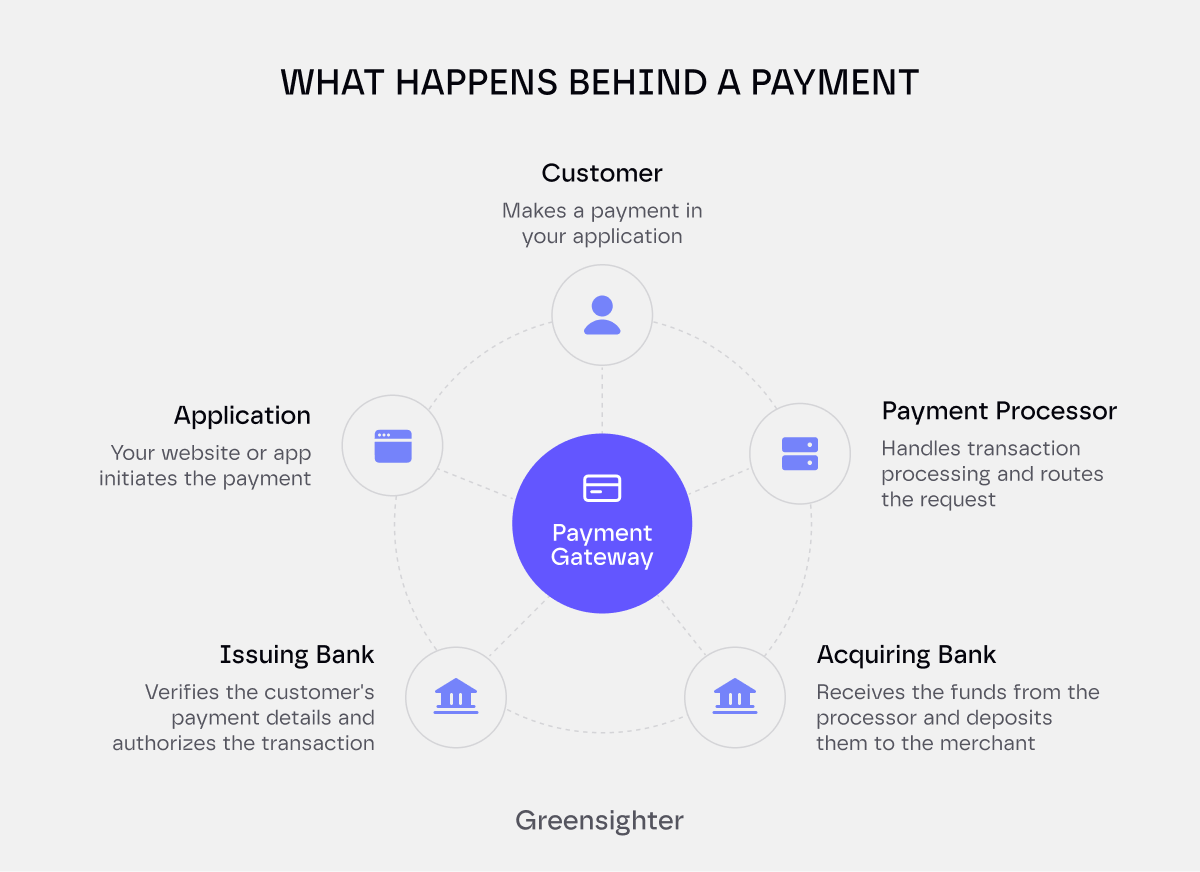
When a customer makes a payment, the gateway acts as a secure intermediary.
Think of it as a bridge between the application, the payment processor, the issuing bank, and the acquiring bank.
The process happens within seconds.
That being said, several systems work in unison backstage to verify payment details, authorize the transaction, and return the result.
A modern payment gateway typically supports:
- Credit and debit cards
- Digital wallets
- Bank transfers
- Recurring payments
- Subscription billing
- Alternative payment methods
If you’re a business developing custom software, make sure you choose the right integration approach.
It can significantly influence scalability, customer experience, and long-term maintenance.
How Payment Gateway Integration Works
Every payment follows a series of coordinated steps.
Understanding this process helps development teams design more reliable payment experiences.
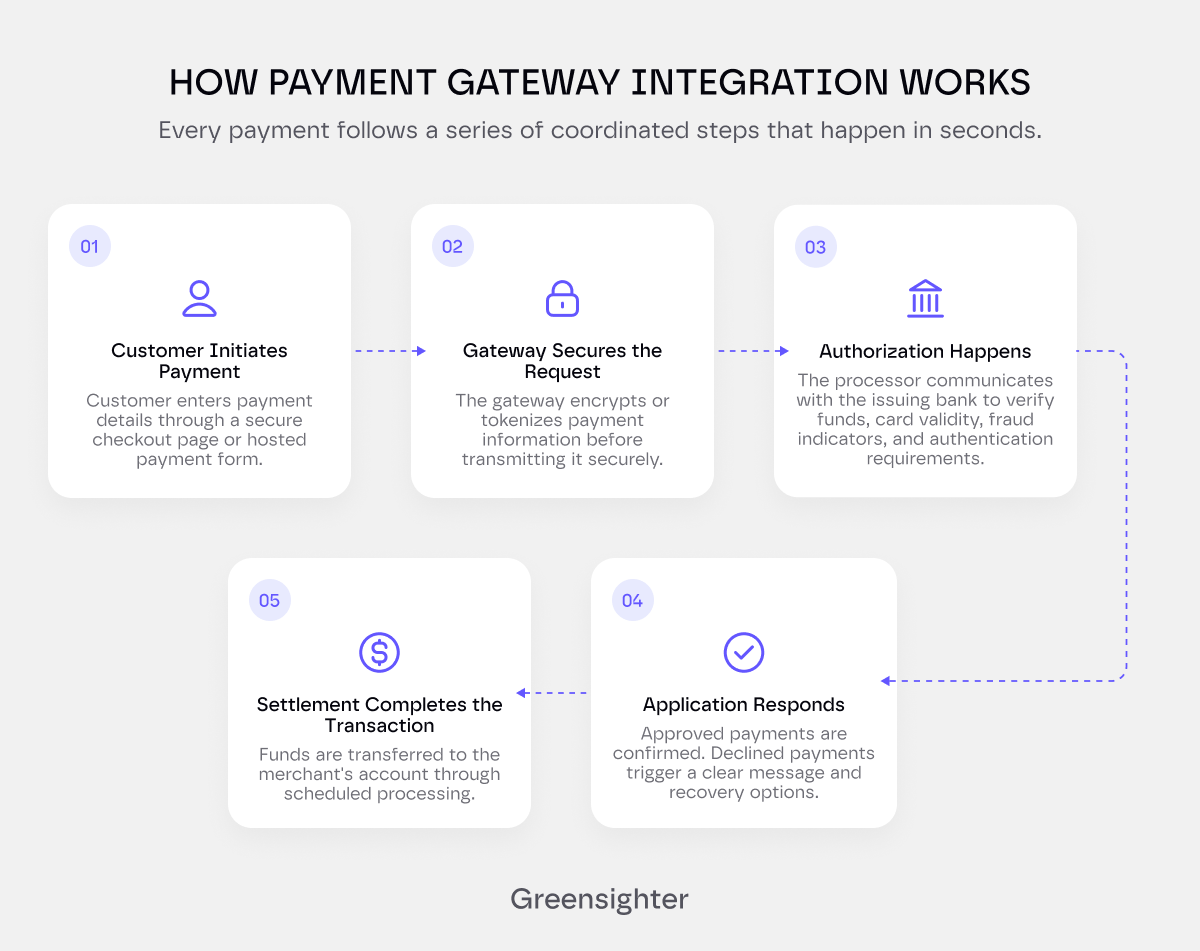
1. The Customer Initiates Payment
The customer enters payment details through a secure checkout page or hosted payment form.
Depending on the provider, sensitive card information may never pass through the application's servers.
2. The Payment Gateway Secures the Request
The gateway encrypts or tokenizes the payment information before transmitting it securely for authorization.
This helps protect sensitive financial data throughout the transaction.
3. Authorization Happens
The payment gateway forwards the request to the payment processor, which communicates with the customer's issuing bank.
The bank verifies:
- Available funds
- Card validity
- Fraud indicators
- Authentication requirements
The authorization response is then returned to the application.
4. The Application Responds
If approved, the application confirms the payment and allows the customer to continue.
If declined, the application should display a clear message while providing appropriate recovery options where possible.
5. Settlement Completes the Transaction
Authorization confirms that funds are available.
Settlement transfers those funds to the merchant's account.
This is typically done through scheduled processing performed by the payment provider.
Once you figure out the complete payment lifecycle, troubleshooting issues will be easier.
So will designing resilient payment workflows.
Choosing the Right Payment Provider
Every payment gateway has different capabilities to offer.
To select the provider that works for you, start with your business requirements.
Don’t focus just on pricing.
When evaluating providers, consider factors such as:
- Supported countries and currencies
- Available payment methods
- Recurring billing capabilities
- Subscription management
- API quality and documentation
- SDK availability
- Webhook support
- Reporting features
- Transaction fees
- Uptime history
- Technical support
If you operate on an international scale, consider local payment preferences, regulatory requirements, and regional compliance obligations.
Security Best Practices for Payment Gateway Integration
Security should be part of the integration strategy from the get-go.
Think about it:
What does handling payment information mean?
Protecting sensitive customer data while complying with industry standards.
And those standards are designed to reduce fraud and data breaches.
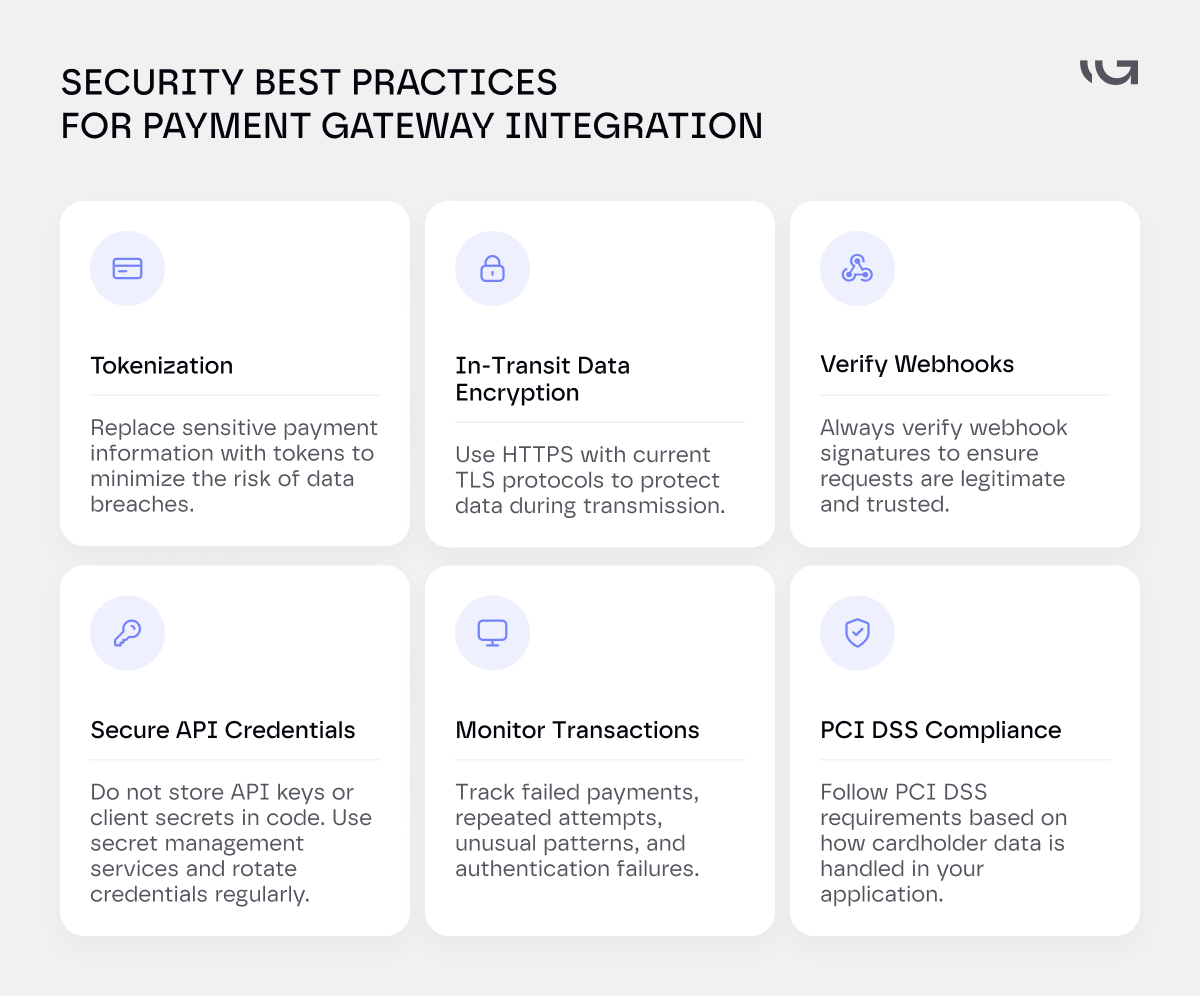
Here are some of the most important security practices:
Using Tokenization Whenever Possible
Tokenization replaces sensitive payment information with unique tokens that have no value outside the payment system.
This reduces the amount of cardholder data your application processes and stores.
In-Transit Data Encryption
All payment traffic should be protected using HTTPS with current TLS protocols.
Encryption prevents attackers from intercepting payment information during transmission.
Never Store Card Data Unnecessarily
Whenever possible, allow the payment provider to handle card storage.
Using hosted payment pages or secure payment fields can reduce compliance requirements while improving security.
Verify Webhooks
Payment gateways often rely on webhooks to notify applications about successful payments, refunds, disputes, or subscription events.
Applications should always verify webhook signatures before processing incoming requests.
This will prevent unauthorized actions.
Secure API Credentials
API keys, client secrets, and authentication credentials should never be stored directly in application code.
Instead, use secure secret management services and rotate credentials regularly.
Monitor Transactions
Continuous monitoring helps identify unusual activity before it becomes a larger security issue.
You should track failed payments, repeated transaction attempts, unusual purchasing patterns, and authentication failures.
PCI DSS Compliance
If your application accepts card payments, include PCI DSS in the conversation from the beginning.
Short for Payment Card Industry Data Security Standard, PCI DSS establishes security requirements for organizations that store, process, or transmit cardholder data.
The level of compliance required depends on how payments are handled.
For example, apps that redirect users to a hosted payment page generally have fewer compliance responsibilities.
Even when a payment provider manages most of the sensitive data, development teams still need to:
- Secure their own infrastructure
- Authenticate users
- Manage access controls
- Maintain secure development practices
Planning for PCI DSS early helps reduce compliance challenges later in the project.
Common Sticking Points in Payment Gateway Integration
Connecting a payment gateway is usually straightforward.
Building a reliable payment system that performs well under real-world conditions?
That’s way more complex.
Development teams commonly hit snags such as:
Handling Failed Payments
Declined transactions happen for many reasons.
This can be anything from insufficient funds, expired cards, fraud prevention rules, or temporary banking issues.
Applications should provide clear feedback while allowing customers to retry when appropriate.
Preventing Duplicate Transactions
Network interruptions or repeated button clicks can accidentally submit the same payment multiple times.
Using idempotency keys helps ensure each payment request is processed only once. You can read more here.
Managing Asynchronous Events
Many payment gateways send updates through webhooks after the initial transaction has completed.
Applications need to handle these events reliably without creating duplicate orders or inconsistent payment records.
Reconciling Transactions
Successful payment processing goes well beyond authorization.
You also need to reconcile payments, refunds, chargebacks, and settlement reports with your financial systems.
Bake reconciliation early, and financial reporting becomes much easier.
Preparing for Production
Sandbox environments are valuable for testing functionality.
But they rarely reflect every real-world scenario.
Teams should test error handling, network interruptions, payment failures, webhook retries, and high transaction volumes before launching to production.
Best Practices That Pay Off Over Time
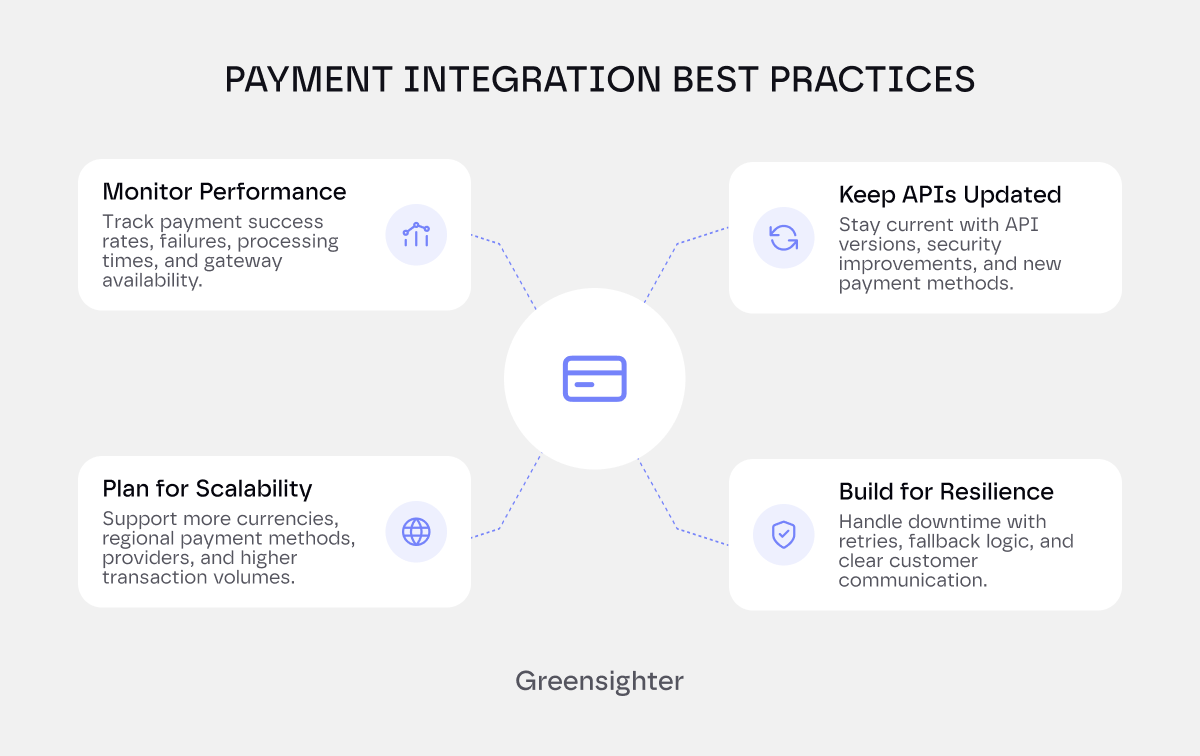
Payment integrations require ongoing maintenance.
Laying the proper groundwork helps keep payment systems reliable as transaction volumes grow.
Monitor Performance
Track payment success rates, authorization failures, processing times, and gateway availability.
Performance metrics often reveal issues before customers begin reporting them.
Keep APIs Updated
Payment providers regularly introduce new API versions, security improvements, and additional payment methods.
Keeping integrations current reduces compatibility issues and improves long-term stability.
Plan for Scalability
As your business grows, payment requirements become harder to untangle
Applications may need to support multiple currencies, regional payment methods, additional providers, or higher transaction volumes.
Designing the payment architecture with growth in mind helps avoid costly rework down the line.
Build for Resilience
External services occasionally experience downtime.
Applications should handle temporary failures gracefully.
They can do this through retry mechanisms, fallback logic where appropriate, and clear customer communication.
Preparing for these scenarios helps protect both revenue and customer trust.
Final Thoughts
A successful payment gateway integration goes far beyond simply connecting an API.
You have to have a careful plan set in place.
This also includes having strong security controls and being compliant with regulations.
You also require an architecture capable of supporting reliable payment processing as your business grows.
Here are a few hints::
- Choose the right provider.
- Use a secure payment gateway API.
- Plan for real-world operational challenges.
Do these, and your payment systems will improve customer experience, reduce risk, and support long-term growth.
FAQ
What is payment gateway integration?
Payment gateway integration is the process of connecting an application to a payment servic.
It authorizes, processes, and manages electronic transactions in a secure way.
How does a payment gateway API work?
A payment gateway API allows applications to securely communicate with payment providers, sending transaction requests, receiving authorization responses, and processing payment-related events such as refunds or recurring billing.
How long does online payment integration take?
The timeline depends on the complexity of the application, the payment provider, compliance requirements, and the number of payment methods being supported.
Basic integrations may take only a few weeks, while enterprise implementations often require considerably more planning and testing.
Does payment gateway integration require PCI DSS compliance?
Yes. Any application that stores, processes, or transmits cardholder data should consider PCI DSS requirements.
The exact level of compliance depends on how payment information is handled during the transaction.
Can one application integrate multiple payment gateways?
Yes. Many businesses integrate multiple payment providers.
They do this to improve regional coverage, support additional payment methods, or provide redundancy if one provider experiences service disruptions.
What happens if a payment fails?
Applications should handle failed payments correctly.
This is done by displaying clear error messages, allowing customers to retry when appropriate, and recording sufficient information for troubleshooting without exposing sensitive payment data.