



Somewhere, an EdTech founder named Priya just got off a call with her third agency this week.
All three said the right things: "pedagogy-first approach," "mobile-optimized," "scalable architecture." All three sent decks with stock photos of children using tablets.
None of them asked about her learner retention problem.
That's the gap. Education app development isn't generic software development with a graduation cap on it.
The agency you hire needs to understand what keeps a learner coming back on day 14, not just what makes the app launch on day one.
Here's how to find the one that does.
Why EdTech Development Is a Different Category
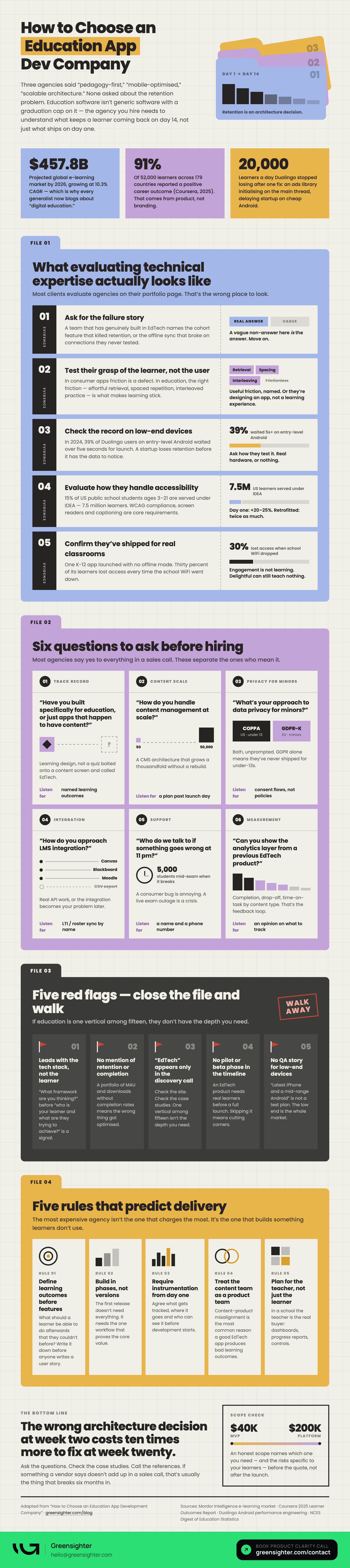
The global e-learning market is projected to reach $457.8 billion by 2026, growing at 10.3% CAGR.
That number has pulled in every generalist agency with a Figma license and a blog post about "digital education."
Most of them have never shipped a product where the measure of success is whether a twelve-year-old
finishes the lesson.
An education mobile app development company that's actually built in this space understands a few things a generalist doesn't:
Engagement isn't the same as learning. An app can be delightful and teach nothing. Good EdTech builds for learning outcomes, not just session time.
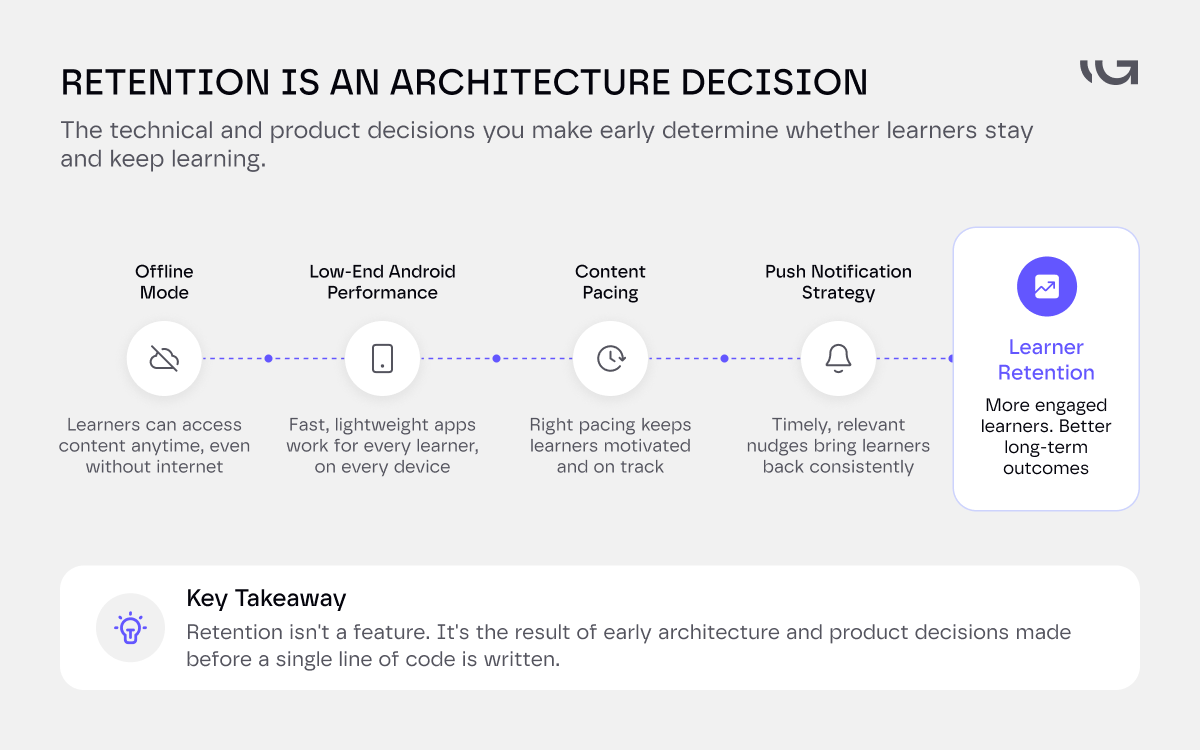
Retention is an architecture decision. Push notification strategy, content pacing, offline mode, low-end device support, these aren't features you add later.
They define whether learners in emerging markets can even open the app.
Coursera's 2025 Learner Outcomes Report surveyed 52,000 learners across 179 countries and found that
91% achieved a positive career outcome.
That kind of result doesn't come from good branding. It comes from a product built around how learning actually works.
Your agency needs to understand that difference before they write a line of code.
What Evaluating Technical Expertise Actually Looks Like
Most clients evaluate agencies on their portfolio pages. That's the wrong place to look.
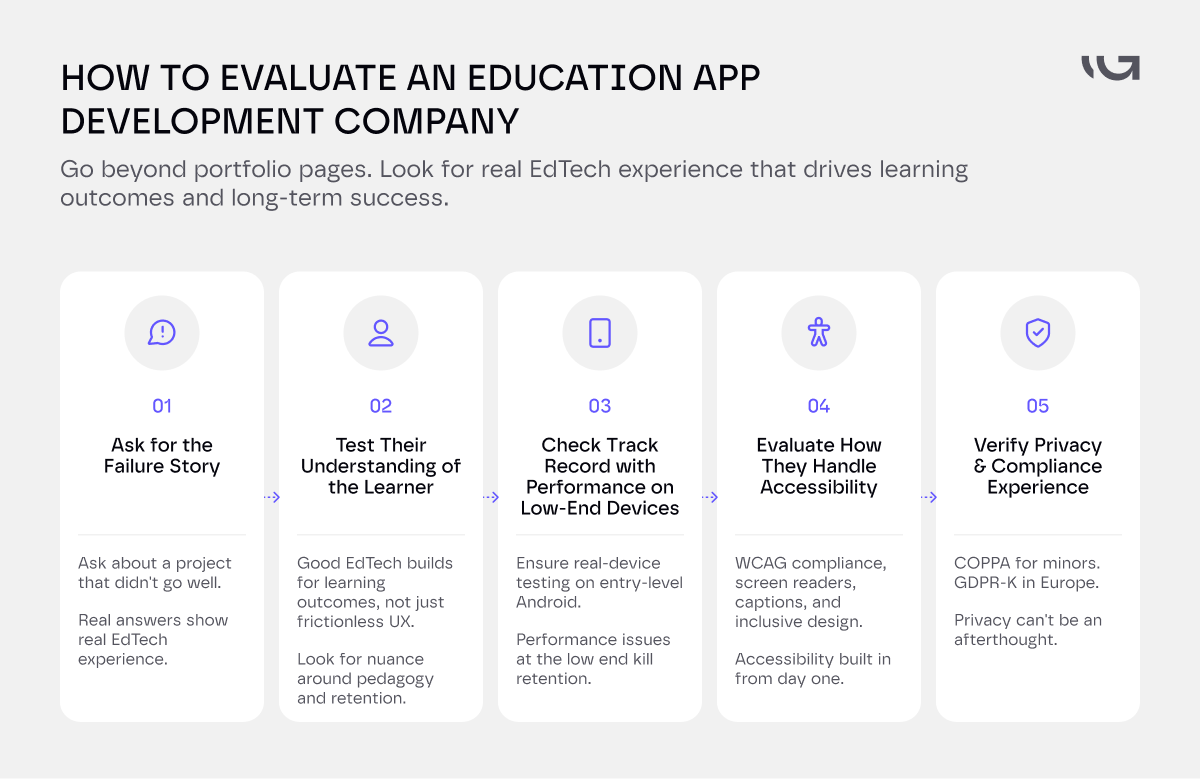
Ask for the failure story
Ask every shortlisted education app development company to describe a project that didn't go well.
A team that's genuinely built in EdTech will have a real answer.
They'll tell you about a cohort-based feature that killed retention instead of improving it, or an offline sync that failed on low-bandwidth connections they hadn't tested for.
A team that's only built generic apps will give you a vague non-answer. Move on.
Test their understanding of the learner, not just the user
There's a difference between UX for a consumer app and UX for an education app.
In a consumer app, friction is bad. In an education app, the right kind of friction, effortful retrieval, spaced repetition, and interleaved practice, is what causes learning to stick.
If your agency talks about "frictionless UX" for every feature without nuance, they're designing an app, not an educational experience.
Check their track record with performance on low-end devices
This is where most education app development services get caught out.
Duolingo's own engineering team documented publicly that in 2024, 39% of their users on entry-level Android devices waited over five seconds for the app to start.
They assembled a dedicated team, found that a single ads library was adding over a second to startup time by initializing on the main thread, and fixed it.
That one fix alone saved 20,000 learners per day from quitting before entering the app.
That's a billion-dollar company catching a performance problem at scale. For a startup, that same problem kills retention before you have the data to notice it.
Ask your shortlisted agency: "How do you test for low-end device performance before launch?"
If the answer doesn't include real-device testing on entry-level Android hardware, you'll find out the hard way.
Evaluate how they handle accessibility
In the US, 15% of public school students ages 3–21 are served under IDEA, that's 7.5 million learners who need accessible design.
Not as a compliance checkbox, but as a core product requirement.
WCAG compliance, screen reader support, captioning for video, and simplified interfaces for different cognitive loads are not optional in EdTech.
Ask the agency how they approach it. Ask to see it in their past work.
If it's an afterthought, it'll cost you twice as much to retrofit later.
Greensighter's own piece on healthcare mobile app development cost covers the same principle: compliance built in from day one adds 20–25% to the build.
Retrofitted after launch, it costs twice as much. The math is identical in EdTech.
We've worked with EdTech clients who came to us after their first agency missed these questions entirely.
One of them launched a K-12 app with no offline mode. Thirty percent of their learners lost access every time the school's WiFi went down.
We'll ask these questions before we quote, not after you've launched.
Let's Talk About Your Learners First.
Questions to Ask Before Hiring
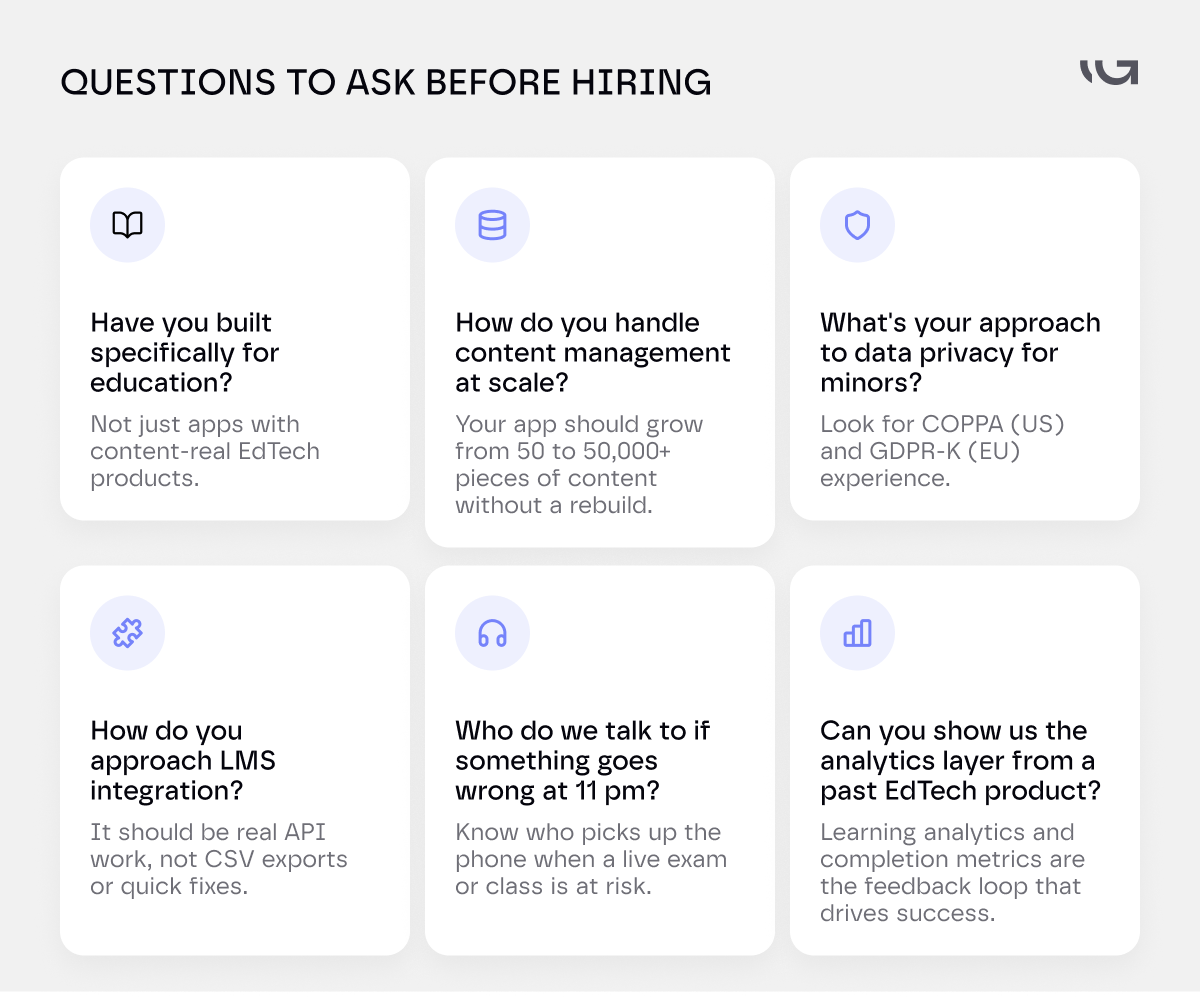
- "Have you built specifically for education, or just apps that happen to have content?"
Phrasing matters. You're looking for an agency that has thought about learning design, not one that added a quiz to a content screen and called it EdTech.
- "How do you handle content management at scale?"
Most EdTech apps start with fifty pieces of content. The good ones grow to fifty thousand.
A well-built CMS architecture handles that growth without a rebuild. An agency that's only thought about launch won't have planned for it.
- "What's your approach to data privacy for minors?"
COPPA in the US, GDPR-K in Europe. Collecting data from learners under 13 carries specific legal requirements that aren't the same as general data privacy.
If the agency starts explaining GDPR without mentioning COPPA, they haven't actually shipped a product for minors before.
- "How do you approach LMS integration?"
If your app needs to connect with a school's existing LMS, whether it's Canvas, Blackboard, or Moodle, that integration needs real API work, not a CSV export.
Our own LMS development cost guide covers what that architecture actually involves, and what it costs when integration is treated as an afterthought.
- "Who do we talk to if something goes wrong at 11 pm?"
Not a dramatic question. A very practical one.
A launch-week bug in a consumer app is annoying.
A launch-week bug in an app 5,000 students use for a live exam is a crisis. Know who picks up the phone before you need them to.
- "Can you show us the analytics layer from a previous EdTech product?"
Learning analytics, completion rates, drop-off points, and time-on-task by content type are the feedback loop that tells you whether the product is working.
An agency that hasn't built this before won't know what to instrument. An agency that has an opinionated view on what to track from day one.
You're not just interviewing an education app development agency. You're auditing whether they understand the product you're actually trying to build.
Most agencies say yes to everything in a sales call. The questions above separate the ones who mean it.
Tell us which of these kept you up at night, and we'll tell you exactly how we've solved it.
See How We've Answered These Questions.
Red Flags to Watch For
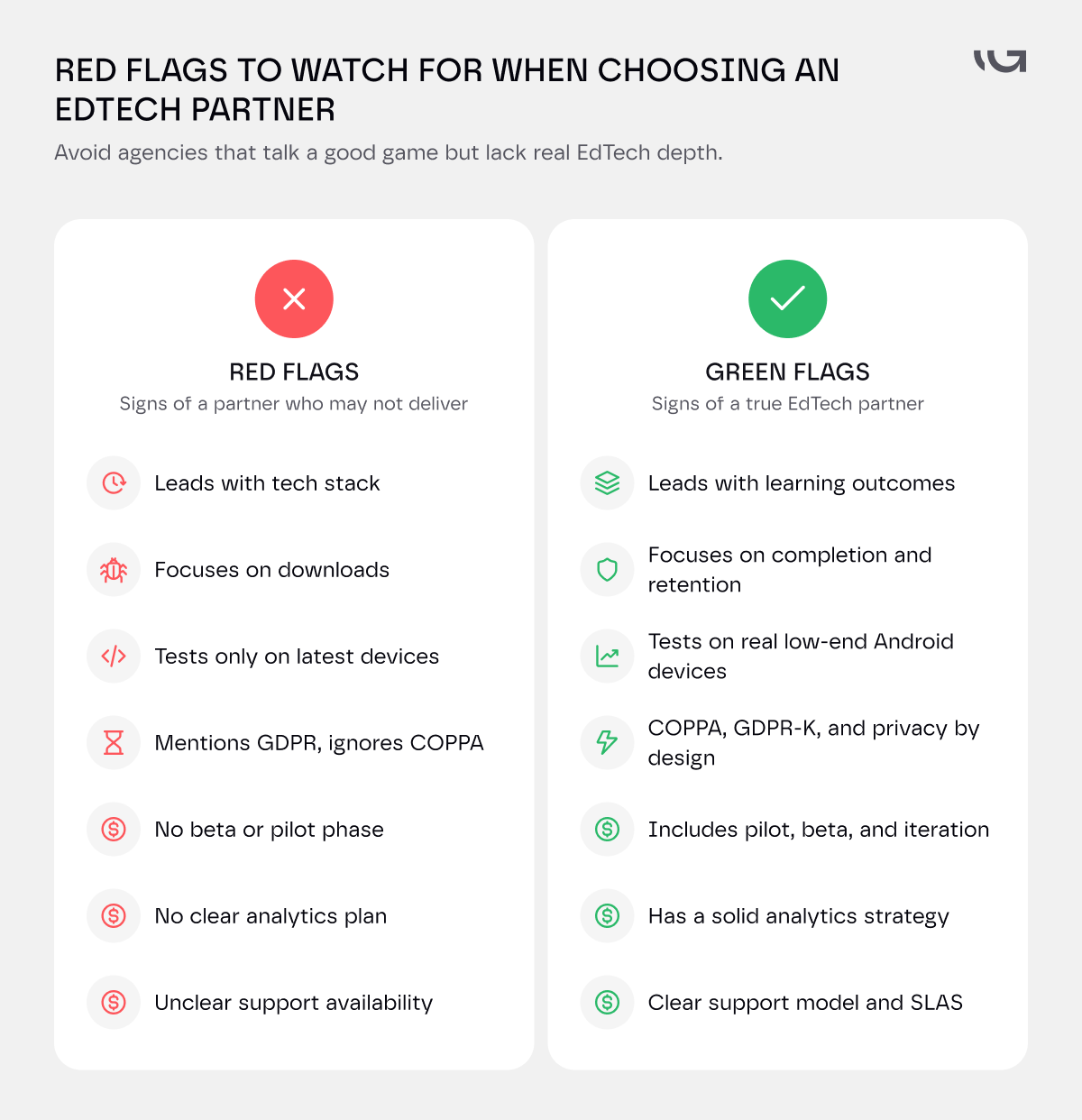
- They lead with the tech stack, not the learner
The best education app development companies lead with understanding.
If the first question is "what framework are you thinking?" rather than "who is your learner and what are they trying to achieve?", that's a signal.
- No mention of retention or completion rates
If an agency's portfolio talks about MAU and downloads without mentioning completion rates or learning outcomes, they've been optimizing for the wrong thing.
- "EdTech" isn't mentioned until the discovery call
Check their website. Check their case studies. If education is one vertical among fifteen, they don't have the depth you need.
- The timeline doesn't include a pilot or beta phase
An EdTech product needs real learners before a full launch.
An agency that doesn't build a testing phase into the timeline either hasn't done this before or is cutting corners to hit a deadline.
- They can't explain their QA process for low-end devices
Performance at the low end isn't an edge case in education. It's the whole market for many EdTech products.
If QA is described as "we test on the latest iPhone and a mid-range Android," walk away.
Ensure Successful Project Delivery
The most expensive education app development agency isn't the one that charges the most.
It's the one that builds something learners don't use.
A few things that actually predict delivery success:
Define learning outcomes before features. What should a learner be able to do after using this product that they couldn't do before? Write that down before your agency writes a single user story.
Build in phases, not versions. The first version doesn't need everything. It needs the one workflow that proves the core value. Our SaaS application development guide covers this discipline in full — it applies just as directly to EdTech.
Require instrumentation from day one. You can't improve what you can't measure. Agree on what gets tracked, where it goes, and who can see it before development starts.
Treat the content team as a product team. The people creating the learning content need to be in product conversations, not handed a CMS on launch day. Misalignment between content and product is the most common reason good EdTech apps have bad learning outcomes.
Plan for the teacher, not just the learner. If your product goes into a school, a teacher is the real buyer. They need dashboards, progress reports, and controls. An agency that's never shipped to a classroom won't have thought about this.
The Bottom Line
The EdTech market is crowded with agencies who've added "education" to their homepage after a single client project.
The ones worth working with have thought about learning science, retention architecture, and low-end device performance.
They've thought about data privacy for minors. And what a teacher actually needs to see in a dashboard.
Ask the questions above. Check the case studies. Call the references.
And if something a vendor says doesn't add up, trust that instinct.
In our experience, the thing that doesn't add up in a sales call is usually the thing that breaks six months later into a project.
We've built for EdTech clients across K-12, higher education, and corporate learning.
We ask hard questions before we quote, because the wrong architecture decision at week two costs ten times more to fix at week twenty.
Tell Us About Your Education App. Greensighter will scope it honestly, flag the risks specific to your learner audience, and tell you whether what you're describing needs a $40,000 MVP or a $200,000 platform. Get a Straight Answer on Scope and Cost.