



A regional hospital network recently wrote off $4 million.
Their Epic integration was supposed to take six months. It took eighteen. The lab system never properly synced. Physicians were manually copying results between screens for over a year.
Nobody planned for legacy data mapping. Nobody budgeted for the compliance remediation that came later. Nobody asked the right questions before the contract was signed.
This is not unusual. Research from KLAS consistently shows only 38% of EHR implementations fully meet expectations. The other 62% go over budget, over time, or both.
The technology is not the problem. The approach is.
This guide covers what EHR integration actually involves, what it costs, and how to do it without the painful surprises.
What EHR Integration Actually Is
EHR integration connects your electronic health record system to the other software your organisation runs.
Labs. Imaging. Billing. Scheduling. Patient portals. RPM platforms. Pharmacy systems. Insurance payers.
Right now, most of these systems hold separate copies of the same patient data.
A lab result lives in the lab system. A prescription lives in the pharmacy system. A billing code lives in the RCM platform. The EHR is supposed to be the single source of truth. Without integration, it is just another silo.
Good EHR software integration makes patient data flow between systems automatically, accurately, and in real time.
A lab result appears in the EHR as soon as it is ready. A medication reconciliation updates across every system the moment it changes. A scheduling change reflects in billing without a phone call.
That is the goal. Getting there requires choosing the right method, the right standards, and the right implementation approach.
Before you do anything else, work through this checklist.
.webp)
Most integrations run into trouble because these questions were never answered upfront.
Answer them before you talk to a vendor, before you choose a method, and before you touch a single system.
- Systems and APIs
☐ Which systems need to connect? List every one, including the ones you are not sure about.
☐ Does each system expose an API? Which version? Is it FHIR R4, HL7 v2, a proprietary API, or none at all?
☐ Do any systems require vendor approval, certification, or a partnership agreement before API access is granted?
☐ Are any systems end-of-life or scheduled for replacement in the next two years?
- Data quality
☐ How clean is the data in each system? Are there duplicate patient records? Missing fields? Inconsistent formats?
☐ Is there a unified patient identifier across your systems, or will you need to build a matching layer?
☐ When did each system last have a data audit?
- Data flows
☐ What data needs to move, and in which direction? Read-only, or does it need to write back?
☐ Does it need to move in real time, or is a scheduled sync acceptable?
☐ What happens to the integration if one system goes down? Does the other need to degrade gracefully?
- Compliance
☐ Which compliance frameworks apply? HIPAA, GDPR, state-level regulations?
☐ Does PHI move during the integration? If so, which vendors need a signed BAA before work begins?
☐ What are your audit logging requirements for data in transit?
- Internal stakeholders
☐ Who owns each system internally? Who needs to approve changes to it?
☐ Who is the clinical lead for this project? Whose workflows will change?
☐ Who will own the integration after it is live- monitoring, maintenance, and responding when something breaks?
If any of these boxes cannot be checked before development starts, that is where your project will stall. Not in the code. In the unanswered questions.
EHR Integration Methods
There is no single way to integrate an EHR. The right method depends on what systems you are connecting, how old they are, and what your data needs to do.
Here is how the main methods compare:
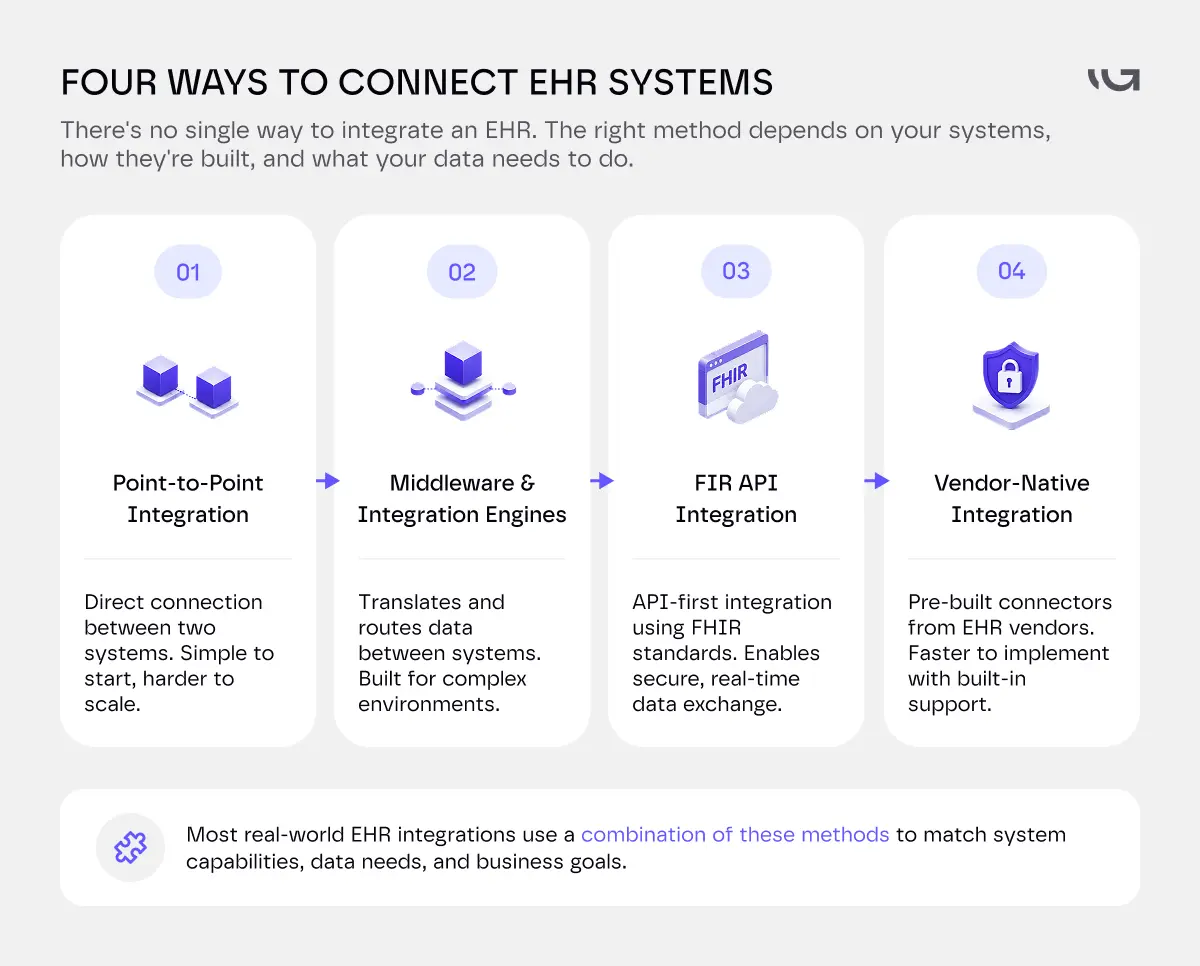
- Point-to-point integration connects two specific systems directly. System A sends data to System B through a custom-built connection. It works fine for one integration. It becomes a maintenance nightmare at five or six.
Every connection is separate. Every update to either system can break the link. Avoid this approach for anything beyond a one-time, narrow use case.
- Middleware and integration engines sit between your systems and handle the translation.
Tools like Mirth Connect, Azure Health Data Services, and Rhapsody receive data from one system, transform it into the format the receiving system expects, and route it to the right destination.
This approach handles volume and complexity well. It also adds a layer of infrastructure you need to maintain and monitor.
- FHIR API integration is the modern standard. FHIR APIs expose data from a system as structured, queryable resources. Other systems can read and write that data directly through an API call.
This is the approach CMS now requires. It is also the cleanest to build and maintain when implemented well.
- Vendor-native integration uses the built-in connectors that major EHR vendors provide. Epic's App Orchard and Cerner's App Market give third-party developers access to certified integration pathways.
This is faster to implement and carries vendor support. The tradeoff is limited flexibility. You can only connect to what the vendor has already certified.
Most real-world EHR integrations use a combination of these. FHIR APIs for modern systems. Middleware for legacy systems. Vendor-native connections where they exist and fit.
Not sure which method fits your systems?
Most integration projects fail not because the method was wrong, but because nobody mapped the actual data flows before choosing one.
Let Us Map Your Integration Architecture.
FHIR and HL7 Standards
You cannot talk about EHR software integration without understanding these two standards. They are the languages healthcare systems use to exchange data.
.webp)
HL7 v2 has been the backbone of healthcare data exchange since the 1980s. It is a pipe-delimited message format. An ADT message tells a system a patient was admitted. An ORU message delivers lab results.
An MDM message shares clinical documents. Most hospital systems built before 2015 run on HL7 v2. It is deeply embedded, widely supported, and notoriously inconsistent. The same message type can be structured differently by different EHR vendors.
Integration work with HL7 v2 usually requires field-by-field mapping between systems.
FHIR R4 is the current international standard for healthcare data exchange. It is RESTful, JSON-based, and built on the same architecture as any modern web API. A patient is a FHIR resource.
A medication is a FHIR resource. An observation, an appointment, a claim- all resources. Any system that can call an API can read and write FHIR data. This is why CMS mandated it.
The 2024 CMS Interoperability and Prior Authorization Final Rule requires Medicare Advantage, Medicaid, CHIP, and ACA Marketplace payers to implement FHIR R4-based APIs, with full compliance required by January 1, 2027.
This is not optional. If you are in a CMS-regulated environment, FHIR integration is now a compliance deadline, not a future consideration.
HL7 v3 and CDA sit between the two. The Clinical Document Architecture is an XML-based format used for things like care summaries, discharge documents, and referral letters.
You will encounter it when connecting to systems that pre-date FHIR adoption but have moved past raw HL7 v2.
In practice, most organisations run on HL7 v2 today and are actively building toward FHIR R4.
If your legacy systems speak HL7 v2 and your new platform expects FHIR, you need a middleware layer to translate between them.
Greensighter's guide on integrating data systems into healthcare workflows covers this translation arHere are both edits, ready to drop in:
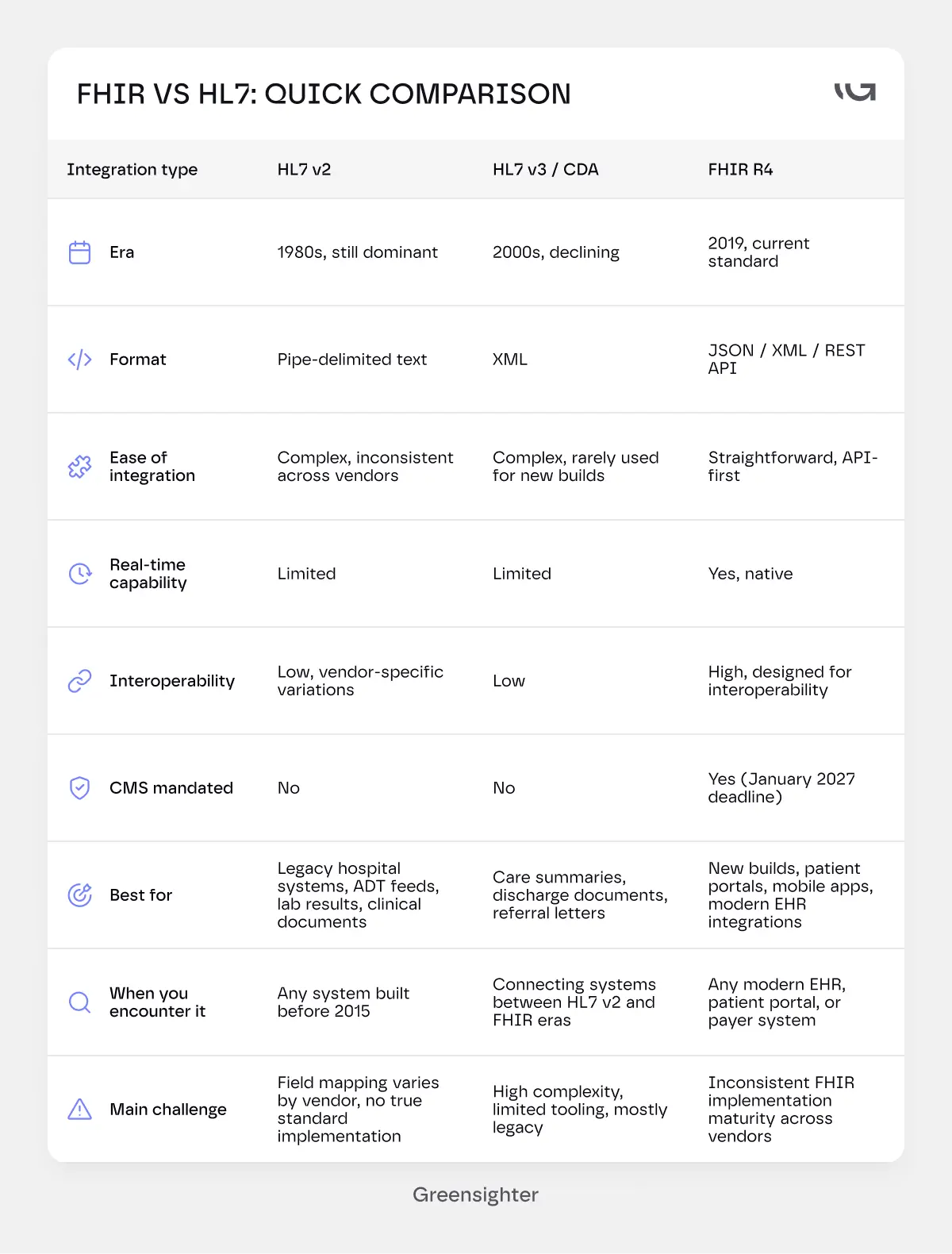
FHIR vs HL7: Quick Comparison
The practical reality: Most organisations are running on HL7 v2 today and building toward FHIR R4. The transition is not a clean cutover.
Systems run both standards simultaneously for years.
Your integration strategy needs to account for both, which is exactly why middleware layers like Mirth Connect and Azure Health Data Services exist; they speak both languages so your application does not have to.
Common EHR Integration Challenges
Most EHR integration failures trace back to one of the following. Understanding them before you start is the cheapest way to avoid them.
- Data mapping complexity is the first real obstacle. Two systems can both claim to store a patient's medication list. They rarely store it the same way. Field names differ. Code sets differ. Dosage formats differ. Reconciling these differences requires mapping every field manually before a single byte of real patient data moves.
- Legacy system limitations slow down every project that touches older infrastructure. Some systems built in the 1990s and 2000s do not expose APIs at all. Data extraction requires direct database queries, custom scripts, or RPA. Each approach carries its own fragility. A database schema change in the source system breaks the connection without warning.
- Vendor resistance is more common than most organisations expect. Some EHR vendors make integration intentionally difficult. Proprietary formats. Certification requirements. Contractual restrictions on data access. The 21st Century Cures Act explicitly prohibits information blocking, but enforcement is still catching up with practice.
- Data quality problems appear the moment you try to move data between systems at scale. Duplicate patient records. Missing fields. Inconsistent date formats. Values that exist in one system and have no equivalent in another. Cleaning this data before migration is non-negotiable. Cleaning it after causes significantly more damage.
- Testing with real data takes longer than planned. Synthetic test data rarely surfaces the edge cases that real patient records do. An integration that works perfectly in a test environment can fail on real data within days. Budget for full regression testing with a representative sample of real records before go-live.
- Schema drift continues after launch. The system on the other end of your integration will change its API. It will deprecate fields. It will restructure its data model. Your integration needs monitoring to catch these changes before they become clinical data gaps.
Security Considerations
EHR integration creates new attack surfaces. Data moving between systems is more vulnerable than data sitting in one place.
Here is what a secure EHR integration requires.
.webp)
Encryption in transit and at rest. Every message, every API call, every data file. TLS 1.3 for data in transit. AES-256 for data at rest. This applies to middleware layers too, not just the source and destination systems.
Mutual authentication. Both sides of an integration should verify each other's identity. OAuth 2.0 and SMART on FHIR handle this for FHIR-based integrations. API keys work for simpler connections but are harder to rotate and scope cleanly.
Minimum necessary access. An integration that pulls lab results should not have write access to billing. Scope every connection to exactly what the integration needs to do. Nothing more.
Audit logging on every data transfer. Who requested what data, when, and what was returned. This is a HIPAA requirement. It is also what you need when something goes wrong and you have to explain it.
Vendor BAAs. Every system that touches PHI during an integration needs a signed Business Associate Agreement. This includes middleware platforms, cloud infrastructure, and any third-party translation services.
Penetration testing before go-live. Integration layers are a common attack vector. Test them specifically, not just the individual systems they connect.
Greensighter's breakdown of healthcare software development costs covers what security architecture adds to a build budget across different healthcare project types.
EHR Integration Costs
The range is wide, and the variables are real.
Here is what realistic EHR integration projects cost in 2026.
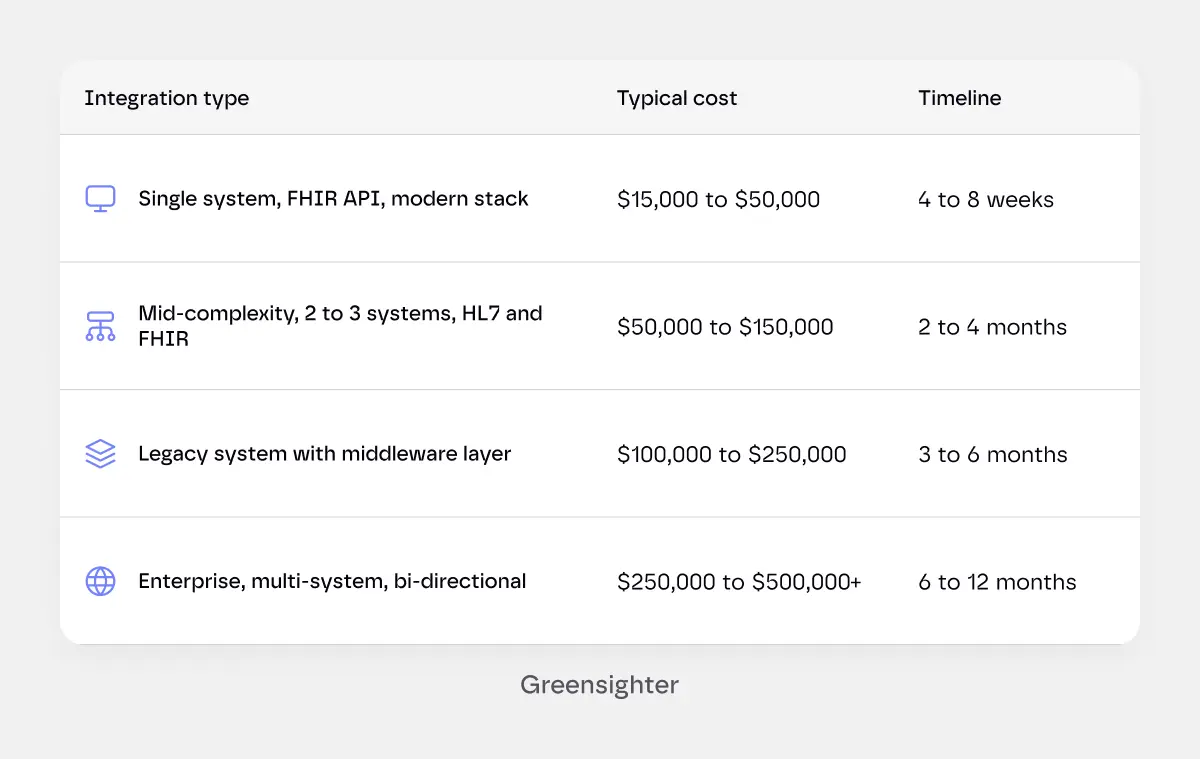
The variables that move the number most are how many systems you are connecting, whether any of them are legacy, how clean your existing data is, and whether you need bi-directional data flow or read-only access.
Hidden costs that do not appear on initial quotes. Data cleaning and migration take longer than anyone estimates.
Compliance remediation after a failed security review costs more than building security in from the start. Post-launch monitoring and maintenance for schema drift and API deprecations is ongoing, not one-time.
Plan 15 to 20% of the initial build cost annually for post-launch upkeep.
The high-profile failures are instructive.
MD Anderson's Epic project contributed to a $266 million operating loss. NYC Health and Hospitals' Cerner project exceeded $764 million with documented patient safety concerns.
These are extreme examples.
The underlying causes- poor scoping, underestimated data mapping complexity, and inadequate testing- are not unusual at all.
Best Practices for EHR Integration
First, map your data flows before you choose a method.
Which data needs to move?
Between which systems? In which direction?
In real time or on a schedule?
These questions determine everything else.
Most failed integrations choose a method before answering them.
Start with read-only access. Get the data flowing correctly in one direction before you allow write-back. A read-only integration that surfaces wrong data is a data quality problem. A bi-directional integration that writes wrong data back to the source is a patient safety problem.
Treat data cleaning as a project in itself. Do not underestimate this. In most organisations, years of inconsistent data entry, duplicate records, and format differences mean the data migration is more work than the integration itself. Budget for it separately.
Test with real patient data in a sandboxed environment. Synthetic data will not surface the edge cases that break integrations. Use a representative sample of real records in a sandboxed test environment before touching production.
Build monitoring in from the start. Schema changes, API deprecations, and connectivity drops happen. Your integration needs automated monitoring that flags anomalies before they become clinical data gaps. An alert that fires when expected data stops arriving is worth more than any post-incident report.
Plan the exit.
If you need to replace a system or a vendor, can you extract your data cleanly?
In what formats?
Under what timeline?
The organisations that answer these questions before signing contracts are the ones that do not spend two years trying to leave a vendor who knows they cannot.
Greensighter's piece on clinic scheduling and how broken handoffs cost practices patients shows what happens at the operational level when integration is the missing link between scheduling, intake, and clinical care.
The Bottom Line
EHR integration is not a technical problem with a technical solution.
It is a data problem, a workflow problem, a compliance problem, and a vendor management problem, all running at the same time.
The integrations that hold up are not the ones that used the most sophisticated technology. They are the ones that mapped the data flows first, tested with real data, built monitoring before they went live, and had a clear answer to the question nobody wants to ask: what happens when this breaks?
Get those foundations right, and the technical implementation is manageable. Skip them, and no technology will save you.
We have built EHR integrations across Epic, Cerner, and Meditech using FHIR R4 and HL7 standards. We scope the data mapping and compliance requirements before we quote a number, because the quote looks very different once you know what the data actually looks like.


.webp)
.webp)