



Martin runs a B2B SaaS platform for independent contractors.
Last year, $40 million in contractor payments flowed through it. Every payment immediately left for a third-party payroll service.
Martin captured none of it.
Then he looked at what Shopify was doing.
Shopify does not just run an e-commerce platform. It runs a financial operation. Shopify Payments processes merchant transactions. Shopify Capital lends against real-time sales data.
Together, those financial products now dwarf Shopify's software subscription revenue.
That is embedded finance. Financial services built into a product customers already use, at the moment they need it, without going anywhere else.
And it is not just for companies at Shopify's scale.

What Embedded Finance Actually Is
It is simple: financial services built directly into non-financial products.
You do not go to a bank to pay for Uber. You pay inside the app. You do not visit a lender for a Shopify store loan. The offer appears in your dashboard, based on your real sales data.
The financial service comes to the customer. At the right moment. Inside a product they already trust.
Three layers make this work.
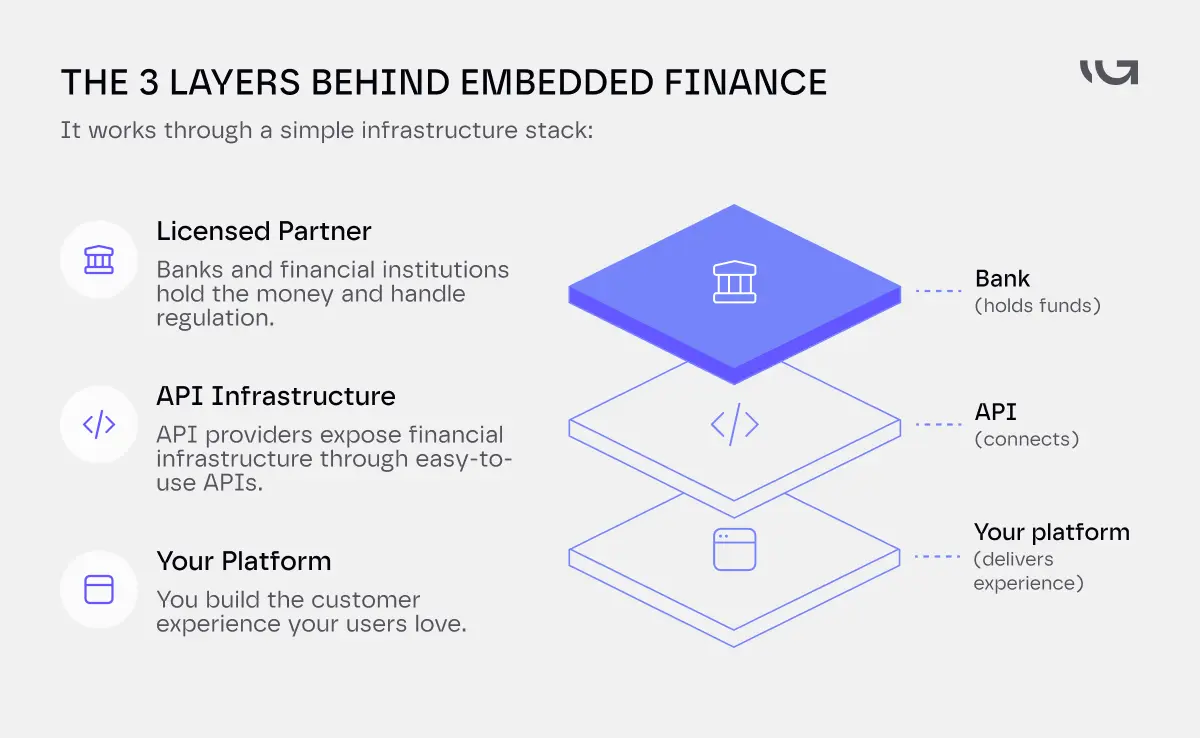
- First, a licensed bank or financial institution holds the money and handles the regulation.
- Second, API providers like Stripe and Marqeta sit in the middle, exposing that infrastructure through developer-friendly APIs.
- Third, your platform builds the customer experience on top.
You are not becoming a bank. You are adding financial capabilities to a product your customers already use every day.
Why Businesses Are Doing This
Every transaction on your platform generates economics. Right now, someone else is capturing them. Embedded payments put that revenue back in your hands.
Retention that no feature update can match.
When customers hold a balance on your platform, get paid through it, or access credit through it, they do not leave. Platforms with embedded finance report churn reductions of up to 64% compared to software-only competitors.
Data that becomes a competitive advantage.
Shopify knows every merchant's real-time sales before underwriting a loan. That is why their approval rates beat traditional banks. The data your platform already holds is the moat. Embedded finance is how you use it.
These three things compound. More financial products mean more data. Better data means better underwriting. Better underwriting means lower churn. Lower churn means more revenue per customer over time.
The embedded finance market is projected to grow from $155 billion in 2025 to over $454 billion by 2031, at nearly 24% annually. That is not hype. That is platforms realising they have been leaving money on the table.
Is Embedded Finance Right for Your Business?
Not every platform should build this.
Before you scope anything, three questions decide whether embedded finance is worth pursuing.
Do you own a recurring transaction relationship with your customers?
Embedded finance needs volume to work. If customers touch your platform once and disappear, there is no transaction stream to embed a financial product into.
Do you already hold data that a bank does not have?
Shopify's edge in lending is real-time sales data no traditional lender can see. If your platform does not generate a comparable data signal- payment history, utilization, cash flow- the underwriting advantage does not exist yet.
Can your customer base absorb the compliance friction?
KYC, identity verification, and disclosure requirements add steps to onboarding. A platform with high-trust, high-frequency customers absorbs this easily. A platform with low-trust or one-time users will see it kill adoption.
If the answer to at least two of these is yes, embedded finance is worth scoping.
If not, the software product usually needs to mature further first: more transaction volume, more usage data, more customer trust, before financial services make sense on top of it.
The 5 Ways to Embed Finance in Your Product
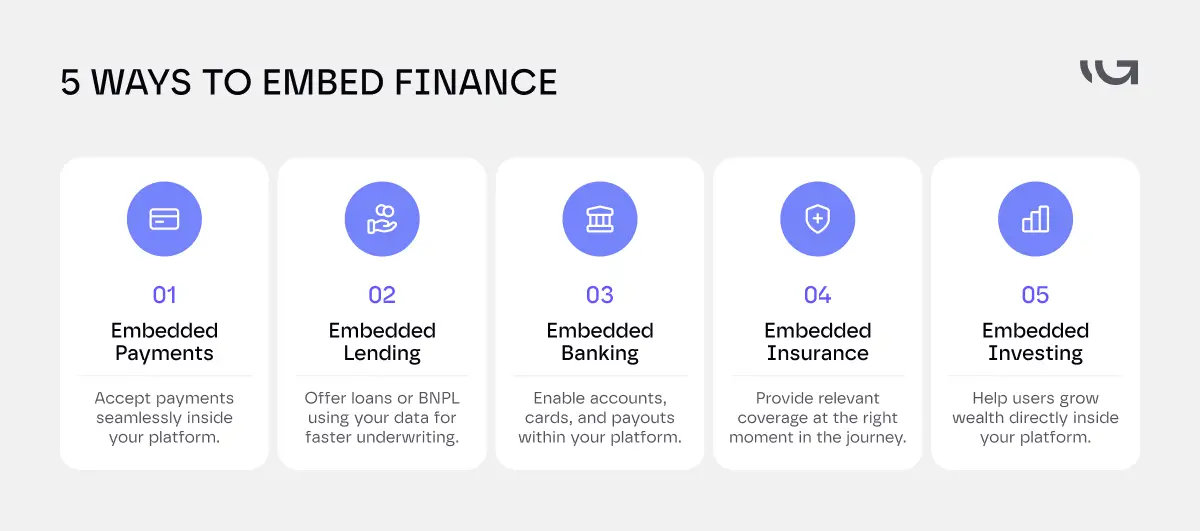
Not every embedded finance product is the same. Each category has different infrastructure requirements, different compliance burdens, and different economics.
- Embedded Payments: Start Here
This is the most common entry point and the lowest barrier.
The customer pays inside your product. No redirects. No third-party checkout pages. No moment where they leave.
Uber. Airbnb. DoorDash. Every major marketplace built this first. The payment experience became seamless, and the platform captured the transaction data, the relationship, and the economics.
For SaaS platforms, embedded payments solve one specific problem: transaction volume flowing through your product but earning revenue for someone else.
- Embedded Lending: Where the Real Money Is
A small retailer finishes a strong sales month and receives a working capital offer inside their dashboard.
A contractor completes a job and gets offered an advance on their next payment.
This is embedded lending. The offer appears at the right moment, underwritten by data the platform already has.
Toast, the restaurant software company, now generates over 85% of its revenue from financial services. The software brought restaurants in. The embedded payments and lending kept them. That is the model.
- Embedded Insurance: At the Moment of Risk
Travel insurance appears when you book a flight. Vehicle insurance is offered when you purchase a Tesla.
The customer does not shop for insurance. It is there, priced for their specific situation, at the exact moment they need it.
For platforms in travel, logistics, healthcare, and real estate, insurance creates a revenue stream from a customer moment that already exists.
- Embedded Banking: Making Your Platform a Financial Home
Shopify Balance lets merchants receive payouts, manage funds, and spend with a Shopify debit card, without a traditional bank account.
Uber's Instant Pay gives drivers access to earnings immediately after each trip, via a Visa debit card. It solved a real driver complaint and created a deeper financial relationship between Uber and 8.8 million drivers worldwide.
When customers hold balances in your platform, switching costs become very real.
- Embedded Investing: For the Right Audience
Crypto trading inside PayPal. Stocks inside a consumer spending app.
This category has the highest regulatory burden and the narrowest fit. It works when your platform already has a strong financial trust relationship with customers. Not as a first embedded finance product.
Here’s a table for a quick glance:
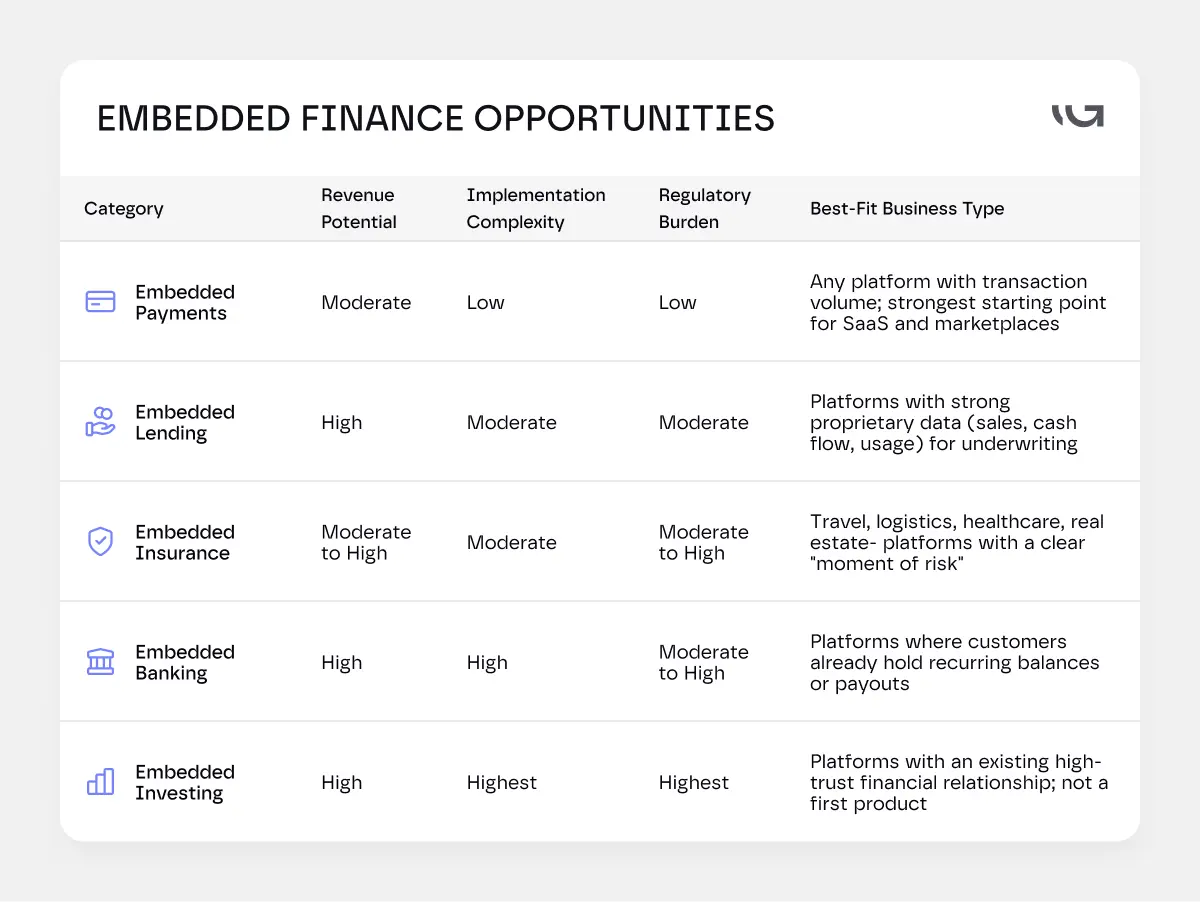
Which category fits your platform?
The right starting point depends on your customer relationship, your existing data, and your compliance appetite.
We help platforms identify the highest-impact first move before any development begins.
Let's Map Your Embedded Finance Opportunity.
The Infrastructure Behind It
You do not need a banking licence to offer financial products.
Most platforms build using Banking-as-a-Service (BaaS) providers. Companies like Stripe, Unit, Marqeta, and Synapse sit between you and the licensed bank. They handle the regulatory relationship. You build the customer experience using their APIs.
This approach gets you to market quickly. Stripe Treasury, for example, lets platforms offer financial accounts and cards in weeks. The tradeoff is margin, the BaaS layer takes a cut of every transaction.
As your embedded finance revenue grows, a direct bank partnership becomes worth exploring. More control. Better economics. Longer setup time and more legal work.
Becoming a licensed financial institution is the path taken by companies that built their entire business model around financial services from day one. It is not a route most software platforms need to consider.
Start with BaaS. Build the customer relationship and the data. Revisit the structure once the revenue justifies it.
This is where most platforms either move fast or get stuck evaluating providers for months. Greensighter has helped SaaS platforms and marketplaces work through exactly this decision. We match BaaS providers to a platform's compliance appetite, data maturity, and target jurisdictions, so the infrastructure choice does not become the bottleneck
What Actually Breaks: Real Development Challenges
Your data is probably not ready.
Embedded lending and personalised insurance depend on your platform data as a financial signal. If transaction records are inconsistent, if customer identifiers are duplicated, if data lives in silos, the financial product cannot use it. Fix the data architecture before you build the financial layer.
KYC friction kills adoption.
Regulated financial products require identity verification. That is a friction point in onboarding. Design the verification flow to feel like part of the product, not like a compliance checkpoint you bolted on. How this is handled directly affects how many customers actually adopt the financial product.
Fraud infrastructure is separate from payment infrastructure.
To add payments means adding fraud risk. Transaction monitoring, velocity checks, dispute handling, and fraud operations are not included in most BaaS integrations by default. Plan for them before launch.
Reconciliation is harder than it looks.
Multiple payment rails. Multiple settlement cycles. Multiple BaaS providers. Daily reconciliation across all of them is an operational problem, not just a technical one. Build it into the product design from day one.
Greensighter's SaaS application development guide covers the architectural decisions that affect products like this at scale.
The Compliance Question You Cannot Skip
Embedded finance is regulated everywhere it operates.
In the United States, the CFPB oversees financial products offered through non-bank platforms. Most platforms manage their regulatory exposure through their sponsor bank relationship and BaaS provider, not by holding licences themselves.
In the EU, PSD2 created the open banking framework most embedded finance builds run on. The Digital Finance Package adds requirements for investment and crypto products.
In the UK, the FCA oversees embedded lending and insurance distribution. Some platforms need their own authorisation even when a licensed bank is the primary regulated entity.
A few things worth knowing before you start.
- Regulators increased oversight of BaaS arrangements significantly in 2024 and 2025. Several enforcement actions highlighted compliance gaps across BaaS providers. Responsibility now extends across the platform, the BaaS layer, and the sponsor bank. Evaluate your BaaS partner's regulatory track record as carefully as their API documentation.
- Some products require platform-level licensing even with a bank partner in place. Insurance distribution and investment offerings often require registration in each jurisdiction you operate in. Get legal review early. It is significantly cheaper than getting it wrong.
Greensighter's guide on identifying the right features for a first product release applies directly here: the compliance complexity of your first financial product shapes how fast you can move.
What It Costs to Build
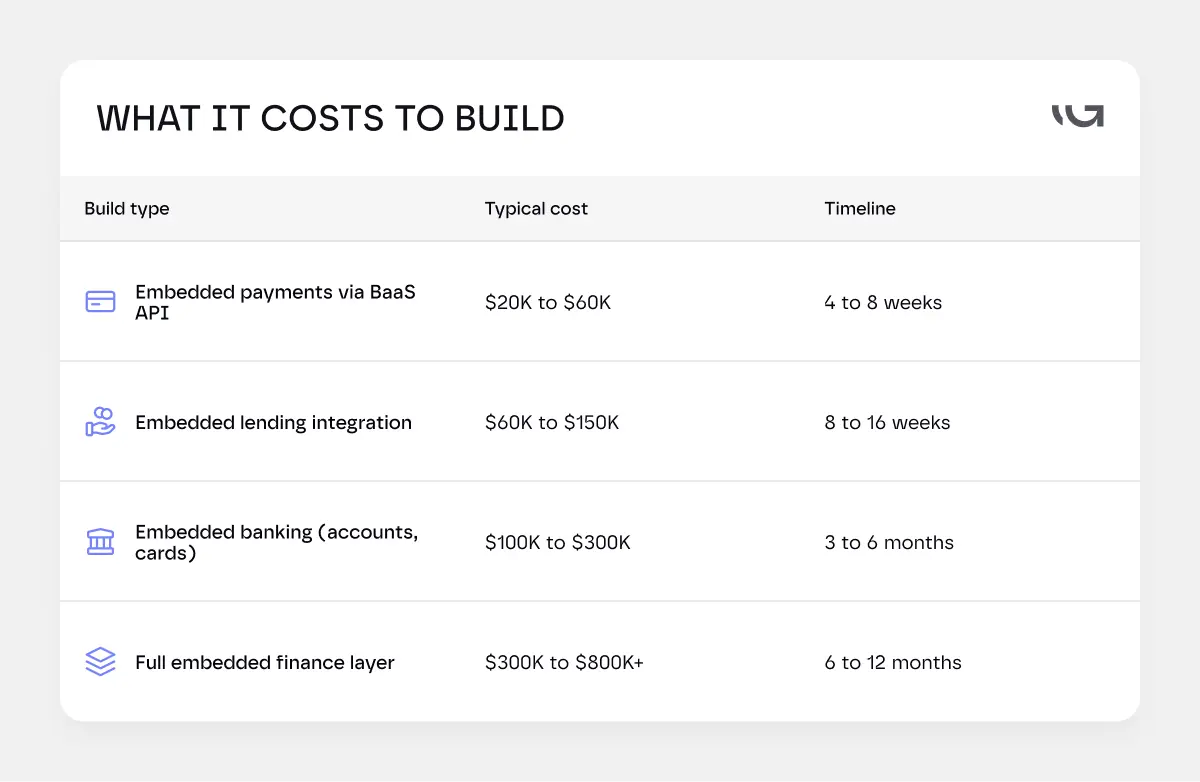
The variables that move the number are compliance architecture, number of jurisdictions, BaaS or bank partnerships involved, and the state of your existing data infrastructure.
Budget for ongoing costs too. Regulatory monitoring, fraud operations, KYC infrastructure, and BaaS platform fees run continuously after launch. These are not one-time expenses.
Start Here
Every platform that has built embedded finance successfully followed the same sequence.
Start with payments. It is the lowest compliance burden, the fastest time to market, and the product that generates the most useful data for everything you build next. If your platform does not yet own the payment relationship with your customers, fix that first.
- Payments are the right first move when your platform sits between two parties who already need to exchange money- a marketplace, a booking platform, a services platform paying out contractors or vendors.
It is also the right move when you need transaction data before you can credibly build lending or insurance on top of it later.
- Payments are not the right first move if your platform does not generate real transaction volume. If customers pay you but never pay each other or get paid through you, or if your existing payment flow already runs through a partner your customers trust and are unlikely to switch away from.
In those cases, embedded lending or insurance, built around a specific customer moment rather than the payment rail itself, may be the better entry point.
Pick one BaaS partner and stay focused. The BaaS market has more providers than it did two years ago and more failures too. Choose a partner with a clean regulatory track record and production experience with platforms similar to yours.
Design the financial product around a real customer problem. Not a revenue line item. The embedded finance products that achieve adoption solve friction at exactly the right moment. Instant pay when a driver finishes a shift. Working capital when a merchant's cash flow tightens. Insurance when a customer books a risky trip. Revenue follows adoption. Adoption follows usefulness.
Build monitoring before you need it. Transaction monitoring, reconciliation, and compliance reporting are significantly easier to build before launch than to retrofit under regulatory scrutiny.
We have worked with SaaS platforms, marketplaces, and vertical software companies building embedded payments, lending, and banking capabilities. We scope the compliance model alongside the technical architecture, because the right approach to one shapes the other.
Tell Us What You Are Building.
The Bottom Line
Embedded finance is not a technology trend. It is a business model.
The platforms winning in their markets moved from charging for access to owning the financial relationship with their customers. Software subscriptions have a ceiling. Financial services revenue scales with every transaction that runs through your platform.
The infrastructure is there. The regulatory paths are clearer than they were three years ago.
Start with payments. Solve a real customer problem. Build the data and the trust.
Everything else follows.