



The demo looked great. The proposal was detailed. The price was competitive.
Six months later, the system couldn't connect to the EHR, the compliance documentation didn't hold up to audit, and the vendor's response time had dropped from hours to weeks. The clinic was 80% into a rebuild they hadn't budgeted for.
This isn't unusual.
Healthcare technology projects fail at a rate of up to 70%. Delayed timelines. Budget overruns. Missing goals. Complete abandonment.
Most of these failures? Predictable. The warning signs were there all along. In the vendor conversations. Before you signed anything.
Here's how to read them.

What You're Actually Buying When Choosing a Healthcare Software Development Company
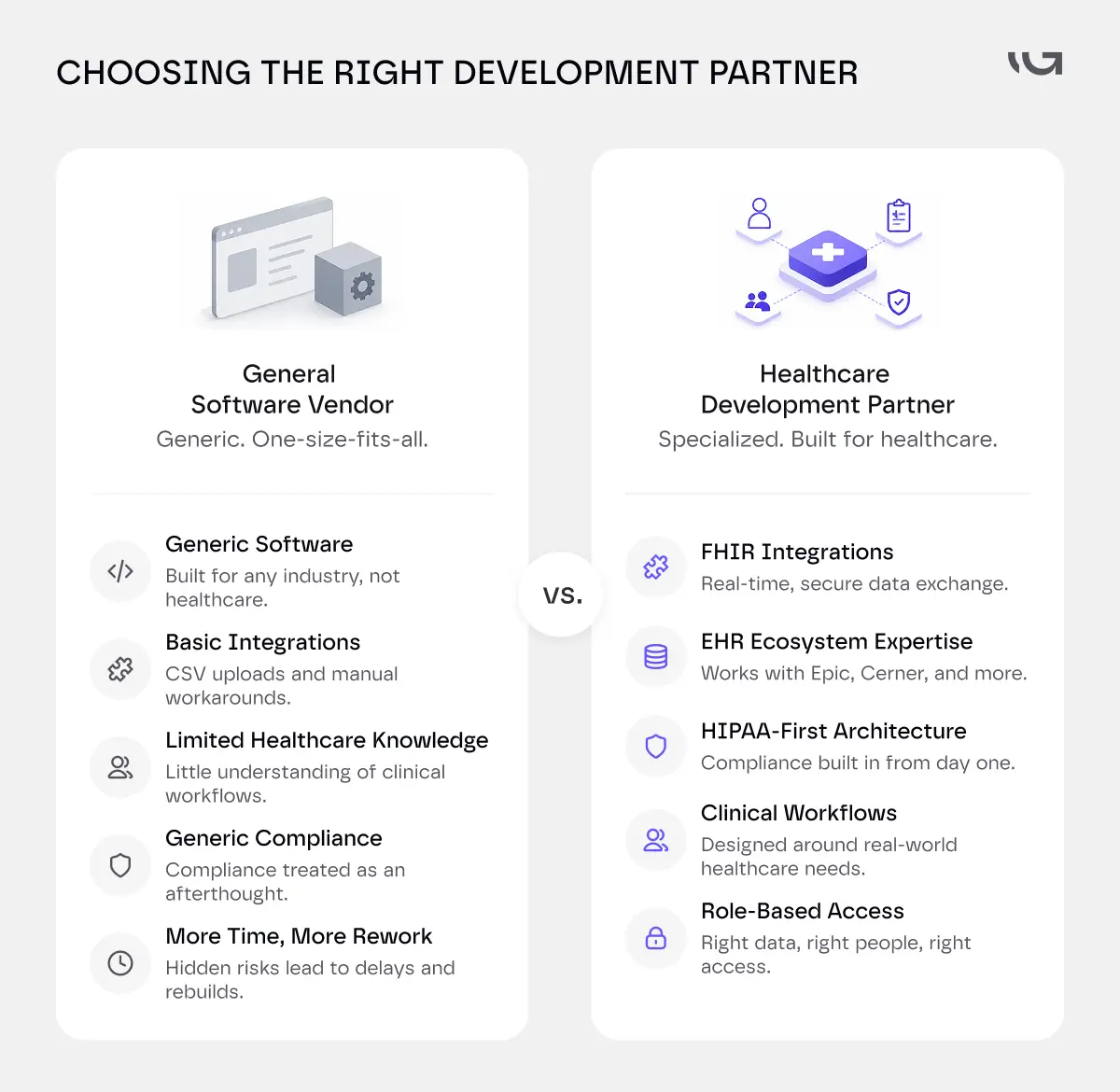
Healthcare software isn't general software with compliance bolted on. It's a completely different beast.
Clinics that treat it like standard IT procurement get standard IT results. In a non-standard environment.
That doesn't work.
Here's what a clinic workflow tool actually has to do:
Pull patient data from Epic or Cerner via FHIR APIs without touching the underlying record. Push results back safely. Create audit logs that satisfy HIPAA. Set up role-based access so a nurse sees different data than an admin.
A generalist agency can make all of this look perfect in a demo. Then integration testing starts. Reality hits.
The right partner doesn't replace your EHR. They build around it.
Custom dashboards. Workflow apps. Integration layers. Patient-facing tools. All connected to your existing systems through APIs.
That's where the gaps hide. That's where the value actually is.
Pick the wrong vendor? They'll either overbuild everything you don't need or fail to connect everything you do.
You're evaluating partners right now. This distinction matters.
You need a team that already builds FHIR workflows. EHR integrations. Clinical tools designed around compliance constraints. Not a generalist shop reading from a compliance checklist.
Greensighter specializes in healthcare and SaaS development for regulated environments. Which means this isn't new to us. It's baseline.
The Evaluation Criteria That Actually Matter
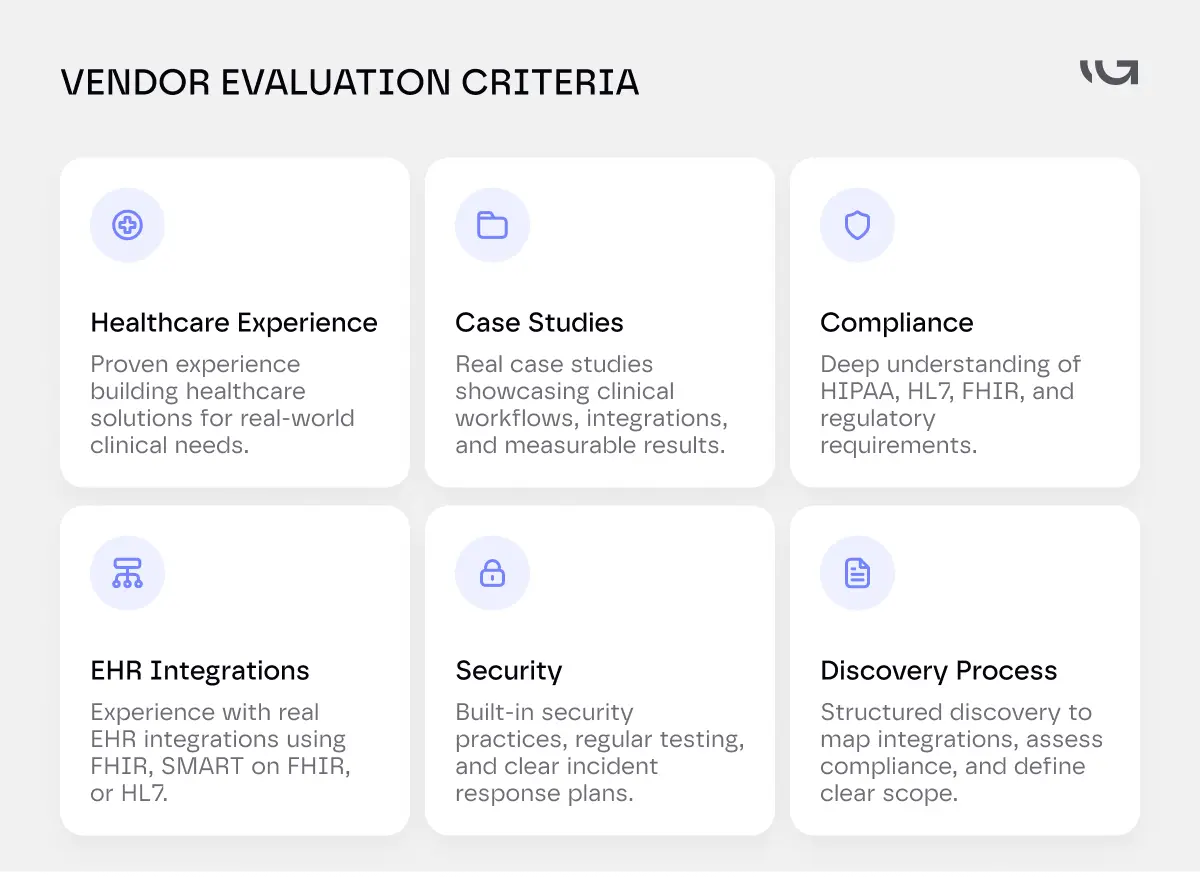
Domain experience- specifically healthcare, not adjacent to it
A vendor who built three e-commerce platforms and one medical app is not a healthcare software company. They're a generalist with one relevant line on their portfolio page.
Ask for case studies, not logos.
Don't accept a PDF with a client logo and some screenshots. Ask for real case studies.
What should they show? The clinical workflow. The integrations they built. How they navigated compliance. What actually happened after launch?
If they can't show you two or three for work like yours, that's your answer. Move on.
Compliance fluency, unprompted
The 2024 CMS Interoperability and Prior Authorization Final Rule is clear: FHIR-based APIs are now the standard for health data exchange. Compliance deadlines run through 2027.
A vendor who actually works in healthcare? They'll bring up HIPAA, HL7, and Business Associate Agreements without you asking. Not because you mentioned them. Because they know these are non-negotiable.
They talk about compliance the way a contractor talks about building codes: not as an obstacle, as the baseline.
Here's a simple test. Don't mention compliance in the first call. Let the vendor walk you through their proposed approach. If twenty minutes pass without them raising data standards, access controls, or BAAs, you have your answer before you've spent a dollar.
Integration depth: real, not claimed
Every vendor says they integrate with EHRs.
The question is how.
Ask them directly: Do you use real API integration or CSV export/import? Real API integration is live, data flows in real time, and stays accurate. CSV is a workaround. It creates sync delays, requires manual intervention, and breaks quietly in ways that are only discovered when something goes wrong clinically. A vendor who defaults to CSV for EHR connectivity has either never done it properly before or is planning to cut corners on yours.
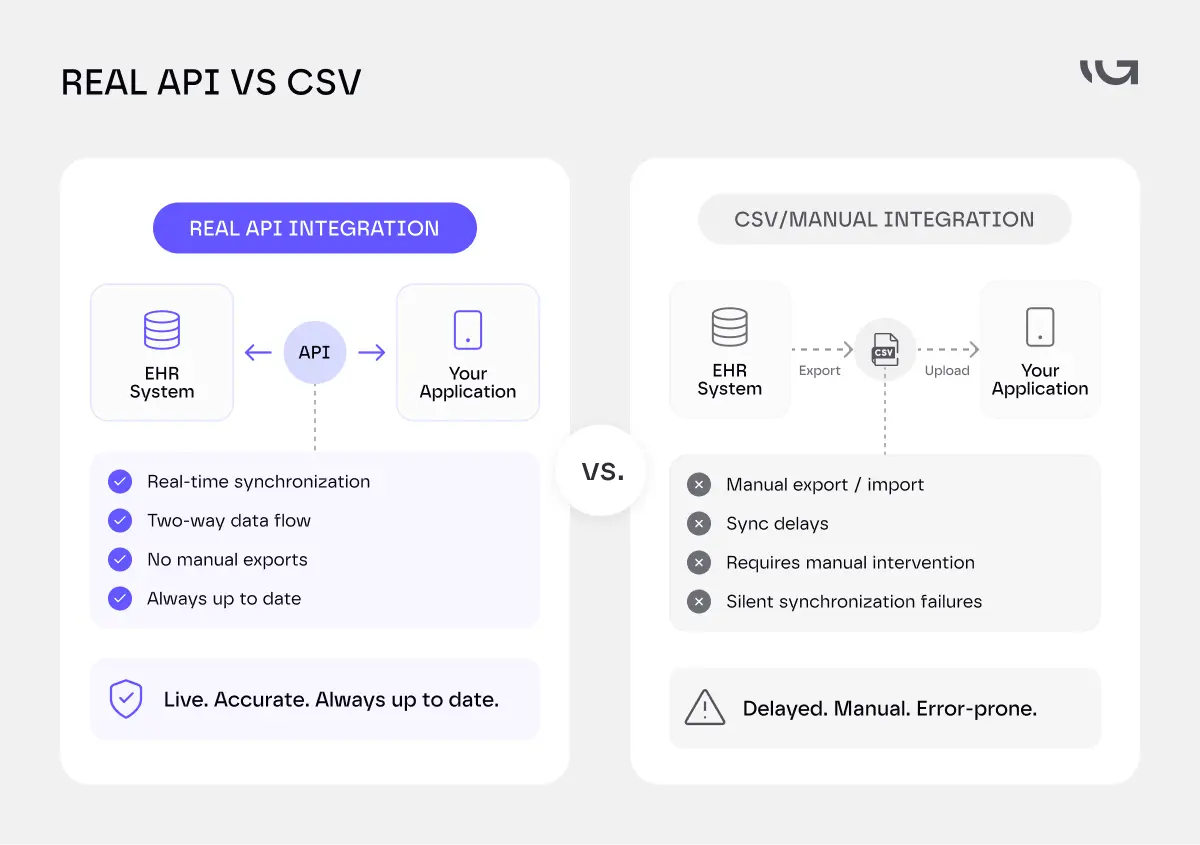
Push further: ask them to name the specific protocols- FHIR R4, SMART on FHIR, HL7 v2. If the answer is "we support standard APIs," that's not an answer.
Security- built in, not bolted on
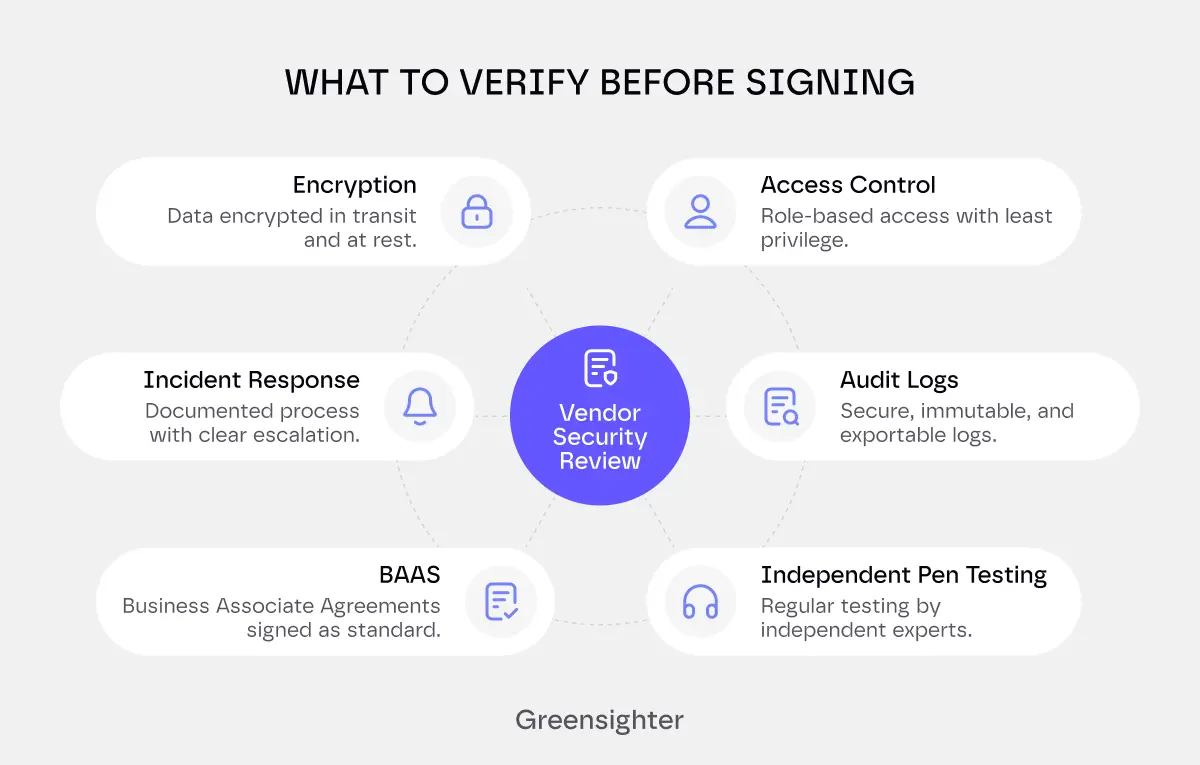
Compliance documentation and actual security are not the same thing. A system can pass a paper audit and still have patient data stored in plain text.
Ask:
Who conducts your penetration testing, how often, and can we see a recent report?
What's your incident response process if there's a breach during the project?
Do you sign BAAs as standard, or only when clients specifically request it?
A general-purpose development team can build a healthcare app that looks right, passes a demo, and satisfies stakeholders, until the security audit happens and 40% of the codebase needs to be rewritten.
Ready to evaluate vendors without surprises?
We've helped clinics navigate vendor selection for FHIR integrations, EHR connectivity, and compliance-first architecture. See what questions separate serious healthcare partners from generalists.
Get Our Vendor Evaluation Checklist.
Pricing: What's Realistic and What's a Warning Sign
Healthcare software costs what it costs because of what's required to do it right. Compliance infrastructure, proper integration architecture, security review, and clinical workflow validation. None of these is optional, and none of them is cheap.
Realistic ranges for custom healthcare software:
- FHIR-connected workflow tool or patient-facing app (MVP scope): $15,000–$60,000
- Integration layer connecting EHR, scheduling, and intake via APIs: $25,000–$80,000
- Multi-system middleware connecting five or more tools: $50,000–$150,000
A full custom EHR built from scratch sits above all of these, and for most clinics, it's the wrong solution entirely.
A bid that comes in at 40% below every other quote isn't a bargain. It's a signal. The vendor is either cutting scope you haven't noticed, skipping compliance infrastructure, or planning to bill for "change requests" throughout the project that recover the margin they didn't charge upfront.
McKinsey and the University of Oxford studied 5,400+ large IT projects. Here's what they found:
45% over budget. 7% over schedule. 56% less value delivered than promised.
A lowball bid doesn't help. It makes it worse. An underqualified vendor starts with a low baseline. Then the overruns compound from there.
What about the contract structure?
Fixed price feels safer, but creates incentives to cut corners when the scope gets complicated. Time-and-materials gives flexibility but requires oversight.
In healthcare, where integrations surface surprises and compliance requirements shift during build, a hybrid works best, with a fixed discovery and architecture phase, time-and-materials for development.
Any vendor who refuses a scoped discovery engagement before writing code is in a hurry to lock you in before you know what you're buying.
The safe alternative? Vendors who lead with scoped discovery.
Not a free consultation.
A paid discovery phase.
Integration mapping.
Architecture review.
Compliance assessment.
A detailed scope document.
Before a single line of code.
Greensighter requires discovery before development. Why? Integration complexity in healthcare can't be estimated without mapping it first. You can't know the real scope until you've actually looked.
Red Flags in Vendor Conversations
These are specific. Not "poor communication", the actual behaviours that tell you to walk away before the contract is signed.
- They propose a full platform when you need a workflow tool. You need a patient check-in app that connects to your scheduling software. The right answer is a FHIR-connected wrapper that pulls from your existing EHR and pushes back results.
A vendor who responds to that with "we'll build you a complete patient management system" is either padding scope or doesn't understand the ecosystem.
Neither is good.
- They've never executed a BAA. A Business Associate Agreement is a legal requirement for any vendor who handles, transmits, or stores protected health information.
Question them directly: Is signing a BAA standard practice for you? If they need to check with someone, or if they've never heard the term, they have not worked in healthcare seriously before.
- Their timeline is half what every other vendor quoted. Real-world healthcare IT failures follow a consistent pattern. Rushed implementations with unrealistic deadlines compromise patient safety and produce systems that clinical staff refuse to use.
Compliance review, integration testing, and clinical validation take time. A vendor promising a HIPAA-compliant EHR integration in six weeks is either skipping steps or redefining what "complete" means.
- They can't explain their data model.
Where does patient data live in your architecture, how is it encrypted at rest and in transit, and who can access it?
"We follow best practices" is not an answer.
How data is structured determines integration speed, reporting capability, and audit readiness.
A senior engineer on a serious healthcare team can answer this without thinking twice.
- They went out of business once and relaunched. Check the company registry. A vendor who dissolved and reformed, or whose parent company has a patchy financial history, represents continuity risk.
If they disappear six months into your build, you're left with half-built integrations, no documentation, and a codebase nobody else understands. Choose vendors with three or more years of continuous operation.
In-House vs. Outsourcing: The Honest Version
Most clinics aren't choosing between in-house development and outsourcing. They're choosing between outsourcing and not building the thing at all.
- Outsourcing works when you need specialised skills: FHIR integration, HIPAA-aware architecture, clinical UX, that don't exist in your IT team.
When you need a scoped project delivered without permanently hiring developers. When you want a team that has already solved the integration problems you're encountering for the first time.
- Outsourcing fails when requirements aren't defined before the project starts. There's no internal owner who can make decisions and translate clinical needs to the development team.
The contract has no support clause; a system handed over with no ongoing maintenance is a liability, not an asset.
- On location: Geography matters far less than domain expertise.
A lean, experienced team in Eastern Europe that has built FHIR integrations in regulated environments will outperform a large local agency that has never touched clinical data.
UK enterprises save 30% on labour costs by working with Eastern European nearshore developers instead of hiring in Western Europe. Quality doesn't drop.
But here's what actually matters: What has the team built? For whom? How did it perform in real use?
Not which city they're based in. That's irrelevant
The compliance question isn't about location either. It's about whether the vendor understands the regulatory environment governing your patients and can operate within it.
How to Structure a Shortlist
Don't evaluate more than three or four vendors seriously. Beyond that you're collecting opinions, not making a decision.
Send every vendor the same written brief: the problem, the systems that need to connect, your compliance environment, your timeline, and your budget range.
Evaluate responses on specificity. Not design quality, not enthusiasm, whether they asked the right clarifying questions, and described an approach grounded in your actual constraints.
Require a scoped discovery engagement before committing to a full build. A proper discovery, integration mapping, architecture review, and compliance considerations surface the real scope before development begins. Any vendor who won't do this before writing code is either overconfident or in a hurry to lock you in.
You can also check references from the last two years. Not the references they volunteer, ask for two client contacts from projects of comparable scope, then call them and ask three questions:
- Did it come in on budget?
- Did the vendor raise compliance concerns proactively?
- Would you hire them again?
Ready to choose a healthcare development partner that gets it?
We build integration layers and workflow tools that sit between your existing systems. No replacement. No surprise overruns. No compliance shortcuts. Just healthcare software done right.


.webp)
.webp)