


.png)
Ask three vendors what an AI agent costs. You'll get three different numbers.
None of them is lying. They're just quoting different products.
Here's why. "AI agent" isn't one thing. It's a whole spectrum of builds.
A bot that answers FAQ tickets is one kind of agent.
A system that reads your CRM, makes a judgment call, and triggers a refund on its own? That's a different kind entirely.
Both get called "agents."
They're not the same job, and they are not the same AI agent development cost.
No wonder this question comes up in every budget meeting now.
Let's break down what actually drives the price.
A Quick Glance: What does an AI agent cost in 2026?

Why the Price Tag Swings So Wildly
Three things move the number most: autonomy, integration depth, and governance.
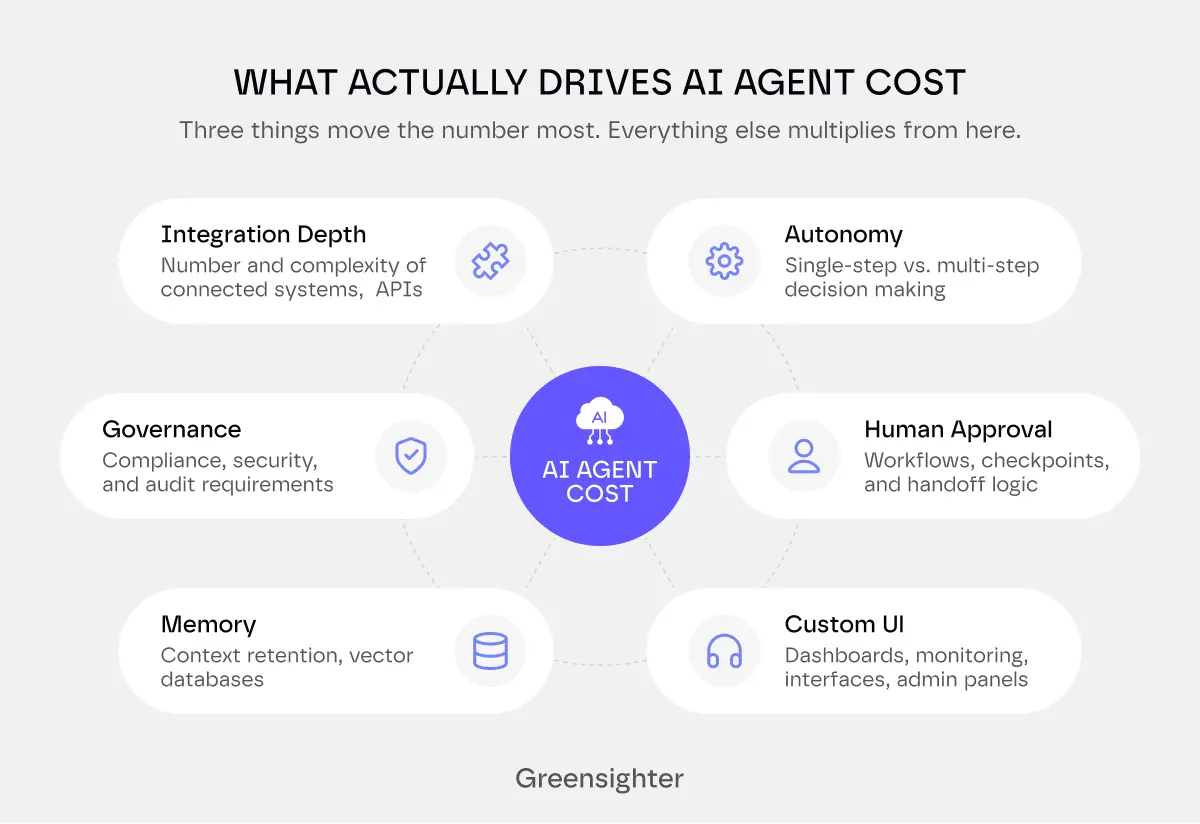
A single-task agent makes one decision and stops. It reads a request, picks an answer, and it's done.
That's the cheap end of AI app development cost.
Simple in, simple out.
An agentic system is a different animal. It plans multiple steps, calls outside tools, and checks its own work.
That's a real engineering project. Not a chatbot with better manners.
Integrations multiply the bill fast. Your CRM, your billing platform, your internal database- each one adds cost.
Each one needs authentication and error handling. Each one is a new place for things to quietly break.
Want the fuller picture on integration cost? Our SaaS development guide breaks it down.
A few more factors most quotes don't mention upfront:
Memory architecture. An agent that needs to remember context across sessions, previous customer interactions, ongoing project state, and historical decisions requires vector databases or persistent storage layers.
That's a separate build, not a default feature.
Custom UI and dashboards. If a human needs to monitor, override, or review the agent's decisions, someone has to build that interface. It's easy to forget in the initial scope. It shows up on the invoice.
Human approval workflows. For any action that carries real risk, a refund, a contract clause, a patient record update, you need a human checkpoint built into the flow. Designing those handoffs cleanly takes more engineering time than it looks like on paper.
Compliance depth. HIPAA, SOC 2, and PCI-DSS each add a different layer of work. HIPAA alone reshapes data architecture, logging, and access controls across the entire system.
Still not sure where your project lands?
Most teams can't tell if they need a $20,000 bot or a $200,000 system.
Not until someone scopes the real workflow underneath it. We'll do the scoping with you, free, before any contract gets signed.
What You Are Actually Paying For
Most AI agent development services price in one of three ways: fixed scope, time and materials, or a retainer.
Fixed scope works when you know exactly what you want. The other two earn their keep once you're iterating live.
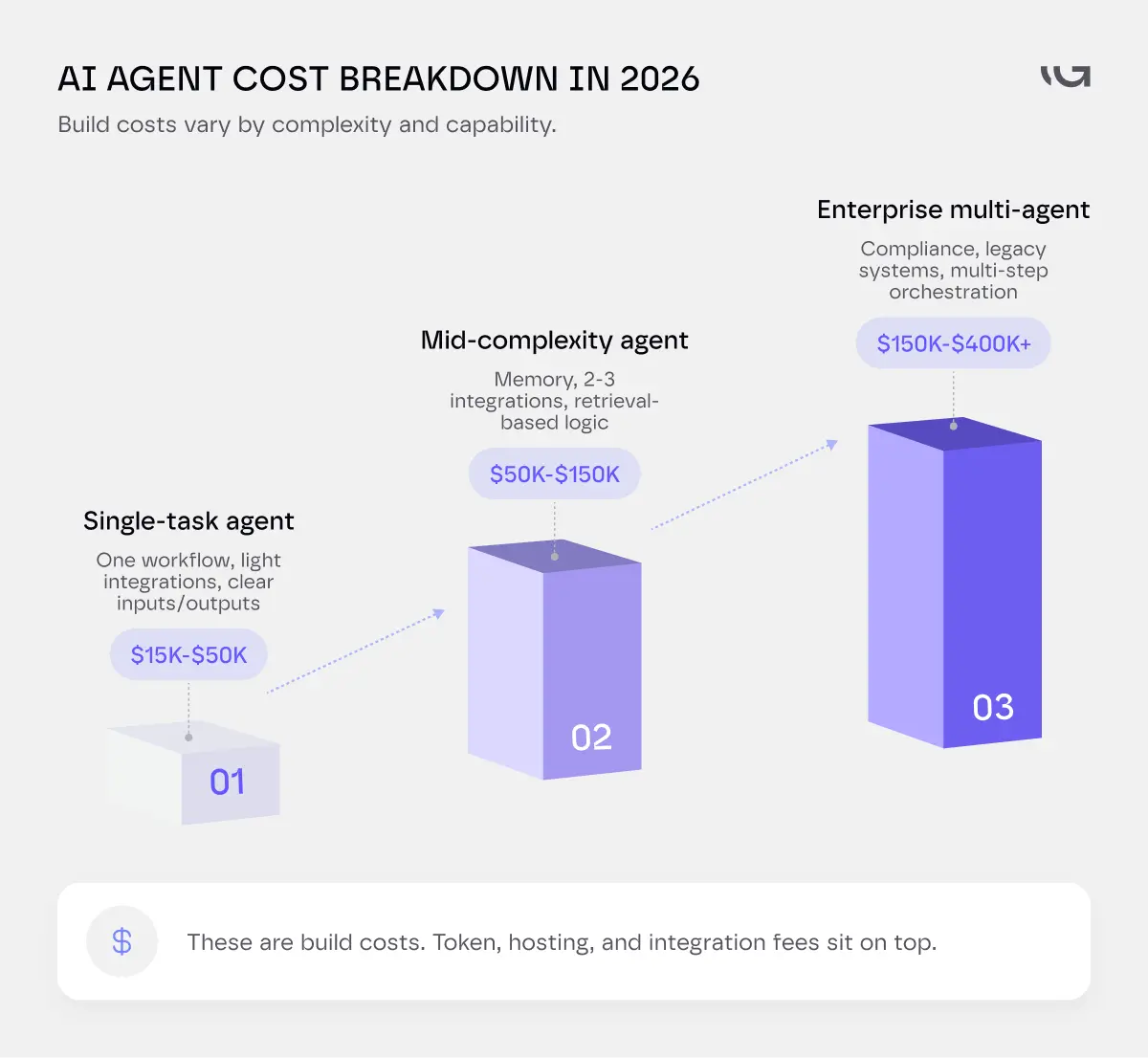
Here's roughly what we see across real 2026 engagements:
- Single-task agent, one workflow, light integrations: $15,000–$50,000.
- Mid-complexity agent with memory and a few integrations: $50,000–$150,000.
- Enterprise multi-agent system with compliance needs: $150,000–$400,000 and up.
That's the build. It's not the bill.
The Costs Nobody Puts In The Quote
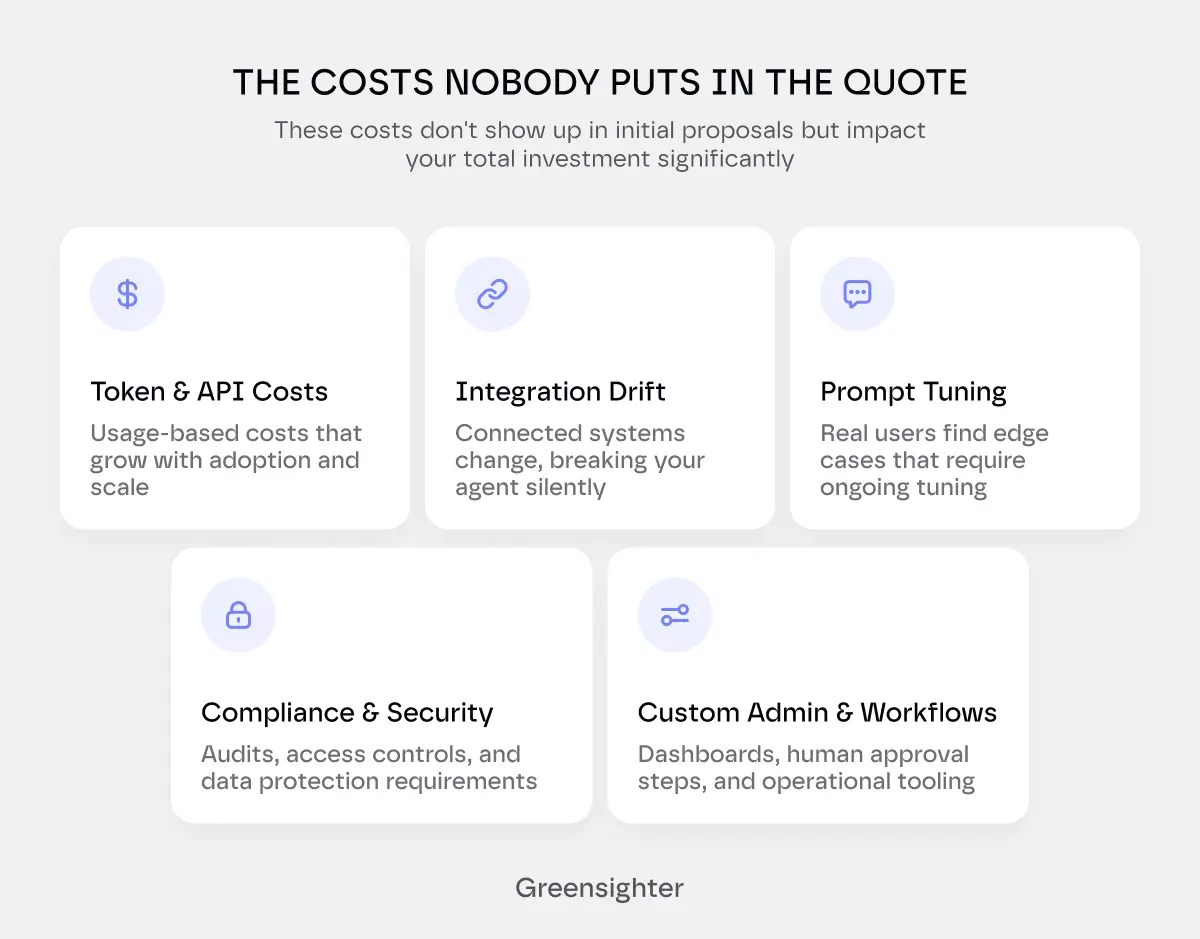
Here's what most proposals skip:
- Token and API costs that grow with usage, not with your build budget.
- Integration drift, when a connected system changes and quietly breaks your agent.
- Ongoing prompt tuning, because real users always find new edge cases.
- Compliance and security work, especially with an auditor in the picture.
In healthcare, that means HIPAA-compliant data pipelines, PHI masking, and audit trails on every agent action. Not optional extras, but architectural decisions made before the first line of code.
Greensighter's own healthcare software development guide covers what it adds to a build budget.
Most companies don't want a generic agent anyway.
Deloitte's 2026 enterprise AI survey found that 85% of companies plan to tailor their agents instead of buying something off the shelf.
That's the real case for custom AI agent development. A generic agent solves a generic problem.
Your workflow probably isn't generic either.
Does It Actually Pay Off?
Adoption and value aren't the same thing.
McKinsey's latest State of AI research found that 23% of organizations are scaling agentic AI somewhere in their business.
Another 39% are still experimenting.
Only 39% report any real EBIT impact at the enterprise level.
A lot of agents go live. Fewer of them move a number that anyone in finance tracks.
The flip side is real too.
In PwC's AI Agent Survey, 66% of companies using AI agents reported a genuine productivity boost.
57% reported real cost savings. 88% planned to grow their AI budget because of it.
The gap between those two stories matters. One is "we deployed an agent."
The other is "we automated something that was genuinely expensive to do by hand."
One pays for itself. The other becomes a line item nobody can explain.
How Greensighter approaches this
Most vendors quote a number before they understand your workflow. We don't.
Every engagement starts with a scoping session where we map the actual process, the data sources, the edge cases, the approval gates, the humans who still need to be in the loop. We've done this across healthcare, finance, SaaS, and operations teams.
That session is free.
It's also where most clients find out they need a $40,000 agent, not a $200,000 one. Or the opposite — that what they described as "simple" touches six systems and needs compliance architecture from day one.
We have also built enough of these to know where they break after launch. Token costs that weren't scoped. Integration drift that nobody monitored. Prompts that worked in testing and quietly degraded in production.
We plan for all of it upfront, because fixing it later costs more than building it right the first time.
So, Is It Worth Building?
Do the math before you sign anything.
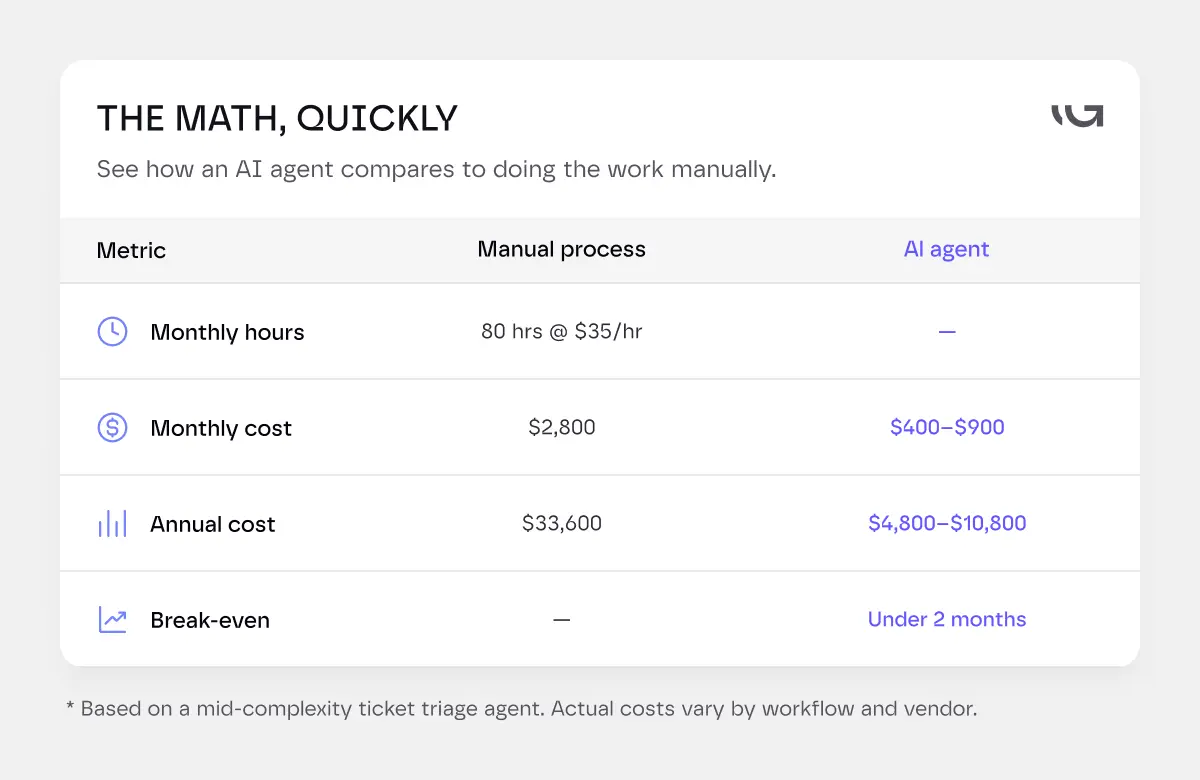
Take your monthly hours on the task, and multiply by what an hour of that work costs you.
That's your manual cost.
Now compare it to the agent's monthly running cost: tokens, hosting, and a slice of ongoing maintenance.
If manual cost wins within six to twelve months, build it.
Say your team spends 80 hours a month on ticket triage, at $35 an hour. That's $2,800 a month in manual cost.
A mid-complexity agent running that same workflow might cost $400 to $900 a month to run. The math works in under two months.
Repeatable, high-volume tasks usually make that math work. Think support triage, invoice matching, and lead qualification.
Judgment-heavy tasks across five systems are trickier. You might pay enterprise prices for savings that never show up.
Weighing AI agents against just buying more software? Our buy vs. build breakdown covers that bigger decision.
AI agent development cost isn't really the question. Whether your use case is worth the engineering is the real question.
Ready to find out what your AI agent would actually cost?
We scope every project honestly before we quote a number.
We'll tell you straight if a custom build isn't the right call for you. No generic estimate, no padded numbers.
Just your workflow, priced for real.
Get a Real AI Agent Cost Estimate.
FAQs
How long does it take to build an AI agent?
A single-task agent with light integrations typically ships in 4–8 weeks. A mid-complexity agent with memory and multiple integrations runs 8–16 weeks. Enterprise multi-agent systems with compliance architecture can take 4–6 months.
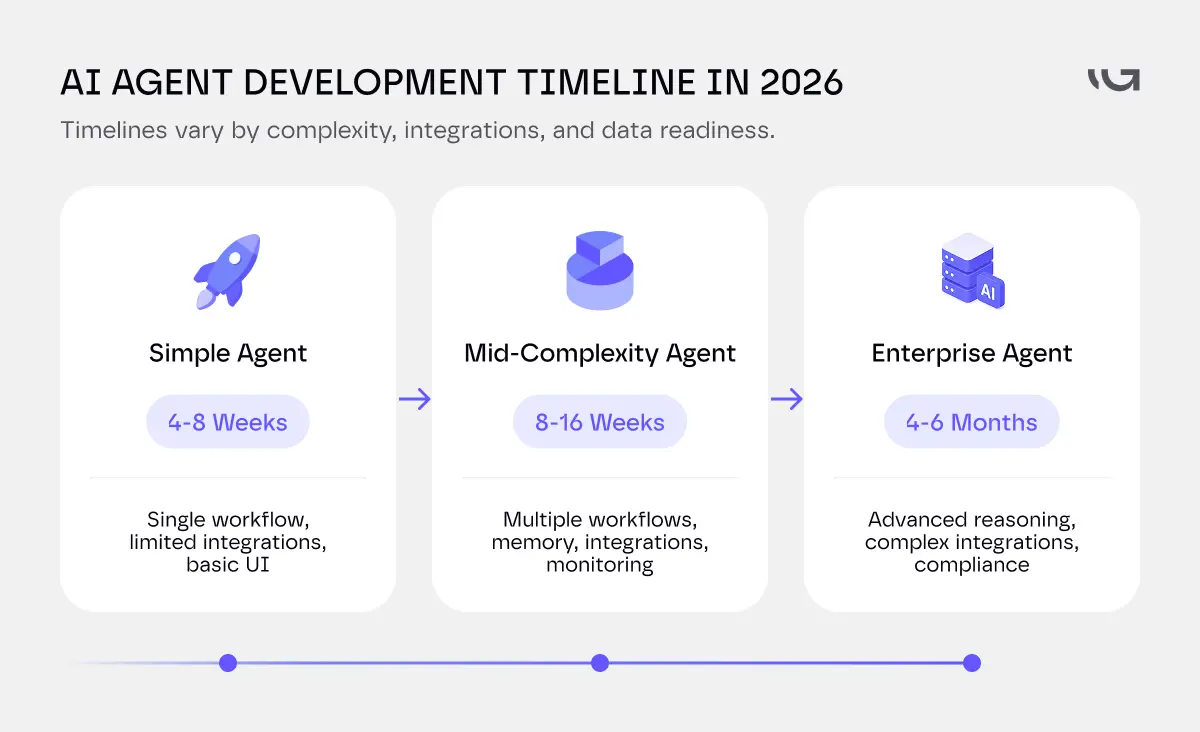
The variable that moves the timeline most isn't the agent itself, It's how clean your data is and how many systems it needs to connect to.
What's the difference between an AI agent and a chatbot?
A chatbot responds. An agent acts. A chatbot answers, "What's my order status?" An agent reads the order, checks the warehouse system, flags a delay, and sends the customer an update — without anyone clicking a button.
Do I need a custom agent, or can I use an off-the-shelf tool?
Off-the-shelf tools work when your workflow is standard. The moment your process is specific to how your business runs, your CRM fields, your approval logic, your edge cases, a generic agent solves a generic problem.
Most of our clients come to us after realizing the out-of-the-box tool handles 70% of their workflow and gets stuck on the 30% that actually matters.
What happens after the agent launches?
The build is roughly a third of the total investment. After launch, you're looking at token and API costs that scale with usage, ongoing prompt tuning as real users find edge cases, and integration maintenance when connected systems change their APIs. Plan for 15–20% of the build cost annually in post-launch upkeep.
Is my data safe with an AI agent?
That depends entirely on how it's built. A well-architected agent scopes permissions tightly, logs every action, and keeps credentials server-side. In regulated industries like healthcare and finance, that also means HIPAA-compliant data handling, audit trails, and human-in-the-loop checkpoints for sensitive decisions.
If a vendor can't explain their security architecture before you sign, that's the answer.