


It's 11 PM. Sarah is sitting on her couch. She's been experiencing back pain for three days. She pulls out her phone and searches for a spine specialist in her area.
She doesn't call. She doesn't wait until Monday morning to phone the clinic.
She goes online, sees available appointments, books one for tomorrow morning, and gets a confirmation text within seconds.
That entire experience, frictionless, digital, on her terms, is your digital front door.
It's the moment your hospital either wins her trust or loses it to a competitor who offers a better experience.
Welcome to modern healthcare. Patients don't just want good clinical care anymore. They want access that matches the convenience they get from every other industry in their life.
What Is a Digital Front Door? (And Why It's Not Just a Portal)
A digital front door is often confused with a patient portal. They're not the same thing, and this distinction matters.
A patient portal is one tool, a place where patients can view their records, request refills, or message their doctor. It's passive. It's reactive.
A digital front door is an entire ecosystem designed around the patient's journey. It's the coordinated experience that starts the moment a patient thinks "I need healthcare" and continues through their entire care experience.
Here's what makes it different:
The digital front door meets patients where they are. They don't have to come to your website. They interact with you through scheduling apps, text messages, their primary care doctor's EHR, or telehealth platforms.
The digital front door is proactive, not reactive. It sends appointment reminders. It alerts patients when test results are ready. It flags when a patient hasn't filled a prescription. It guides them to the right level of care before they even call.
The digital front door integrates everything. Your scheduling system talks to your EHR. Your EHR talks to your telehealth platform. Your patient portal talks to your billing system. The patient sees one cohesive experience, not five different logins and interfaces.
In healthcare, this is revolutionary.
How?
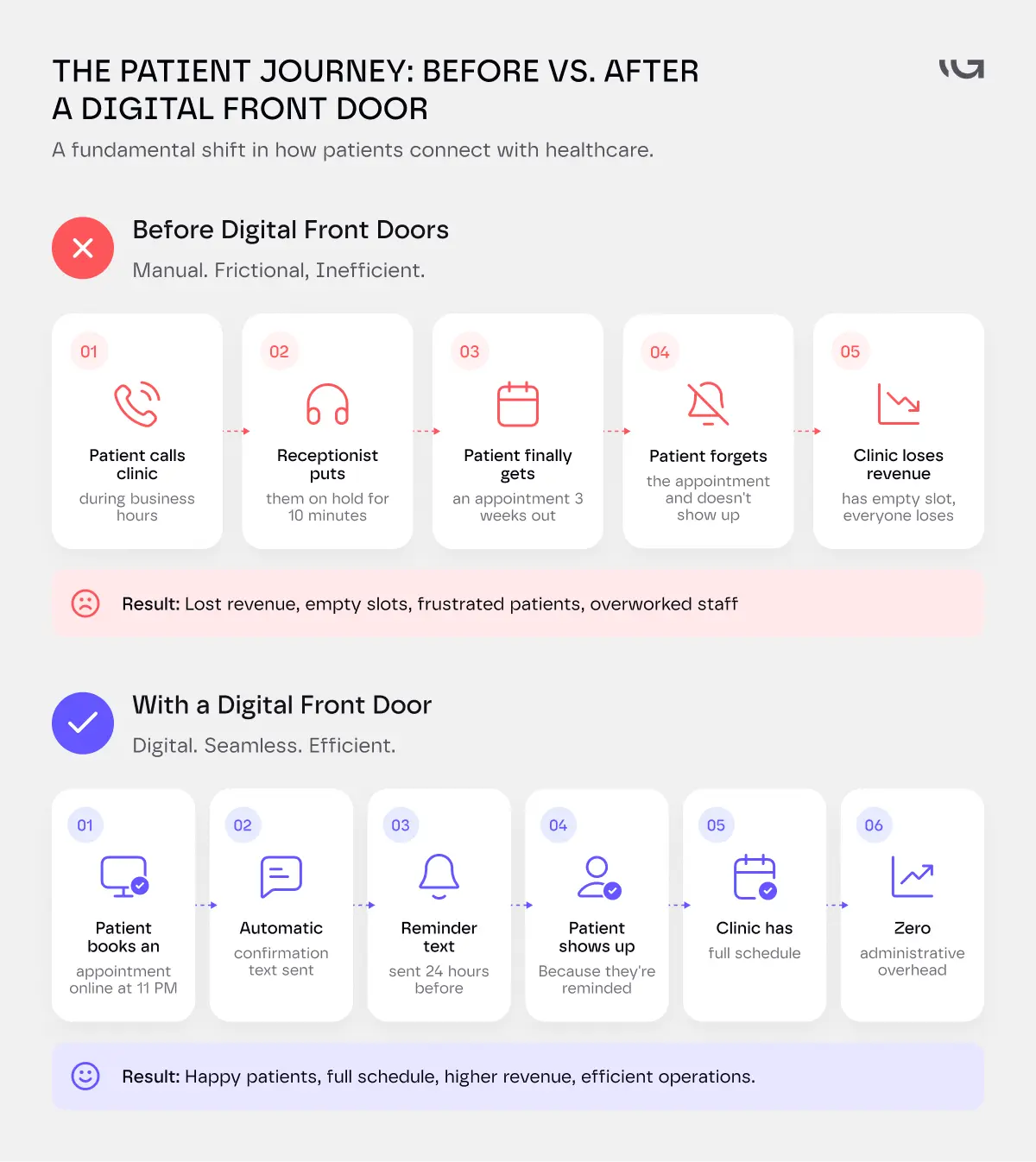
Before digital front doors existed, here's what the patient journey looked like:
- Patient calls clinic during business hours
- Receptionist puts them on hold for 10 minutes
- Patient finally gets an appointment 3 weeks out
- Patient forgets the appointment and doesn't show up
- Clinic loses revenue, has empty slot, everyone loses
With a digital front door:
- Patient books an appointment online at 11 PM
- Automatic confirmation text sent
- Reminder text sent 24 hours before
- Patient shows up (because they're reminded)
- Clinic has full schedule
- Zero administrative overhead
That's the fundamental shift.
Why Healthcare Needs a Digital Front Door Now
The healthcare industry is facing a patient experience crisis and most hospitals don't realize it.
Here's the hard truth: Patients now expect healthcare to work like every other service they use. They book Ubers, order food, manage finances, and schedule fitness classes, all from their phones, instantly, 24/7.
Then they call their hospital and wait on hold for 20 minutes to book an appointment.
The disconnect is killing patient engagement.
The COVID-19 Wake-Up Call:
When the pandemic hit in 2020, hospitals that had already invested in digital infrastructure survived. Those that hadn't were scrambling.
Patients who had telehealth options stayed engaged. Patients who didn't have anywhere to turn except emergency rooms.
This created a permanent shift in patient expectations. Now, patients ask: "Can I see my doctor online?" as a baseline expectation, not a luxury feature.
The Generational Shift:
Younger patients (Gen Z and younger millennials) make up an increasing portion of healthcare users. They grew up with smartphones. They've never paid a bill by mail. They've never called a business during business hours.
If your hospital doesn't offer digital access, these patients don't view you as "behind the times." They view you as not a real option.
The Competitive Landscape:
Mayo Clinic invested heavily in its Center for Digital Health.
Cleveland Clinic secured a $50 million philanthropic grant to build an AI-powered digital navigation system.
Geisinger redesigned their entire access model around online scheduling.
Health systems across the country are racing to build better digital experiences.
Is your hospital losing market share to competitors with a better digital experience?
Most hospitals underestimate how much patients prefer digital access. We help you assess your digital maturity and build a roadmap to compete with national systems.
Get Your Digital Competitive Analysis
The Five Core Components
A digital front door that actually works isn't built from a single tool. It's a carefully orchestrated system of five components, each playing a specific role in the patient journey.
Here's how they work together:
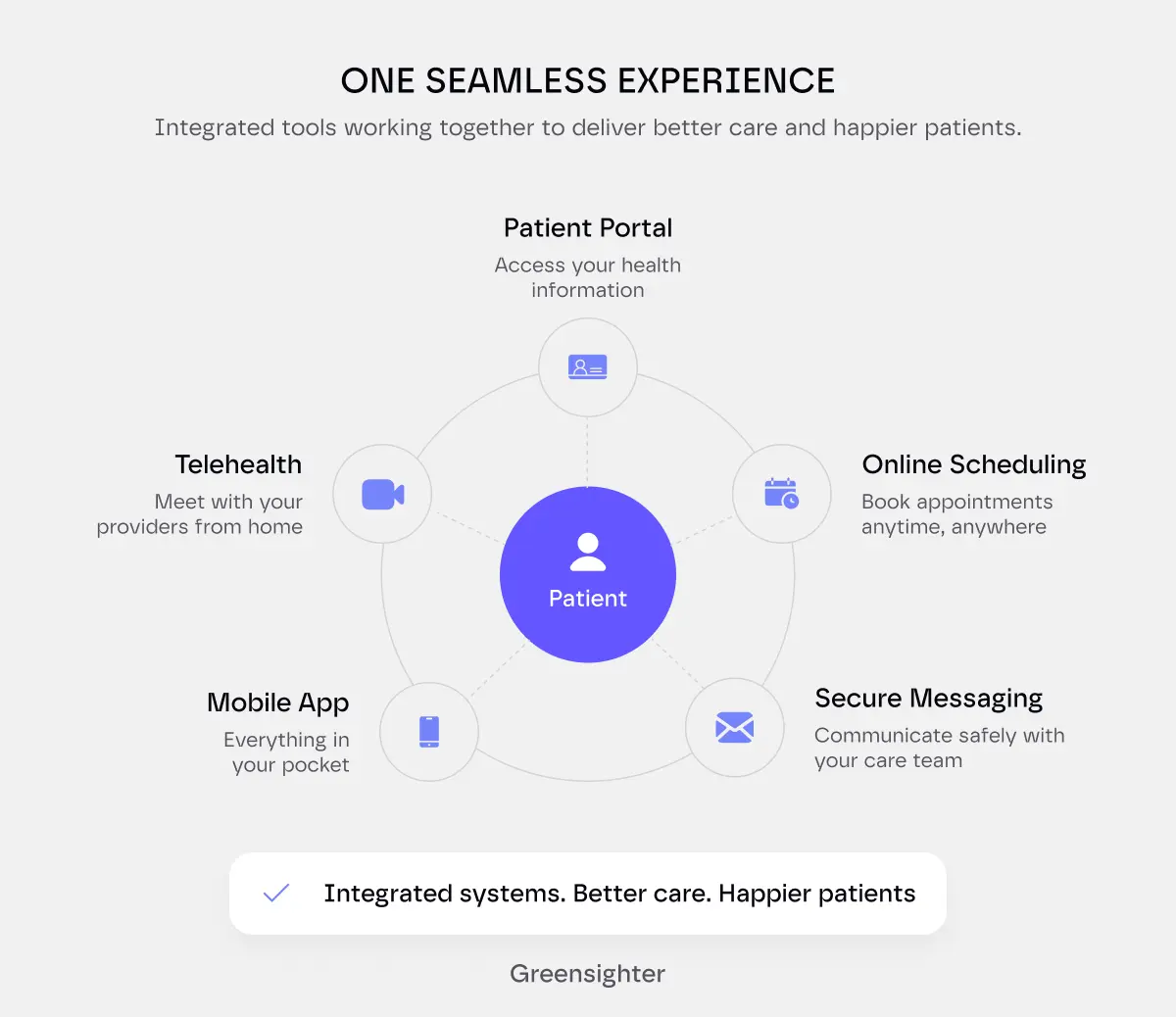
1. Patient Portal (The Hub)
The portal is where patients access their health information: upcoming appointments, test results, medication lists, medical records.
Modern portals do more than show data. They predict what patients need next.
If you have a diabetic patient, the portal reminds them about their annual eye exam.
If a patient is on a medication that needs lab monitoring, it explains why and when labs are due.
2. Online Scheduling (Removing Friction)
Online scheduling is the biggest driver of patient engagement.
When patients book at 11 PM instead of calling during business hours, you capture them at their moment of need.
The evidence is clear. In the foundational open-access scheduling study, five primary care practices cut average wait times from 21 days to 8 days within four months of implementation, with measurable improvements in patient satisfaction.
No-shows drop from 15–25% to 5–10% with automated reminders.
Do the math: 100 appointments/week × 20% no-shows × $150 per appointment = $156,000 annual lost revenue.
Cut that in half with online booking and reminders, and you've added $78,000 in annual revenue.
We have seen this play out in practice. For Great Many, a hair restoration clinic, redesigning the digital booking journey moved conversion from 0.2% to 0.56%, a 2.5x increase in consultations from the same traffic, with no change in ad spend.
- Show real-time availability
- Take 2 clicks to complete
- Sync directly to your EHR
- Send SMS reminders 24 hours before
- Capture insurance and chief complaint upfront
Bad systems require 10 clicks, don't integrate with your EHR, and require manual data entry by your staff.
3. Telehealth (Meeting Patients Where They Are)
Not all visits need in-person care.
Follow-ups, medication management, mental health consultations, specialist opinions, post-hospitalization check-ins, all work via video.
Financially, telehealth is more efficient. A 15-minute virtual follow-up may generate $75–100 in revenue with no clinical staff time for rooming, vitals, or scheduling. An in-person visit takes 30 minutes and costs more.
Telehealth only works if it's integrated. Patients need to see which visits can be virtual when scheduling, join the visit from a simple link, and continue in their portal afterward.
4. Secure Messaging (Continuous Care)
Many of clinic calls are routine: "Is my result back?" "Can I refill my medication?" "What time is my appointment?"
These don't need phone calls. They need secure messaging.
Messages are documented in the medical record. This helps you:
- Identify patients struggling with medications
- Spot worsening conditions before emergencies
- Create continuity across multiple doctors
- Document communication for liability protection
The trap: Hospitals implement messaging but don't allocate time for responses. If patients wait 3 days for replies, they go back to calling.
Successful systems set clear expectations:
- Routine messages: Response within 24 hours
- Urgent (concerning symptoms): Response within 2 hours
- Non-clinical (appointments, billing): Response within 4 hours by admin staff
5. Mobile App (Everything in Their Pocket)
A mobile app lets patients:
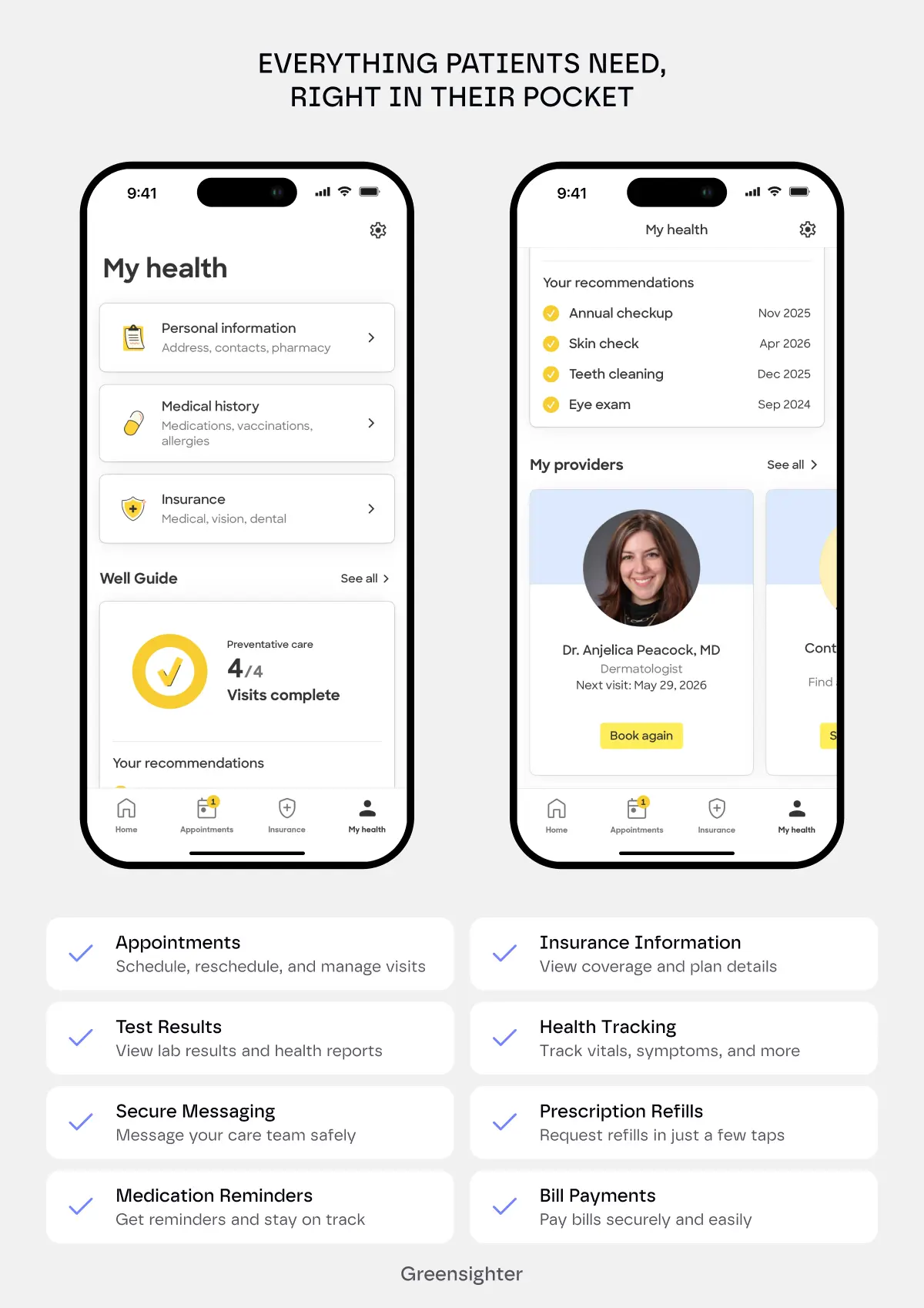
- Schedule appointments while in the parking lot
- Check test results between meetings
- Message their doctor while waiting for prescriptions
- Pay bills from the couch
- Get push notifications ("Your lab results are ready")
Modern apps include: appointment management, medication reminders, health tracking (vitals, blood sugar), care plans, secure messaging, insurance information, health education, prescription refills, emergency contact info.
How Hospitals Measure Success With a Digital Front Door
If you can't measure it, you can't improve it.
Hospitals serious about digital front doors track specific metrics that show impact.
Patient engagement metrics:
- What % of your patient population has registered for the portal? Target: 60–70%
- What % actually uses it? Target: 30–40% (not everyone will, and that's okay)
- Which features do patients use most? (Usually: test results, appointments, messaging)
- How often do patients log in? Target: 2–3x per month average
- How fast does your care team respond to messages? Target: Under 24 hours
Operational metrics:
- No-show rate: Did it decrease after launching online scheduling? Target: Reduce from 15–20% to 5–10%
- Scheduling admin time: How many hours per week does your front desk spend on phone scheduling? Target: 50% reduction after online booking launch
- Phone call volume: How many appointment-related calls do you still get? Target: Reduce by 60–70%
- Average appointment lead time: How far in advance do patients have to schedule? Target: 48 hours or less for most appointments
- Same-day appointment availability: What % of your schedule offers same-day appointments? Target: 50%+
Patient satisfaction metrics:
- HCAHPS scores (access component): How easy did patients find it to schedule appointments and get care? Target: Top 25% nationally
- NPS (Net Promoter Score): How likely are patients to recommend you? Target: 50+
- Digital experience rating: Separate question on patient surveys about digital experience. Target: 4.5/5 stars
Financial metrics:
- Revenue from reduced no-shows: No-show reduction × average visit revenue. For a 100-appointment/week clinic: ($150 average × 20 fewer no-shows/week × 52 weeks) = $156,000 annual impact
- Admin cost reduction: Hours saved on scheduling × hourly wage of scheduling staff
- Patient volume increase: Can you see more patients because your no-show rate dropped and same-day appointments increased availability?
Most hospitals don't track the right metrics. Greensighter helps you identify gaps and build a measurement framework that shows real ROI. Get Your Digital Metrics Audit
How Top Health Systems Implemented Digital Front Doors
Mayo Clinic: The Comprehensive Ecosystem Approach
Mayo Clinic didn't build a digital front door. They built a digital transformation.
Starting with their Center for Digital Health, Mayo redesigned patient experience around digital-first principles. Dr. Bradley Leibovich, medical director of the Center for Digital Health, explains their philosophy:
"If that digital front door is built correctly, the experience will not only be personalized but should be a frustration-free path to get the resources you need, whether know-how or advice, for subsequent stages of care."
What they actually built:
- Personalized digital content for each patient based on their condition
- Virtual consultations that connect local physicians with Mayo specialists
- Digital tools that provide personalized itineraries and navigation assistance
- Remote diagnostics that allow patients to get expert second opinions from home
The 2030 vision:
Mayo published its vision for the future of the patient journey. Here's what it looks like:
Patient "Emily" needs a consultation with a rare disease specialist. She's 500 miles from Mayo's main campus.
Using Mayo's digital front door:
- Emily's local doctor refers her to the Mayo
- Mayo's system matches her with the right specialist
- She has a virtual consultation with that specialist, plus her local doctor
- Before she ever leaves home, she has a treatment plan
- The digital system sends her a personalized itinerary, including when to arrive, where to park, what to bring, and which specialist to see first
- It provides profiles of all her care team members
- It sends real-time updates about her schedule
Most hospitals add digital tools one at a time. Mayo designed the entire experience to flow seamlessly.
Cleveland Clinic: AI-Powered Smart Routing
$50 million investment in an AI-powered digital front door that routes patients to the right level of care.
Problem: Patients don't know where to go, so they show up at the ER for non-emergencies. ERs overflow. Wait times increase. Costs spike.
Solution: AI asks patients about symptoms and suggests the right care:
- "You need urgent care. Here are facilities near you with same-day availability."
- "This can be treated via telehealth. Here are specialists available today."
- "Go to the ER. We've notified them to expect you."
Expected results: 15–20% reduction in ER patient volume, shorter wait times, higher patient satisfaction, lower system costs.
The Bottom Line
A digital front door is now a baseline expectation, not a competitive advantage.
Patients expect it. Competitors are building it. Your staff will thank you for the efficiency.
Winners treat digital as the primary way patients interact with your health system. They redesign operations around digital-first access.
Unintegrated digital tools create a fragmented and frustrating patient experience.
Ready to build a digital front door, or will you wait until competitors steal your patients?
Greensighter integrates scheduling, portals, telehealth, and messaging into one seamless experience. We've helped health systems reduce no-shows, increase engagement, and cut administrative burden.