



One agent, one job. That part's easy.
The moment you need five things to happen in the right order, talking to each other, recovering when one of them fails, that's a different problem entirely.
Somewhere right now, a support lead named John is staring at a dashboard. Four different bots all replied to the same customer within ninety seconds of each other.
That's not orchestration. That's four agents who have never met.
This guide covers what AI agent orchestration actually is, how multi-agent systems coordinate in practice, where it pays off in real business workflows, and where it doesn't.

What AI Agent Orchestration Is
AI agent orchestration is the layer that decides which agent does what, in what order, and what happens when something goes wrong.
It's not the same thing as AI agent workflow automation.
Automation can be a fixed sequence: step one, then step two, then step three, no matter what happens in between.
Orchestration is dynamic. The system decides its next move based on what just happened, not a script written in advance.
Think of it less like an assembly line and more like a kitchen during dinner rush.
Each station handles one thing, and someone is calling out who does what, when, based on what's actually coming through the door that night.
How Multi-Agent Systems Work

The Orchestrator-Worker Pattern
Anthropic's own engineering team described the architecture behind Claude's Research feature as an orchestrator-worker pattern.
One lead agent plans and coordinates, while specialized subagents handle individual pieces in parallel.
The lead agent doesn't do the legwork itself. It breaks the problem apart, hands pieces to subagents, and synthesizes what comes back.
This is the pattern underneath almost every real multi-agent AI system design you'll encounter, whether it's labeled that way or not.
Why Parallel Beats Sequential
Running agents one after another is simpler to build. It's also slow.
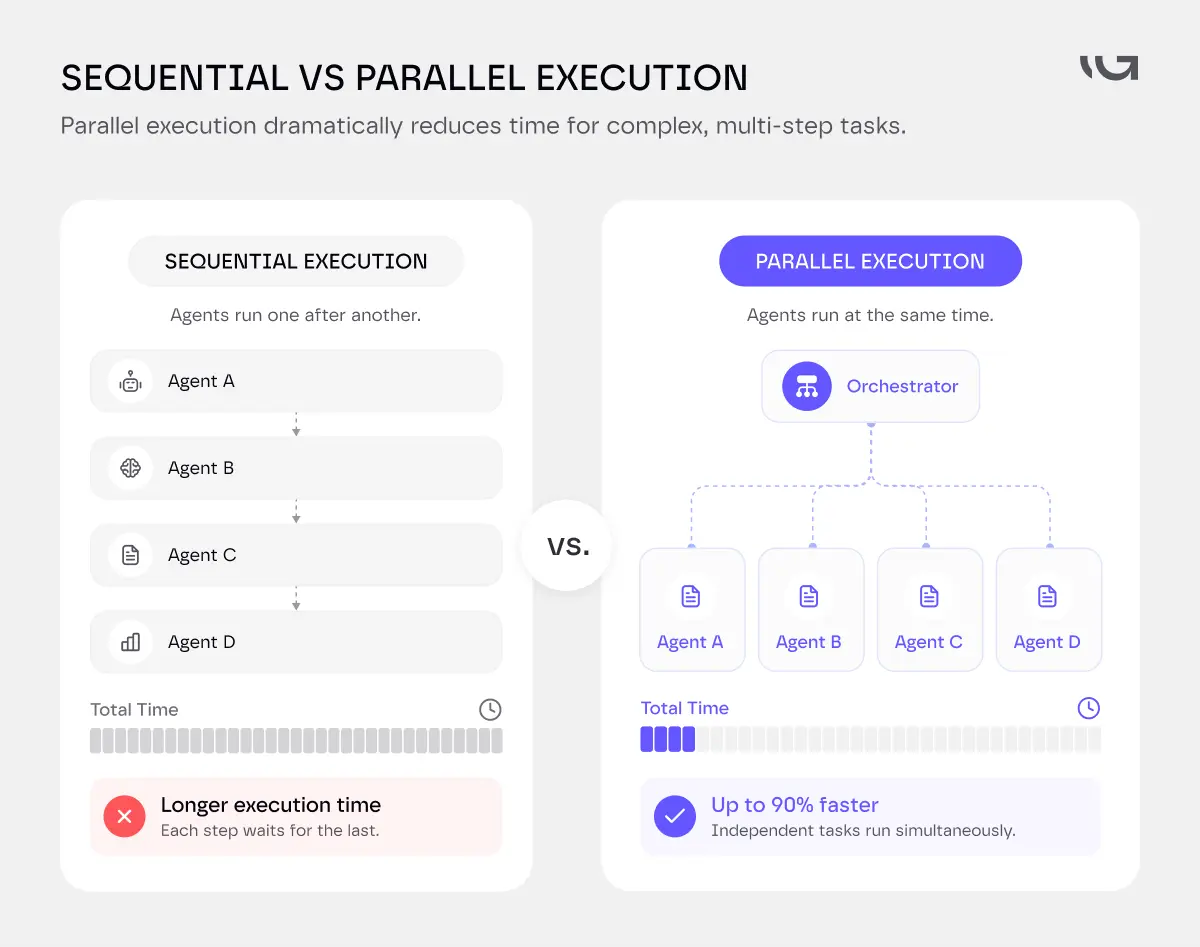
Anthropic found that running subagents in parallel, rather than one at a time, cut research time by up to 90% for complex queries.
That's the entire case for orchestration over a single agent doing everything sequentially: speed that compounds as the task gets bigger.
Coordination Patterns Worth Knowing
A few patterns show up again and again in real systems:
- Hierarchical (orchestrator-worker). One lead agent delegates to specialized subagents and synthesizes their output. The most common pattern, and the one Anthropic's own system uses.
- Sequential pipeline. Agent A's output becomes Agent B's input, in a fixed order. Simple, predictable, and the right choice when steps genuinely depend on each other.
- Parallel/concurrent. Multiple agents work on the same problem from different angles at once, with no dependency between them.
- Peer-to-peer/debate. Agents critique or check each other's work before anything ships. Useful when accuracy matters more than speed.
The Real Cost of Coordination
Orchestration isn't free. Anthropic's data shows multi-agent systems burn through roughly 15 times the tokens of a single chat interaction.
That's not a rounding error. It's the price of the parallelism.
It only makes sense when the task clears at least one of these bars:
- The work can genuinely be split into independent pieces running at the same time.
- The task is too large for a single context window to hold.
- Speed matters enough that waiting for sequential steps is a real business cost.
- Accuracy is critical enough to justify agents checking each other's work.
If none of those apply, a single well-scoped agent is almost always cheaper, faster to build, and easier to maintain.
That's not a rounding error. It's the price of the parallelism, and it only makes sense when the task is valuable enough to justify it.
AI Agent Lifecycle Management
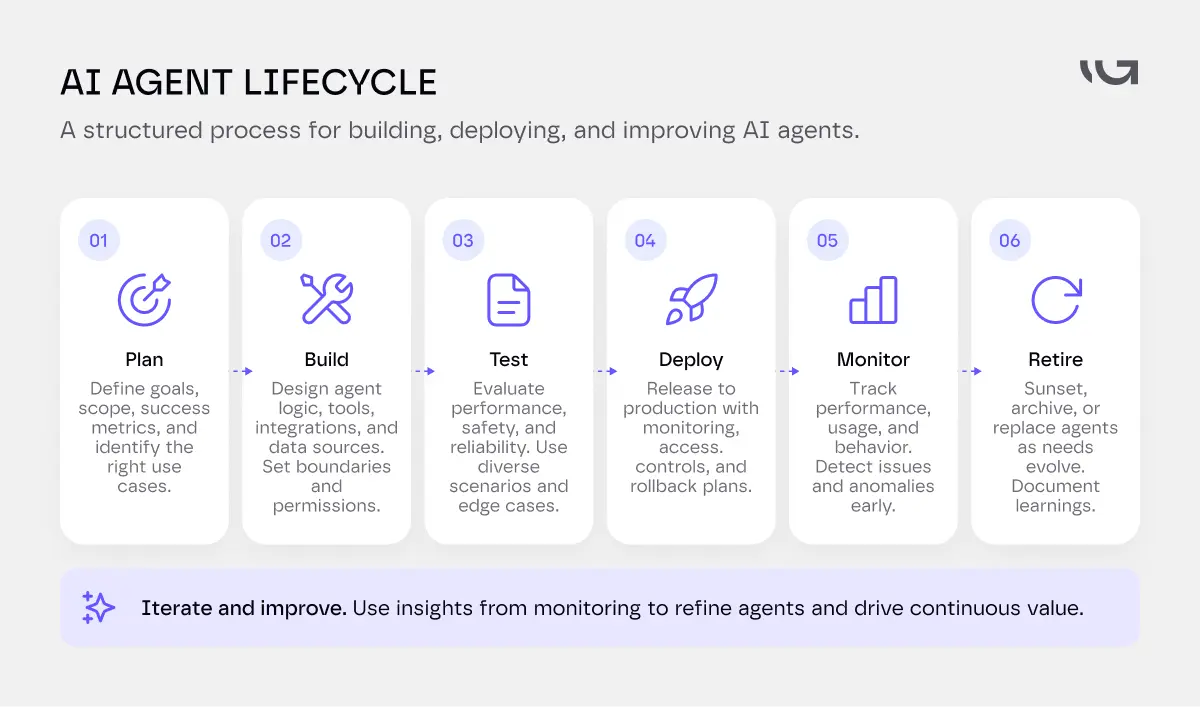
Building the agents is maybe a third of the work. Most of what makes orchestration hold up happens after that.
Plan: Scope Before You Build
Decide which tasks genuinely need more than one agent before writing a single prompt.
Most projects don't. A single well-scoped agent with good tools quietly outperforms an over-orchestrated mess more often than anyone wants to admit.
Build: Tool Design Is Half the Job
Vague task descriptions are where multi-agent systems quietly fall apart.
Anthropic found that without clear task boundaries, subagents duplicated each other's work entirely, with two agents independently researching the same topic because nobody told them not to.
Each agent needs an explicit objective, explicit tools, and an explicit boundary: this is your job, that part over there is somebody else's.
Test: Evaluation Looks Different Here
Traditional software testing checks if the system followed the steps you expected. Multi-agent systems don't work that way.
Two runs with identical inputs can take entirely different, equally valid paths to the same answer. You're testing outcomes, not fixed scripts.
Deploy: Updates Mid-Flight Are Dangerous
Picture Sam, the on-call engineer, getting paged at 2 a.m.
Half the running agents picked up a new prompt. Half are still on the old one, mid-task.
Monitor: Watch Patterns, Not Just Outputs
A single failed run tells you almost nothing in a non-deterministic system. A pattern across a hundred runs tells you everything.
Track which tools agents reach for, where they loop, and where they quietly give up. That's where the real bugs live.
One more thing that gets skipped at this stage: ownership.
Every agent in a multi-agent system needs a named owner. Not a team. A person.
Someone who reviews the logs, catches drift before it becomes a failure, and decides when a prompt needs updating. In a single-agent system, this is easy to assign. In a five-agent system, it's easy for accountability to fall between the gaps.
Define who owns each agent before you deploy it. Not after something goes wrong.
Retire: Plan the Exit Before You Need It
Models get deprecated. Tools get sunset. Workflows change.
An agent without a documented retirement plan becomes the thing nobody wants to touch a year from now, the orchestration equivalent of legacy code with no comments.
A two-person startup once asked us to design a six-agent system just to send one weekly summary email. One well-built agent would have done the entire job.
Most teams build their first multi-agent system the hard way: by accident, after one agent's prompt turns into an unreadable 400-line mess.
Greensighter helps you figure out, before any of that happens, whether your use case needs one agent or five.
Business Use Cases for AI Agent Orchestration
Where do businesses use AI agent orchestration? Let’s take a detailed look:
- Customer Support Triage
One orchestrator reads the incoming ticket. It routes billing questions to a billing-specialist agent, technical issues to a different one, and escalates anything ambiguous to a human.
- Healthcare Intake and Scheduling
Intake, triage, and scheduling are genuinely separate jobs, even though patients experience them as one conversation.
Greensighter's own piece on clinic scheduling mistakes that lose patients covers what happens when these steps don't talk to each other.
- Sales Operations
A lead-qualification agent scores the lead. A CRM agent logs and enriches the record. An outreach agent drafts the follow-up.
Three narrow jobs, coordinated, instead of one agent trying to be all three badly.
- Finance and Invoice Processing
One agent extracts line items. Another checks them against a purchase order. A third routes anything outside policy to a human for approval.
- Software Development Pipelines
A code-review agent flags issues. A test-writing agent drafts coverage. A security-review agent checks for anything that shouldn't ship.
Each one narrow, each one good at exactly one thing.
Gartner predicts that by 2027, a third of agentic AI implementations will combine agents with different skills to handle complex tasks, instead of relying on one generalist agent.
Most orchestration failures we see trace back to one thing: nobody owned the lifecycle past launch day.
Tell us where you actually are, pilot, production, or stuck, and we'll tell you which stage you're missing.
Benefits of Coordinated AI Workflows
Here are the benefits you draw from Coordinated workflows:

Speed Through Parallelization
Tasks that would take hours sequentially can run in minutes when independent pieces run at the same time. This is the single biggest practical win orchestration delivers.
Specialization Beats Generalization
A narrowly scoped agent with one clear job consistently outperforms a single agent trying to do everything.
Separation of concerns isn't just a software principle; it works the same way for agents.
Scale Past a Single Context Window
No single agent's context window can hold an entire complex research task or a full enterprise workflow.
Splitting work across agents lets the system reason across more material than any one agent could hold alone.
Resilience When Something Breaks
A well-architected orchestration layer isolates failure. One subagent timing out shouldn't take down the entire system, if checkpoints and retry logic are built in from the start.
A Built-In Audit Trail
Every handoff between agents is a natural checkpoint. That matters in regulated industries where someone, eventually, will ask exactly how a decision got made.
Centralised Governance
A well-designed orchestration layer gives you one place to manage permissions, approvals, and auditability across all your agents.
Instead of each agent operating with its own access rules, the orchestrator enforces what each subagent is allowed to do, what it can't touch, and what requires a human sign-off.
In healthcare, finance, or any regulated vertical, centralised control isn't a nice-to-have. It's the thing that makes the whole system auditable.
When Orchestration Isn't Worth It
This is the part most vendors skip, because it doesn't sell anything.
Anthropic is direct about this in their own research.
Tasks that require agents to share the same context are not a good fit for multi-agent systems today.
Neither are tasks with heavy dependencies between steps. Most coding tasks fall into exactly this category.
A few use cases that almost always work better as a single agent:
- Drafting a contract clause. The whole task lives in one context. Splitting it across agents adds coordination overhead with no speed benefit.
- Answering a customer support ticket. One agent reads the ticket, checks order history, and drafts a reply. Adding a second agent to "coordinate" just slows it down.
- Summarising a document. The content fits in one context window. Sequential subagents have nothing to parallelise.
- Code completion inside one file. Every line depends on the ones before it. Parallelisation breaks the dependency chain.
The test is simple: can the work be genuinely split without one piece needing to wait on another? If not, one agent does the job better.
If your task genuinely needs 2-4 truly independent pieces of work, orchestration earns its cost.
If it's really one task, wearing a trench coat, one agent will outperform five every time.
The token cost is real, and it scales with every agent you add.
Our guide to what 60+ SaaS builds taught us covers the same architecture-discipline question from a different angle: more moving parts aren't automatically better engineering.
The Bottom Line
You don't need ten agents on day one. You need the right two, talking to each other correctly.
Start with the narrowest version that actually needs more than one agent.
Greensighter's guide on how to pick the right features for your MVP makes the same case for a first product, and it holds just as well here.
Quick decision framework
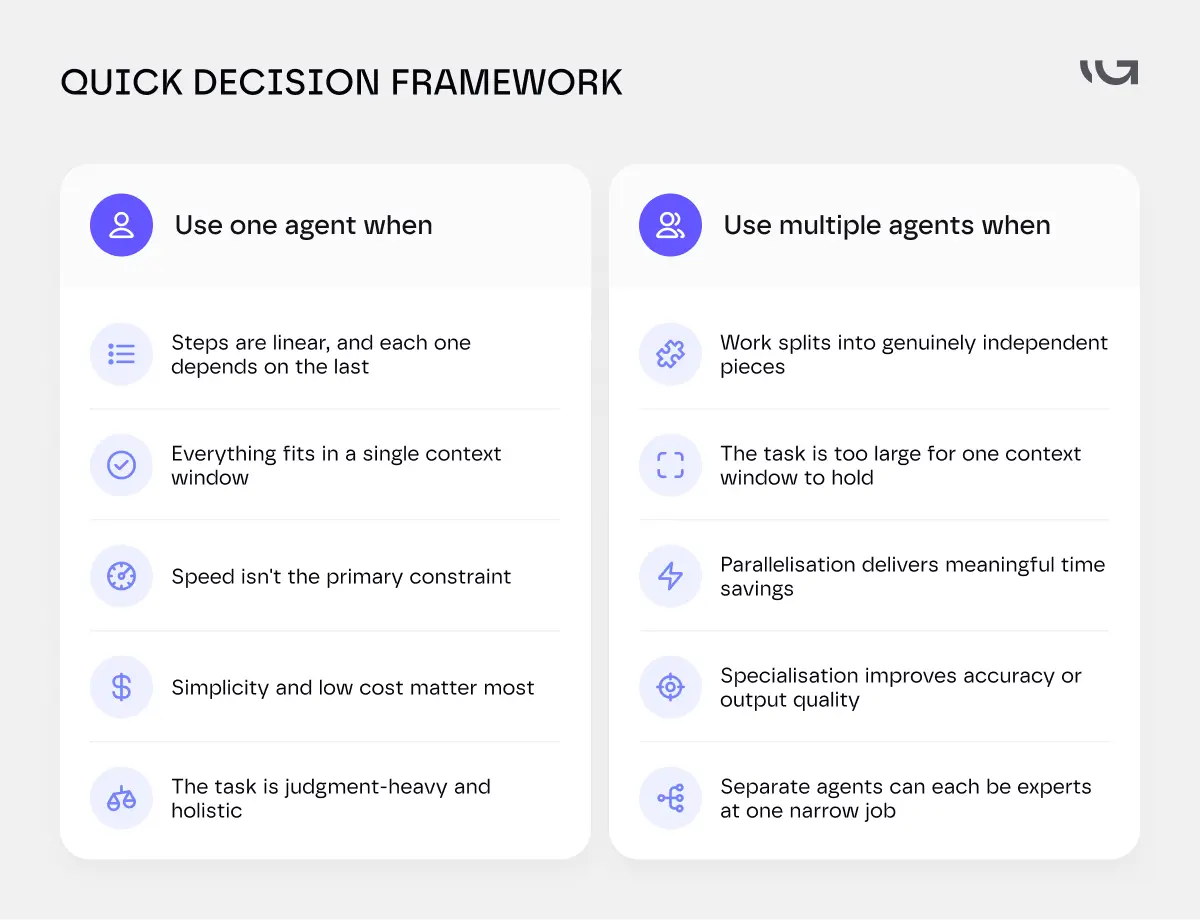
Still not sure which side your use case lands on?
We will help you find which two agents those are, and build the orchestration layer underneath them that still holds up once you add an eleventh.